The short version
For wet carpet drying, stop the water, extract what is standing and get air and a dehumidifier moving. Carpet wet with clean water can often be saved. The pad usually cannot after grey water, and carpet touched by sewage or flood water is removed. Dry it within 24 to 48 hours to avoid mold.
What should I do first when carpet gets wet?
Stop the water, pull the standing water off the carpet and start moving air. Wet carpet drying works best when it starts quickly, because the pad underneath holds water long after the surface feels dry.
- Stop the source. Close the shutoff valve or have a plumber fix the leak. Nothing dries while water is still coming in.
- Turn off power to wet areas at the breaker, but only if you can reach the panel without standing in water. Do not use plugged-in electrics on wet carpet.
- Find out what kind of water it was. Clean supply water, grey water from an appliance and sewage or flood water are handled very differently. See the table below.
- Move furniture off the carpet. Put foil or plastic under any legs that must stay, so wood and stain do not bleed into the fibers.
- Photograph the room before cleanup, including the source of the water.
- Run fans and a dehumidifier and open windows if the weather allows. The EPA advises drying water-damaged areas and items within 24 to 48 hours to prevent mold.
- Call your insurer and a restoration team. Restoration teams differ in what they handle, so ask whether they extract and dry carpet.
If sewage or outside flood water touched the carpet, stay off it and skip to the contaminated water section. If the water came from a burst supply line, see burst pipe water damage.
Can wet carpet be saved?
Often yes, if the water was clean and the carpet was dried quickly. The water category decides it. Clean water from a supply line can often be dried in place. Grey water usually means the pad is thrown out. Contaminated water means the carpet and pad are removed.
| Water category (IICRC S500) | Typical sources | What usually happens to carpet and pad |
|---|---|---|
| Category 1, clean | Supply line, burst pipe, tub overfill | Often dried in place if work starts quickly |
| Category 2, grey | Washer, dishwasher, toilet overflow without waste | The pad is usually removed; the carpet may be cleaned and dried |
| Category 3, grossly contaminated | Sewage, river or creek flood water, outside surface water | Carpet and pad are removed and replaced; call a professional experienced with contaminated water |
These categories come from the IICRC S500 standard, and the water damage glossary explains each one. Water that sat for a long time can become more contaminated than it started, so time matters too.
Should the pad be saved or thrown out?
The pad is the part most likely to be replaced. It is thick foam or fiber that soaks up water like a sponge and dries slowly. Carpet fibers dry faster and can be cleaned. The pad is cheaper to replace than it is to dry, and a wet pad that stays wet is where odor and mold start.
A restoration team may lift the carpet at a corner, remove the pad and dry the carpet and floor separately. When the carpet is reinstalled, it goes over a new pad. If the carpet is glued down or the backing is delaminating, replacement is more likely. Carpet pad water damage is easy to miss because the top looks fine.
Is carpet water extraction different from using a shop vac?
Yes. A shop vac takes off the surface water, but professional extraction pulls much more water out of the carpet and pad. Truck-mounted or heavy portable extractors are built to pull water out of dense fiber, which a household vacuum cannot match.
A wet vac is a reasonable first step for a small spill. Then you still need airflow and a dehumidifier to get the rest out. Never use a regular household vacuum on a wet carpet, since water and electricity do not mix. Extraction is followed by drying equipment, as described in water removal and extraction.
What is the best way to dry wet carpet?
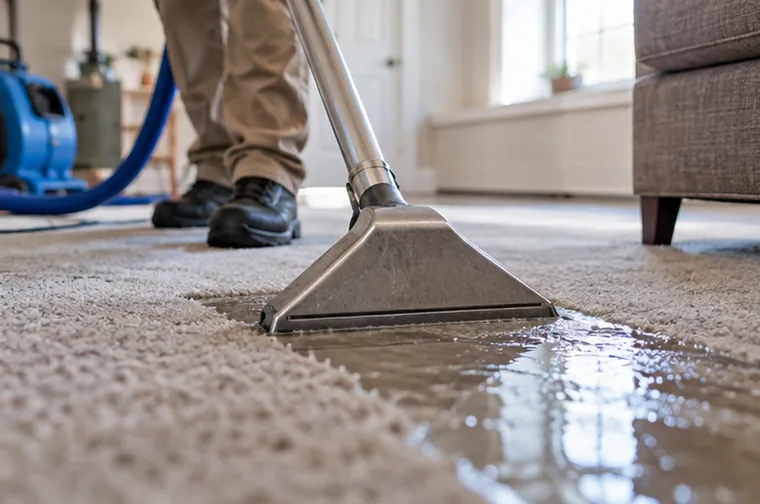
Extract the water, then circulate air and dry the room. For clean water, that usually means removing the standing water, lifting a corner or removing the pad, setting air movers across the carpet and running a dehumidifier. For a small damp patch, fans and ventilation may be enough.
- Air movers push air across the carpet surface and under a lifted corner.
- Dehumidifiers pull the moisture out of the air so it does not settle again. The EPA recommends keeping indoor humidity below 60 percent, ideally between 30 and 50 percent.
- Moisture readings on the carpet, pad and subfloor show when it is truly dry. Touch is not reliable.
The same ideas are covered in structural drying. Do not walk on damp carpet more than you need to, and do not iron or heat it.
Why does wet carpet smell, and does the smell go away?
The smell comes from moisture trapped in the pad and backing, where bacteria and mold feed. If the carpet is dried fully and quickly, the smell usually fades. If it keeps coming back after the carpet feels dry, something is still wet.
A musty smell that returns on humid days points to damp pad or subfloor, not just surface carpet. Cleaning products only mask it. See water damage smell for how to find the source.
How fast can mold grow in wet carpet?
Quickly enough that the first day or two matters. The EPA advises drying water-damaged areas and items within 24 to 48 hours to prevent mold growth. After a flood, the CDC says to remove carpets that were soaked and cannot be dried right away.
The CDC lists symptoms such as a stuffy nose, sore throat, coughing or wheezing, burning eyes or skin rash. People with asthma or mold allergy may have severe reactions. If carpet has been wet for a while and smells musty, treat it as a mold risk. The mold after water damage guide explains what to do next.
What if the wet carpet is in a basement?
Basement carpet is the hardest to save because concrete holds moisture and the water often comes from outside. Water seeping through a slab, a sump failure or a drain backup usually carries more than clean water. Basements also stay damp, so carpet that is wet there tends to stay wet.
If the water came from rain runoff, a creek or a sewer line, it is likely Category 2 or 3, and the carpet and pad are usually removed. Carpet glued to a concrete floor is typically cut out in sections. See basement flooding cleanup for the full process, and sewage backup cleanup if a drain was involved.
What about carpet after contaminated or flood water?
Remove it. Carpet and pad that have touched sewage or flood water cannot be cleaned to a safe level. The EPA advises calling a professional experienced with buildings damaged by contaminated water. Wear rubber boots and gloves and keep children and pets out of the area until the work is done.
Rising flood water from rivers and creeks is Category 3 under the IICRC S500. Flood damage is also not covered by standard homeowners policies, so see the flood cleanup page and the insurance claims guide.
How much does carpet water damage repair cost?
Fixr lists carpeting restoration at $4.75 to $10.50 per square foot. That is a national figure, and it covers the work of restoring the material, not replacing a whole room. Your cost depends on the water type, the area and whether the pad or subfloor are involved.
Ask any restoration team for a written, line-by-line estimate, and confirm what is included. Nothing on this page is a quote. For how bills add up, see the restoration cost page.
When is it fine to handle wet carpet myself?
DIY is fine for a small spill of clean water that you catch right away. Wet vac the area, put fans and a dehumidifier on it, and check that the carpet and pad are fully dry.
Call a restoration team if the water is grey or contaminated, if more than one room is wet, if the carpet has been wet a while, or if there is any musty smell. If you are unsure, have moisture readings taken before you decide. Keep photos and receipts either way, in case you file a claim.
Sources: IICRC S500 standard; EPA mold and moisture guide; EPA mold cleanup in your home; CDC, About Mold and Your Health; Fixr, Water Damage Restoration Cost.