For Maynardville and Union County homeowners
For water damage restoration in Maynardville, TN, shut off the main valve, photograph the damage and start drying in the first 24 to 48 hours. Valley runoff and creek water count as flood-type water, which usually calls for a professional. Requests come from Maynardville, Luttrell and Sharps Chapel.
Which Union County places do requests come from?
Requests come from Maynardville (37807), Luttrell (37779) and Sharps Chapel (37866). Restoration teams differ on how far north of Knoxville they drive, so one confirms your address when they call. Halls Crossroads is the nearest Knox County page: see water damage in Halls Crossroads. North across Norris Lake, Claiborne County is on the Tazewell page.
Union County had 19,802 residents at the 2020 Census, and Wikipedia lists all of them as rural. That means spread-out lots and long drives, so a restoration team may have farther to travel than in Knoxville.
How does Raccoon Valley shape water problems in Maynardville?
Maynardville sits near the middle of Raccoon Valley, a narrow valley about 15 miles long between Copper Ridge to the south and Hinds Ridge to the north. Wikipedia says both ridges are long and narrow and often broken into smaller hills and knobs. A valley floor between two ridges collects runoff from both sides.
After a storm, water reaches a house from uphill and from the ground under it. If it came from outside, it is flood-type water, and the IICRC S500 standard puts surface water in Category 3. Our flood cleanup guide explains the safety steps, and the basement flooding page shows how it enters.
What does growth along State Route 33 mean for older and newer houses?
Maynardville is becoming a suburb of Knoxville. Wikipedia says widening of State Route 33 has made the drive to Knoxville, 15 miles southwest, quicker, and that nearly 62% of residents commuted out of the county for work in 2010. The city began as the community of Liberty and was incorporated in 1870, so old farmhouses and newer subdivisions share the same roads.
The two kinds of houses fail in different ways.
- Older homes built before 1978 may carry lead paint. The EPA's Renovation, Repair and Painting rule covers paid work that disturbs it.
- Farmhouses often have crawl spaces and long runs of old pipe. Read about crawl space water and the signs of water damage.
- Newer homes tend to leak at appliance lines, water heaters and roof flashing, which the appliance leak guide covers.
What is different about homes near Norris Lake and Sharps Chapel?
Sharps Chapel sits on a peninsula in northernmost Union County, surrounded on all sides by the Clinch and Powell arms of Norris Lake. Wikipedia describes many waterfront communities and subdivisions there, plus a marina and a campground, and it puts the community 40 miles northeast of Knoxville.
Norris Lake was created by TVA's Norris Dam, finished in March 1936 for flood control, water storage and hydropower, and it has about 800 miles of shoreline. Waterfront houses often sit on slopes with finished lower levels, and some are only used part of the year. A burst line in an unused lower level can run for a long time before anyone notices.
How do the three places compare?
Each has a different setting. The table uses only what Wikipedia says and the 2020 Census.
| Place (ZIP) | Water and terrain | 2020 population, housing |
|---|---|---|
| Maynardville (37807) | Raccoon Valley between Copper Ridge and Hinds Ridge; Norris Lake about 5 miles north | 2,456; 1,035 units, 10.6% vacant |
| Luttrell (37779) | Valley between Copper Ridge and Clinch Mountain, drained by Flat Creek | 1,017; housing not stated |
| Sharps Chapel (37866) | Peninsula on Norris Lake, with marinas and waterfront subdivisions | Not a town; about 1,500 people in 2018 |
What should Luttrell owners know about Flat Creek and the railroad?
Luttrell lies between Copper Ridge to the north and Clinch Mountain to the south, and Flat Creek drains it. The town was called Cedar Ford until 1890, and a lime kiln and a marble quarry operated there in the 19th century. The Powell Valley Railroad reached it in 1887, which made it a shipping center for the area.
A town with a creek and a rail line usually has older blocks near both. Wikipedia does not say how old any house is, so check the build year of yours. If a creek reaches your yard, a slow rise can still push water against a foundation, and that counts as flood water for insurance.
What did the 1930s dam change for the county?
It put a large part of the county under water. Wikipedia says the Norris Dam project flooded the community of Loyston and displaced many residents, and that electricity promised with the dam did not arrive in Union County until the mid-1950s. The Loyston Sea is one of the widest parts of the lake, just north of Big Ridge State Park.
The lake rarely threatens a house directly, because TVA manages it for flood control. The bigger risk is the land beside it. Hillside lots shed water toward foundations, and gutters that empty at the wall are a common cause of wet lower levels.
Will insurance pay for creek, lake or runoff water?
Usually not. The Insurance Information Institute says flood is excluded under standard homeowners and renters policies, and the NAIC says ground water, rain runoff and snow melt are typically not covered. Water from a home's plumbing or a roof leak typically is.
Union County had 9,569 housing units in 2020, and 18.5% of them were vacant, so many of the houses are second homes. Insurers look closely at how long a loss went unnoticed. Read the claims guide, and keep the heat on and the water off while a place sits empty. The American Red Cross says to leave heat no lower than 55 F when you are away.
What should I do in the first 24 to 48 hours?
Stop the water, protect people, then start drying. The EPA says to dry water-damaged areas and items in the first 24 to 48 hours to prevent mold growth.
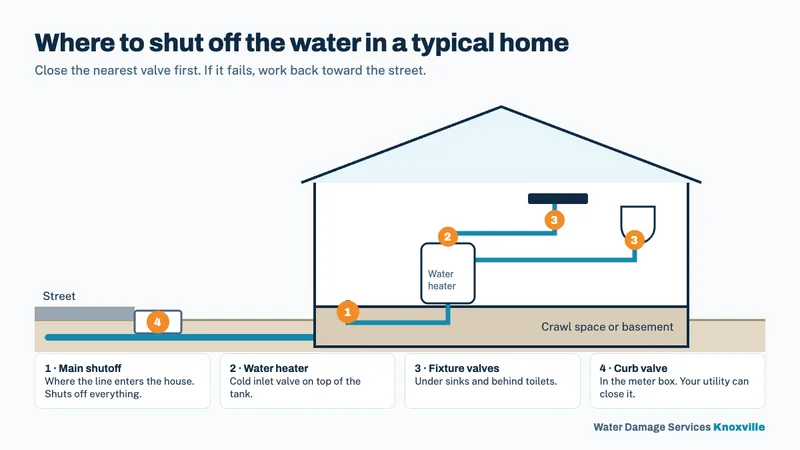
- Shut off the main valve and, if it is safe, the power to wet areas.
- Photograph and video everything before you move it.
- Call your insurer and ask what it needs before work starts.
- Call a restoration team and ask how they will measure and document drying.
- Keep indoor humidity below 60 percent, ideally 30 to 50 percent.
The emergency page has a longer checklist, and mold after water damage covers what to do if growth has started. Confirm coverage with the restoration team, since they differ on how far they travel. Nearby pages: Powell, LaFollette and Rutledge.
Sources: Maynardville, Tennessee; Luttrell, Tennessee; Sharps Chapel, Tennessee; Union County, Tennessee; Norris Lake (all Wikipedia, citing the 2020 Census); EPA, A Brief Guide to Mold, Moisture and Your Home; IICRC S500; Triple-I, disasters covered by homeowners insurance; NAIC homeowners insurance; American Red Cross, frozen pipes.