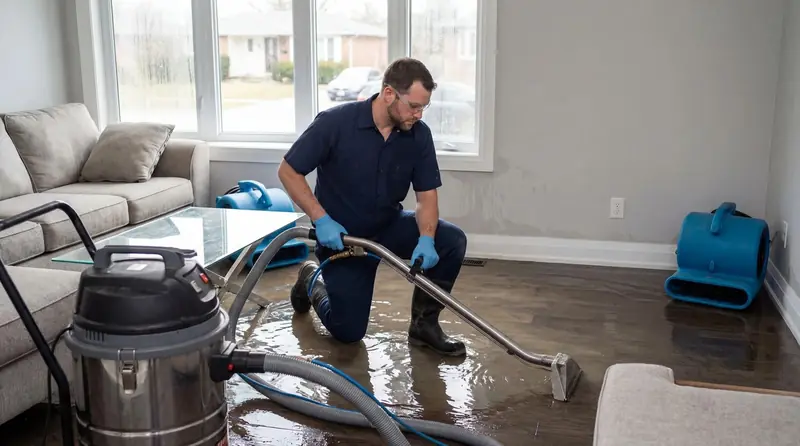
The short version
Make sure the power and gas are safe before stepping into the water. Find the source: a pipe or appliance, a failed sump pump, a drain backup or water from outside. Clean water can be extracted and dried quickly. Sewage and outside flood water are contaminated and mean removing soaked materials.
Is it safe to go into a flooded basement?
Not until you know the power and gas are safe. Water in a basement often reaches outlets, extension cords, the furnace, the water heater and sometimes the electrical panel.
- If water is touching or near outlets, cords or the panel, do not step in it. Call the power company to disconnect service if you cannot reach the breaker from dry ground.
- If you smell gas, leave the house and call the gas company from outside.
- If the water came from a sewer or from outside, treat it as contaminated and keep children and pets away. See sewage backup cleanup.
Where is the water in my basement coming from?
Finding the source decides who fixes it and whether insurance pays. Look at where the water is deepest and when it appeared.
| Source | Typical sign | Water category |
|---|---|---|
| Failed sump pump | Water rising from the sump pit during or after rain, often in a power cut | 2 or 3, depending on the source |
| Water heater or washer | Water spreading from the appliance, clear and steady | 1 or 2 |
| Burst pipe | Water spraying or running from a line, may stop when the main is closed | 1 |
| Seepage through walls or floor | Wet lines along wall joints or cracks after long rain | 2 or 3, depending on the source |
| Window wells or doorways | Water entering at a window or walk-out door during storms | 3 (outside surface water) |
| Floor drain backup | Dirty water coming up through the drain, often with a smell | 3 (sewage) |
Water categories follow the IICRC S500 standard. Category 3 water means porous materials it touched are normally removed, not dried.
Should I pump the water out myself?
For a shallow layer of clean water on a concrete floor, a wet vac or a small pump is fine. For deeper water, or water that came from outside, be careful about speed.
When the ground around the house is still saturated, pumping a basement dry very fast can leave outside water pressure pushing on the walls with nothing pushing back. Restoration crews often pump flood water out in stages when the soil outside is waterlogged. For clean water from a burst pipe or appliance, this is not a concern and fast extraction is best.
What can be saved in a finished basement?
- Carpet pad is almost always replaced. Carpet itself can often be dried after clean water, but not after sewage or flood water.
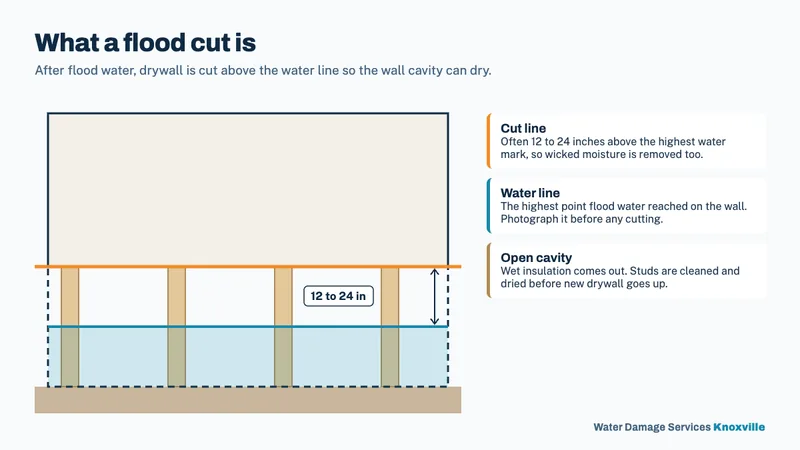
- Drywall wicks water upward. Expect the bottom 12 to 24 inches to be cut out so the wall cavity and insulation can dry.
- Laminate and engineered flooring usually swell and are replaced. Tile and sealed concrete clean up well.
- Furniture and boxes sitting on the floor should be lifted out quickly. Paper and particleboard rarely recover.
What should I do with belongings from a flooded basement?
Move everything out of the wet area quickly, sort it by material, and photograph it before throwing anything away. Hard, non-porous items can usually be cleaned. Soft, porous items soaked by sewage or flood water should go. Paper, photos and electronics need their own handling.
- Keep and clean: metal, glass, hard plastic and sealed tools.
- Usually discard after contaminated water: mattresses, upholstered furniture, stuffed toys, particleboard furniture and cardboard boxes.
- Documents and photos: rinse off mud gently, then lay them flat to dry or freeze them in plastic bags until there is time to deal with them.
- Electronics and appliances: do not plug in anything that got wet until it has been checked.
- For insurance: list each item, photograph it, and ask the adjuster before you throw out large items.
How do I prevent mold in a basement after flooding?
Dry it fast and keep it dry. The EPA advises drying water-damaged areas and items within 24 to 48 hours to prevent mold growth. It also advises keeping indoor humidity below 60 percent, ideally between 30 and 50 percent. Basements are the hardest room to keep in that range, so plan on a dehumidifier.
- Pull out wet carpet pad and insulation, and cut wet drywall so air reaches the wall cavity.
- Run a dehumidifier and fans, and check humidity with an inexpensive hygrometer.
- Do not paint or caulk over moldy surfaces, as the EPA advises.
The EPA says that if the moldy area is less than about 10 square feet, roughly a 3 ft by 3 ft patch, most people can handle it themselves. Larger areas, mold inside walls, or mold after sewage or flood water call for a professional.
What affects the cost of flooded basement cleanup?
Cost depends mostly on how much water there was, what kind it was, and how much of the basement is finished. Clean water on bare concrete is the simplest job. Sewage or flood water in a finished basement is the most involved. According to the Insurance Information Institute, the average water damage and freezing claim was $15,400 (2019 to 2023).
- Water category: Category 3 water means porous materials come out and surfaces are disinfected.
- Area and depth: how many square feet got wet and how high the water rose.
- Finishes: carpet, drywall, built-ins and flooring that must be removed.
- Time: how long the water sat, and whether mold has started.
- Access: stairs, tight spaces and how much equipment fits.
Ask the provider for a written estimate and a daily moisture log. Your insurer will want both.
Why is my basement wet after rain?
Usually because rain water is collecting against the foundation and finding a way in. Common causes are short or clogged downspouts, ground that slopes toward the house, full window wells, and soaked soil pushing water through cracks and the joint where the wall meets the floor.
- Water along one wall often lines up with a downspout or low ground outside that wall.
- Water at the floor edge all around points to groundwater pressure beside and under the slab.
- Water near a window means the window well fills faster than it drains.
- Damp walls with no puddles may be condensation. Tape a square of plastic to the wall for a day or two. Moisture under the plastic is coming through the wall. Moisture on top is from the air.
Knox County Stormwater notes that properties outside mapped flood zones still flood from runoff, blocked drains, sinkholes and undersized pipes.
What causes a sump pump to fail?
Most sump pump failures come down to power, switches or size. A power cut stops the pump when rain is heaviest. A float switch can stick against the side of the pit. Debris can clog the inlet, a check valve can fail, and an older or undersized pump may not keep up with the inflow.
| Cause | What you notice | Usual fix |
|---|---|---|
| Power cut | Pit fills during a storm with the pump silent | Battery backup pump |
| Stuck float switch | Pump never starts though the water is high | Free or replace the switch, keep the pit clear |
| Failed check valve | Water runs back into the pit when the pump stops | Replace the check valve |
| Blocked or frozen discharge line | Pump runs but water does not leave the pit | Clear the line, protect the outlet from freezing |
| Worn or undersized pump | Runs nonstop in heavy rain and still falls behind | Have a plumber size a replacement |
Is basement waterproofing the same as water damage cleanup?
No. Water damage cleanup deals with water already inside: extraction, removing wet materials, drying and cleaning. Waterproofing stops the next flood with drainage, sump systems, wall sealing and grading. They are different trades. Call a restoration provider first for a wet basement, then a waterproofing contractor once it is dry.
| Water damage cleanup | Basement waterproofing | |
|---|---|---|
| When | Right after water gets in | After the basement is dry and the source is known |
| Who | Restoration provider | Waterproofing or foundation contractor |
| Work | Extraction, flood cuts, drying, disinfecting | Drains, sump pumps, wall sealing, grading, gutters |
| Goal | Dry the house and prevent mold | Stop the water coming back |
Sealing walls before they are dry can trap moisture inside them. Cleaning up without fixing the cause means paying for it again after the next storm.
How do I stop my basement flooding again?
- Check the sump pump before storm season. Pour water into the pit and make sure it switches on. Pumps commonly fail in storms, often because the power is out.
- Add a battery backup pump and a water alarm. They cost far less than replacing a finished basement.
- Move water away from the foundation. Extend downspouts and make sure the ground slopes away from the house.
- Cover window wells and keep their drains clear.
- Put a drain pan under the water heater and use braided steel washer hoses.
- Check your insurance for a sewer and drain backup endorsement, and consider flood cover if you are in a mapped flood zone.
Does insurance cover a flooded basement?
It depends entirely on where the water came from. A burst pipe or failed water heater is often covered by homeowners insurance. Water backing up through a drain or sump usually needs a sewer and drain backup endorsement. Surface water from outside is flooding, which standard homeowners policies generally exclude, and needs a separate flood policy, often through the National Flood Insurance Program.
Knox County takes part in the NFIP. You can check whether an address is in a mapped flood zone on the KGIS map or the FEMA Flood Map Service Center. For outside water, our flood cleanup guide covers the full process.
Sources: IICRC S500; FloodSmart.gov; Knox County Stormwater; EPA, Mold Cleanup in Your Home; EPA mold and moisture guide; Insurance Information Institute, Homeowners Insurance Facts.