For Roane County homeowners
For water damage restoration in Kingston, Harriman and Rockwood, TN, shut off the water, photograph the damage and start drying in the first 24 to 48 hours. Runoff from Walden Ridge and lake-side groundwater are not covered by a typical homeowners policy, so call your insurer before you sign anything.
Which Roane County addresses do you take requests from?
Requests come in from Kingston (37763), Harriman (37748) and Rockwood (37854). A restoration team confirms whether they can reach your address when they call. Oak Ridge, which also touches Roane County, has its own page: see water damage in Oak Ridge. Wartburg and the rest of Morgan County are on the Morgan County page.
Roane County had 53,404 residents at the 2020 Census. Kingston is the county seat and had 5,953 of them, Harriman 5,892 and Rockwood 5,444, so the three towns are close to equal in size.
Distance is worth knowing before you call. Wikipedia puts Kingston 36 miles southwest of Knoxville, and Interstate 40 runs through Kingston, Harriman and Rockwood. That is a longer drive than for most Knox County addresses, so ask the restoration team how they plan to reach you and how soon they can start. Standing water is the first job, and our water removal guide explains what extraction involves.
Why is water such a big part of life in Roane County?
Because three rivers run through it. Wikipedia names the Tennessee, the Clinch and the Emory, and says that the Emory empties into the Clinch near Kingston and the Clinch empties into the Tennessee just downstream. Most of those rivers are part of Watts Bar Lake. Of the county's 395 square miles, 34 are water.
For a homeowner the point is simple. Many lots here are close to a shoreline or a river bottom, and high ground behind them is steep. Water arrives from two directions, the lake side and the ridge side.
What does Watts Bar Lake mean for a house in Kingston?
Kingston sits where the Clinch, Emory and Tennessee rivers meet, and that junction is now part of Watts Bar Lake, formed by Watts Bar Dam several miles to the southwest. About 9.56% of the city's area is water, per the Census figures Wikipedia cites.
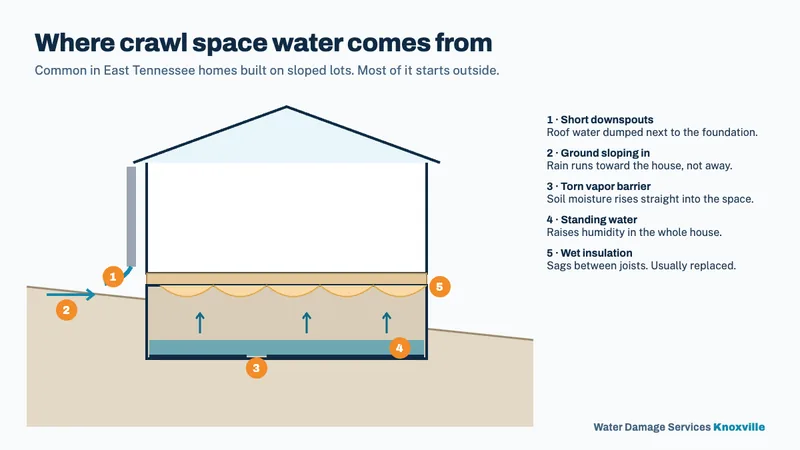
A reservoir is a managed water level, so most lake-side homes are not hit by sudden river surges. What they do see is damp ground, high humidity under the house and groundwater after long rain. None of that is covered by a typical homeowners policy, which the NAIC says excludes ground water and rain runoff. Read crawl space water removal if there is standing water under your floor.
How does Walden Ridge affect Harriman and Rockwood?
Both towns sit against the Walden Ridge escarpment of the Cumberland Plateau. Wikipedia says the ridge rises several hundred feet above Harriman to the west, and that Rockwood sits at its base. Slopes that tall shed rain quickly onto whatever is below.
- Check where your downspouts end. Water dumped beside the foundation goes straight to the crawl space.
- Look at the grade. Ground that tilts toward the house is the usual cause of repeat wet floors.
- Watch for water coming through the wall low down after heavy rain, which is a sign of pressure from the hillside.
When runoff comes inside, it is surface water, which the IICRC S500 standard calls Category 3. See basement flooding cleanup for how to handle it.
What happened with the Emory River in Harriman?
Wikipedia reports that in 1929 a flood of the Emory River, together with the stock market crash, wiped out much of Harriman's industry. The river forms an oxbow bend that wraps around the original part of the city, and it enters the valley at a pass called Emory Gap.
That is one historical fact, not a flood forecast for your street. For your own lot, check the flood maps through the county, and remember that flood damage is excluded from standard homeowners and renters policies. FEMA says most homeowners insurance does not cover flooding, and a separate flood policy is needed.
Are Kingston, Harriman and Rockwood homes older?
Often, but the towns' histories say little about individual houses. Kingston grew from Fort Southwest Point, built in 1792, and was established in 1799. Rockwood grew around the Roane Iron Company, chartered in 1867. Harriman was founded in 1889 as a planned temperance town. A town that old has older blocks, though a house on any street could be a 1950s ranch or a newer build.
Find your own house's age, then plan around it:
- Before 1978, there may be lead paint. Paid work that disturbs it falls under the EPA's Renovation, Repair and Painting rule.
- Older supply lines corrode at joints. See the burst pipe guide.
- Plaster and old plank floors hold water longer than drywall and need meter readings, not guesses.
What did the iron and hosiery mills leave behind?
Mostly buildings and street layouts, not anything special about your plumbing. Wikipedia says Rockwood's iron furnace ran from the late 1860s until the company shut down in 1929, and that Harriman had a paper mill and two hosiery mills operating into the 1980s. Harriman's brick land company headquarters, with four Norman towers, is now City Hall.
If you own an older commercial or mill-era building, ask the restoration team how they handle large open spaces and thick masonry. These dry more slowly than a small room, and moisture readings in several spots matter more than one.
The vacancy numbers deserve a note too. Wikipedia counts 3,023 housing units in Harriman, with 14.7% vacant, and 2,664 in Rockwood, with 13.5% vacant. An empty house can leak for weeks unnoticed, so owners who live elsewhere should leave the water off and have someone check after storms.
How do the three towns compare?
| Town (ZIP) | Water and terrain, per Wikipedia | Housing units, share vacant |
|---|---|---|
| Kingston (37763) | Clinch, Emory and Tennessee rivers meet; part of Watts Bar Lake | 2,775, 7.7% vacant |
| Harriman (37748) | Emory River oxbow; Walden Ridge rises above the city | 3,023, 14.7% vacant |
| Rockwood (37854) | Base of Walden Ridge; Watts Bar Lake on the south edge | 2,664, 13.5% vacant |
Across the county, the Census counted 25,374 housing units, with 75.0% owner-occupied. Renters should read the insurance claims guide and tell their landlord in writing.
What should I do in the first hours after a leak or flood?
Stop the source, then protect people and start drying. The EPA says to dry water-damaged areas and items in the first 24 to 48 hours to prevent mold growth.
- Shut off the main valve. If the water came from outside, stay out of it and keep power off in wet rooms.
- Photograph and video the damage before you move anything.
- Call your insurer, and ask what they need before work starts.
- Call a restoration team and ask how they will measure and record drying.
- Keep humidity below 60 percent, ideally 30 to 50, as the EPA recommends.
The emergency page has a longer checklist. If mold has already started, read mold after water damage. Restoration teams differ on how far they drive, so confirm coverage when they call.
Sources: Roane County, Tennessee; Kingston, Tennessee; Harriman, Tennessee; Rockwood, Tennessee (all Wikipedia, citing the 2020 Census); EPA, A Brief Guide to Mold, Moisture and Your Home; IICRC S500; NAIC homeowners insurance; FEMA, flood insurance.