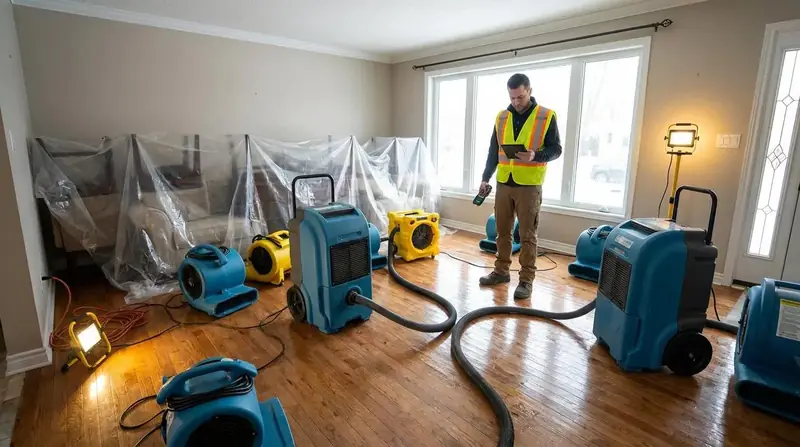
For Sweetwater and Monroe County homeowners
For water damage restoration in Sweetwater, TN, shut off the main valve, photograph the damage and start drying in the first 24 to 48 hours. Creek, lake and hillside runoff count as flood-type water, which usually needs a professional. Requests come from Sweetwater, Madisonville, Vonore, Tellico Plains and Coker Creek.
Which Monroe County towns and ZIP codes do requests come from?
Requests come from Sweetwater (37874), Madisonville (37354), Vonore (37885), Tellico Plains (37385) and Coker Creek (37314). The restoration team that calls you confirms whether your address is on their route, because restoration teams differ in how far they drive. Towns to the north and east have their own pages: Loudon, Lenoir City, Maryville and Townsend.
Monroe County had 46,250 residents at the 2020 Census, and Wikipedia says 73.3% of them lived in rural areas. That matters for a leak: a house on a long county road is farther from help than one in town, so the first hour of your own steps counts for more.
Why does Sweetwater Creek matter for homes in Sweetwater?
Sweetwater sits in a lowland that the creek cut, called Sweetwater Valley, with low hills around it. Wikipedia says the creek flows northeast and ends in the Watts Bar Lake part of the Tennessee River. Low ground between hills collects runoff, so heavy rain tends to find the same wet spots on the same lots.
Water that comes in from outside the house is flood-type water. The IICRC S500 standard puts rising flood water and outside surface water in Category 3, which usually means wet porous materials come out rather than dry in place. Read flood cleanup before you start pulling anything up.
What is different about Vonore and Tellico Lake?
Vonore is built around water that did not exist before 1979. The town sits where the Little Tennessee and Tellico rivers meet, and both stretches became Tellico Lake when TVA finished Tellico Dam. Wikipedia lists 2.9 of the town's 11.9 square miles as water, or 24.67%.
Lakeshore and low lots are where owners should look hardest.
- Boat houses, docks and lower-level rooms sit closest to the waterline, so a storm or a failed pump reaches them first.
- Wikipedia says the old part of town along Depot and Hall streets has many older houses, with a newer retail strip on US 411.
- Seasonal owners may be away for weeks. A supply line that fails in an empty house runs until someone arrives.
Lake views do not change the insurance rule. A standard homeowners policy excludes flood, so ask your agent what you have before a storm, not after.
How do the mountains change things in Tellico Plains and Coker Creek?
Water moves fast off steep ground, and these two places are the steepest in the county. Tellico Plains is on the Tellico River where it leaves the high Appalachian peaks, and Coker Creek is in the Unicoi Mountains, completely surrounded by the Cherokee National Forest. Wikipedia counts 762 residents in Tellico Plains and 150 in Coker Creek.
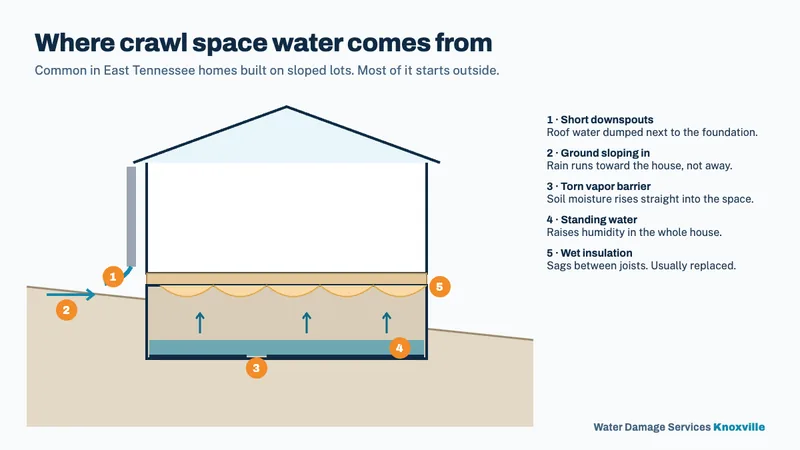
A house cut into a slope takes runoff from above, and a crawl space below it takes the rest. If your crawl space has standing water, our crawl space water removal guide explains what a restoration team looks at.
How do Sweetwater, Madisonville and the others compare?
Each town has a different setting and a different housing picture. The table uses only what Wikipedia says and what the 2020 Census counted.
| Town (ZIP) | Setting | 2020 Census |
|---|---|---|
| Sweetwater (37874) | Sweetwater Valley, creek drains to Watts Bar Lake | 2,816 housing units, 10.5% vacant |
| Madisonville (37354) | County seat on US 411; Unicoi Mountains to the southeast | 2,269 housing units, 10.4% vacant |
| Vonore (37885) | Little Tennessee and Tellico rivers, now Tellico Lake | 1,574 people, 715 households |
| Tellico Plains (37385) | Tellico River at the foot of the mountains | 762 people |
| Coker Creek (37314) | Unicoi Mountains, inside Cherokee National Forest | 150 people |
What should I know about older homes in Madisonville?
Madisonville has been the county seat since the early 1820s, so it has some of the oldest blocks in the county. Wikipedia says the town began as Tellico, was renamed in 1830 and incorporated in 1850. That history does not tell you when your house was built, so check the deed or the county records.
- Homes built before 1978 may have lead paint, and the EPA's Renovation, Repair and Painting rule covers paid work that disturbs it.
- Older supply lines often leak at joints and shutoffs. See the burst pipe guide for where to look.
- Of the 2,269 housing units Wikipedia counts there, 10.4% were vacant in 2020. An empty house nearby is not always someone watching it.
How do I know whether the water is clean or contaminated?
Trace it to the source, because the source sets the category. The IICRC S500 standard lists a supply line or burst pipe as Category 1, a washer, dishwasher or toilet overflow without waste as Category 2, and sewage, river water or outside surface water as Category 3.
- Category 1. A broken supply line. Dry fast and most materials survive.
- Category 2. Appliance overflow. Porous items may need to go.
- Category 3. Creek water, runoff or sewage. The EPA says to call a professional experienced with contaminated water.
A backed-up drain is its own case, covered in sewage backup cleanup.
Does homeowners insurance cover creek and lake water?
Usually not. Triple-I says flood damage is excluded under standard homeowners and renters policies, and the NAIC says ground water and rain runoff are typically not covered. A sudden plumbing leak is usually a different story.
Sweetwater Creek and Tellico Lake do not change the wording of a policy. Call your agent before you sign a work order, and hold off on major permanent repairs until the adjuster has seen the damage. Our insurance claims guide covers photos and receipts.
What happens to furniture and belongings after a leak?
Move what you can to a dry room, and photograph it first. Some restoration teams pack out and clean contents themselves, some hire it out, and some do not offer it, so ask. Read contents cleaning and pack-out for what usually gets saved. Once everything is dry, rebuilding is a separate job, described under water damage repair.
What are the first steps in the first 24 to 48 hours?
Stop the water, keep people safe, then start drying. The EPA says to dry water-damaged areas and items in the first 24 to 48 hours to prevent mold growth.
- Shut off the main water valve. Turn off power to wet areas only if you can do so safely.
- Photograph and video the damage before moving anything.
- Call your insurer and ask what they need before work starts.
- Call a restoration team and ask what they will measure and how they will log drying.
- Aim for indoor humidity below 60 percent, ideally 30 to 50, as the EPA recommends.
For a longer checklist see the emergency page, and for growth that has already started read mold after water damage. For a lake house you leave empty in winter, the American Red Cross says to keep the heat no lower than 55 F.
Sources: Sweetwater, Tennessee; Madisonville, Tennessee; Vonore, Tennessee; Tellico Plains, Tennessee; Coker Creek, Tennessee; Monroe County, Tennessee (all Wikipedia, citing the 2020 Census); EPA, A Brief Guide to Mold, Moisture and Your Home; EPA, Mold Cleanup in Your Home; IICRC S500; Triple-I, disasters covered by homeowners insurance; Triple-I, settling claims; NAIC homeowners insurance; American Red Cross, frozen pipes.