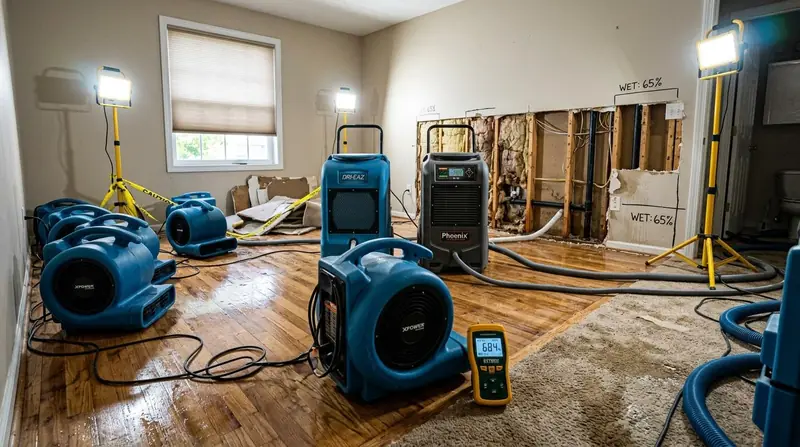
The short version
Flood water from outside is treated as contaminated. Cleanup means removing soaked porous materials, cleaning and disinfecting what stays, then drying the structure with equipment before anything is rebuilt. Most homeowners policies exclude this kind of flooding, so it is usually a flood insurance claim.
How is flood cleanup different from a pipe leak?
Water from a burst pipe starts clean. Flood water does not. Water that came in from a creek, a yard, a street or a backed-up storm drain carries soil, oil, bacteria and often sewage. Restoration crews treat it as Category 3 water under the IICRC S500 standard.
That changes the job. Porous materials the flood water touched, such as carpet, pad, insulation and the lower part of drywall, are usually removed rather than dried. Hard surfaces are cleaned and disinfected before drying starts.
Is it safe to go back into a flooded house?
Check these before anyone starts cleaning:
- Power to the flooded area is off, and an electrician has checked anything that was under water.
- There is no smell of gas. If there is, leave and call the gas company from outside.
- Floors and stairs are firm, and ceilings are not sagging.
- You have boots, gloves and an N95 mask at minimum. Flood mud is not ordinary dirt.
Never walk or drive through moving flood water. Ready.gov notes that six inches of moving water can knock a person down and a foot of moving water can carry away a vehicle.
What are the steps of flood cleanup?
- Document first. Photograph the water line on every wall and every damaged item before it is moved. Your flood insurer will want it.
- Pump and extract. Remove standing water and mud from floors, basements and crawl spaces.
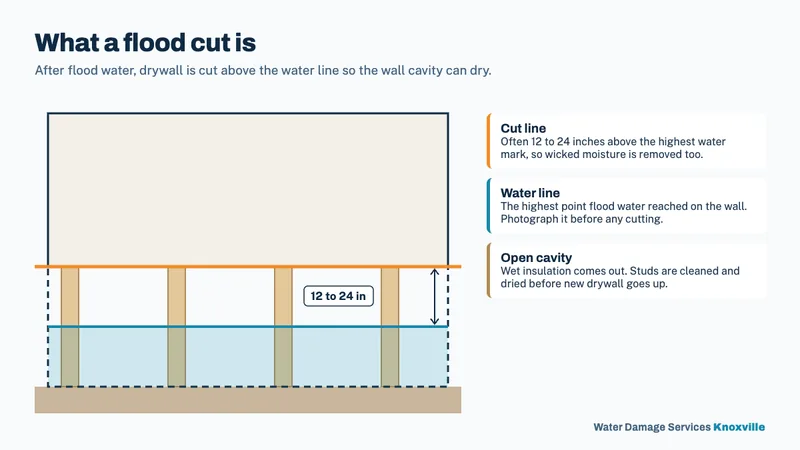
- Remove soaked materials. Drywall is usually cut a foot or two above the water line, called a flood cut, so the wall cavity can dry and wet insulation can come out.
- Clean and disinfect. Studs, subfloors, concrete and anything staying in the house are cleaned and treated.
- Dry with equipment. Dehumidifiers and air movers run until framing and subfloors read dry.
- Check for mold before closing walls. Rebuilding over wet or contaminated framing is how mold problems start.
Contents need sorting too. Mattresses, upholstered furniture, stuffed toys and food that touched flood water usually go. Hard items can often be cleaned.
What should you throw away after a flood?
Throw away anything porous that flood water soaked and that cannot be fully cleaned and dried: carpet and pad, mattresses, upholstered furniture, stuffed toys, wet insulation, the lower drywall, and any food or medicine the water touched. Photograph each item before it goes, because your insurer will ask.
- Carpet, carpet pad and rugs soaked by outside water
- Mattresses, box springs, pillows and upholstered furniture
- Stuffed toys and soft children's items
- Wet insulation and drywall below the flood cut
- Food, drinks and medicine that touched flood water, including sealed packaging that is not waterproof
- Particleboard furniture and cabinets that have swollen
Make a list as you go: item, room, rough age and where it was bought. That list becomes your contents claim.
Which flooded items can be cleaned, and which need replacing?
Hard, non-porous items such as metal, glass, solid plastic and sealed tile can usually be cleaned and disinfected. Porous items that absorbed contaminated water usually need replacing. Solid wood furniture and hardwood floors are in between: some can be cleaned and dried, others warp or grow mold.
| Item | Usually cleaned | Usually replaced |
|---|---|---|
| Floors | Tile, sealed concrete | Carpet, pad, laminate |
| Walls | Studs, masonry | Drywall and insulation below the cut |
| Furniture | Metal, glass, some solid wood | Upholstered pieces, particleboard |
| Household items | Dishes, hard plastic, metal tools | Mattresses, soft toys, food |
Appliances, HVAC equipment and anything electrical that sat in flood water should be checked by a qualified technician before use. A flood damage restoration provider in Knoxville can help sort and photograph contents, but the keep-or-replace decision on a claim is yours and the adjuster's.
How do you stop mold after flooding?
Stop mold after a flood by getting soaked materials out and the structure dry fast. The EPA advises drying water-damaged areas within 24 to 48 hours to prevent mold growth, and keeping indoor humidity below 60 percent, ideally 30 to 50 percent. Flood water is contaminated, so the EPA advises professional help.
- Run dehumidifiers with the windows shut when the outdoor air is humid.
- Do not close walls until framing and subfloors read dry on a meter.
- The EPA warns against painting or caulking over moldy surfaces.
- For mold left after sewage or flood water, the EPA recommends a professional experienced with contaminated-water damage.
How likely is flooding in Knoxville?
Knoxville sits on the Tennessee River, and creeks such as First Creek, Second Creek and Third Creek run through the city to it. Heavy rain can push these creeks out of their banks quickly. Flash flooding after intense rain is a bigger risk for most homes than river flooding, because the main river is managed by TVA dams.
Knox County takes part in the National Flood Insurance Program, and its stormwater office notes that properties outside mapped flood zones still flood from runoff, blocked drains, sinkholes and undersized pipes. Drainage problems in the county can be reported through the Knox County floodplain page.
To check a property, use the floodplain layers on the Knoxville Knox County GIS (KGIS) map or look up the address on the FEMA Flood Map Service Center. Living outside a mapped flood zone does not mean a property cannot flood. Storm drains and small creeks back up too.
Does insurance cover flood cleanup?
Standard homeowners policies generally do not cover flooding from rising surface water. That needs a separate flood policy, often through the National Flood Insurance Program. NFIP policies usually have a 30-day waiting period before they take effect, so buying cover after a forecast does not help.
Water that backs up through drains or a sump pump is a third case. Many homeowners policies only cover it with a sewer and drain backup endorsement. Check which of the three you have before the next storm.
After a flood, call your flood insurer, ask whether they want to inspect before removal starts, and keep samples of flooring and drywall if they ask for them.
How do you file a flood insurance (NFIP) claim?
Report the flood to the insurance company or agent that sold your flood policy as soon as it is safe, then document the damage before cleanup. An adjuster is assigned to inspect. You submit proof of loss with photos, receipts and an inventory. FloodSmart.gov explains each step.
- Report the loss to your flood insurer or agent and write down the claim number.
- Photograph and video everything, including the water line on each wall, before items are removed.
- Make an inventory of damaged contents, with photos and any receipts.
- Keep samples of carpet, flooring and drywall if the adjuster asks for them.
- Start cleanup to stop further damage, and keep receipts for that work.
- Meet the adjuster and review the estimate line by line.
- Sign and send the proof of loss by the deadline your insurer gives you.
Can you get FEMA disaster assistance after a flood?
Only when the flood is part of a federally declared disaster that includes individual assistance for your county. If it is, you apply at DisasterAssistance.gov. Have your address, insurance details and damage photos ready. Assistance is meant to help with needs, not to replace insurance.
Apply even if you are still waiting on an insurance decision, and keep every letter FEMA sends. Watch local news and Knox County announcements after major storm water damage, because a declaration is announced, not automatic.
For flood cleanup in Knoxville, TN, storm water damage cleanup often runs alongside these claims. Keep the provider's photos and drying logs. Both the insurer and FEMA may ask for them.
How does commercial flood cleanup work?
Shops, offices, rental units and churches get the same process at a larger scale, plus a few extra concerns: keeping part of the building open, protecting stock and records, and coordinating with a landlord or property manager. Ask the provider whether they can phase the work by area and how they handle after-hours access.
For water from a burst pipe or appliance rather than from outside, see water removal and extraction.
Sources: Ready.gov, Floods; FloodSmart.gov (NFIP); EPA, Flooded Homes; EPA, A Brief Guide to Mold, Moisture and Your Home; EPA, Mold Cleanup in Your Home; DisasterAssistance.gov; Knox County Stormwater, Floodplain.