For LaFollette and Campbell County homeowners
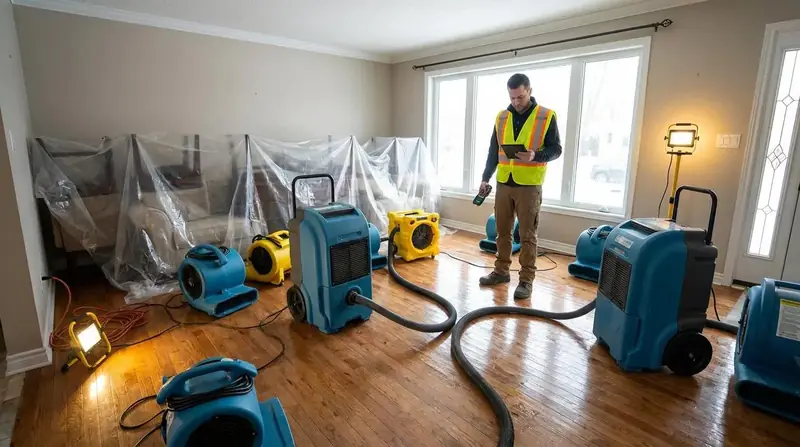
For water damage restoration in LaFollette, TN, shut off the main valve, photograph the damage and start drying in the first 24 to 48 hours. Mountain runoff and creek water count as flood-type water, which usually calls for a professional. Requests come from LaFollette, Jacksboro, Caryville, Jellico, Duff, Newcomb and Pioneer.
Which Campbell County towns and ZIP codes do requests come from?
Requests come from LaFollette (37766), Jacksboro (37757), Caryville (37714), Jellico (37762), Duff (37729), Newcomb (37819) and Pioneer (37847). Restoration teams differ on how far north they drive, so one confirms your address when they call. Clinton is the closest Anderson County page: see water damage in Clinton. Neighbors to the east and west have their own pages: Tazewell and Claiborne County and Oneida and Scott County.
Campbell County had 39,272 residents at the 2020 Census, and most of them live in the southern half, around LaFollette, Jacksboro and Caryville. Jellico sits far to the north, on the Kentucky line, in a different kind of country.
How does the land around LaFollette push water toward a house?
LaFollette sits in Powell Valley, where the Ridge-and-Valley gives way to the Cumberland Plateau. Wikipedia says Cumberland Mountain rises north of the city and that the ground runs from about 1,050 feet in the valleys to about 1,500 feet on the ridge tops. Rain that falls on that slope has only one place to go, and it is downhill toward the streets and foundations.
Look at your lot after a hard rain. Water that pools beside a wall, runs under a garage door or seeps up through a slab is outside water, and the IICRC S500 standard treats runoff and surface water as Category 3. Our basement flooding guide explains how it gets in, and flood cleanup covers what to avoid touching.
What did the coal boom and the 1904 fire leave behind?
LaFollette was laid out around 1890 by two brothers who bought 37,000 acres at Big Creek Gap and started a coal, iron and railway company. The town was incorporated in 1897. On May 10, 1904, a fire that began in the Cumberland Inn burned most of downtown, with a reported 31 businesses destroyed.
So the oldest blocks were rebuilt after that fire, and later buildings were added around them. Wikipedia does not date any individual building, so check the age of yours before you plan repairs.
- Paint on a house built before 1978 may contain lead. The EPA's Renovation, Repair and Painting rule applies to paid work that disturbs it.
- Aging supply lines and drain joints leak slowly behind walls. The signs of water damage page lists what to look for.
- Storefronts with rooms above them can pass a leak from one unit to the next.
What does Norris Lake mean for homes and cabins here?
Norris Lake lies south of LaFollette and is the main body of water in the county. TVA built Norris Dam on the Clinch River and finished it in March 1936 for flood control, water storage and hydropower. Wikipedia says the lake has about 800 miles of shoreline, and that the county has 11 marinas on it.
A lake home brings its own water problems. Docks, boathouses and bathrooms near the water sit on slopes, and many lake properties are seasonal. A supply line that fails while the owner is away can run until someone drives out to look.
If the cabin sits above a crawl space, read crawl space water removal too, because moisture gathers there first.
How do Jacksboro and Caryville differ from LaFollette?
Each town has a different creek and a different slope. The table uses only what Wikipedia says and the 2020 Census.
| Town (ZIP) | Water and terrain | 2020 population |
|---|---|---|
| LaFollette (37766) | Powell Valley, Cumberland Mountain to the north, Norris Lake to the south | 7,430 |
| Jacksboro (37757) | Big Creek on the east side and Cove Creek on the west, both in the Norris Lake system | 2,306 |
| Caryville (37714) | Valley below Cross Mountain; Cove Lake beside town, made by Caryville Dam | 2,212 |
| Jellico (37762) | Elk Creek valley among steep hills, on the Kentucky border | 2,154 |
| Duff, Newcomb, Pioneer | No Wikipedia article used here; ZIPs 37729, 37819 and 37847 | Not stated |
In Jacksboro, the county seat, Big Creek and Cove Creek cross town on both sides. A house near either one deserves a look at the crawl space after storms. In Caryville, Cove Creek is dammed to form the lake at Cove Lake State Park, and the town lies in the valley below Cross Mountain, whose summit reaches 3,534 feet.
Why is Jellico a different case?
Jellico lies along the Kentucky border, 58 miles by road north of Knoxville, in the valley of Elk Creek. Wikipedia says it spans the bases and slopes of three steep hills, with Indian Mountain rising nearly 1,000 feet above town. The city was founded as Smithburg in 1878 and renamed in 1883 when coal mining took off.
Many Main Street buildings date from the years after a 1906 dynamite explosion, and the commercial district has been on the National Register of Historic Places since 1999. That matters for a wet building. Ask a restoration team how they would dry it in place, and ask the city what rules cover your property before walls come out. Wikipedia counts 1,069 housing units in Jellico, 11.3% of them vacant, so a neighbor's empty house may be a leak nobody has noticed.
What can I do about a home that sits empty?
Treat an empty house as a place where small leaks grow. Campbell County had 19,941 housing units in 2020, and 18.1% were vacant, which says a lot of homes are cabins, rentals or houses between owners.
- Turn off the main water valve when you leave for any length of time.
- In cold weather, keep the heat on. The American Red Cross says to leave it no lower than 55 F when you are away.
- Ask someone local to walk through after a freeze or a heavy storm.
- If you find damage, photograph it before moving anything, then call your insurer.
The burst pipe guide shows where frozen lines tend to fail.
Does insurance pay for creek and runoff water?
Usually not. The Insurance Information Institute says flood is excluded under standard homeowners and renters policies and needs a separate policy. The NAIC adds that ground water, rain runoff and snow melt are typically not covered, while water from a home's plumbing or a roof leak typically is.
Living near Norris Lake or Cove Creek does not change those rules. Read the insurance claims guide before you sign any work order, and call your agent first if you are unsure how your loss will be classed.
What should I do in the first 24 to 48 hours?
Stop the source, protect people, then begin drying. The EPA says to dry water-damaged areas and items in the first 24 to 48 hours to prevent mold growth, and the CDC gives the same window after a flood.
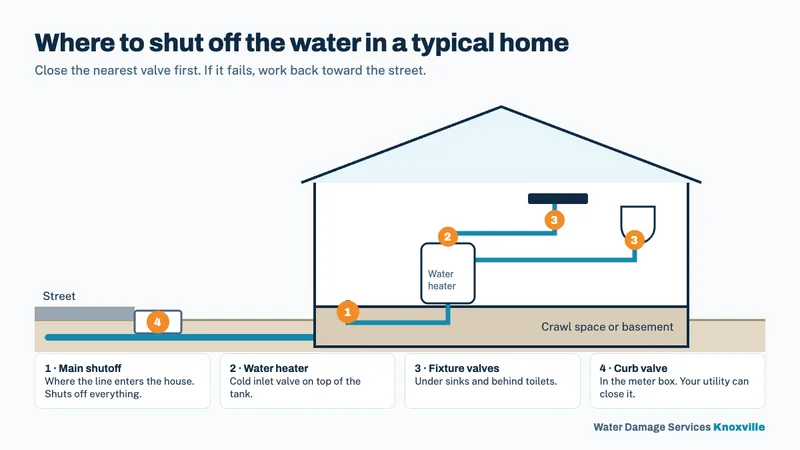
- Shut off the main water valve. Turn off power to wet areas only if you can do it safely.
- Photograph and video the damage before you move things.
- Call your insurer and ask what it needs before work begins.
- Call a restoration team and ask what they will measure and how they will log drying.
- Keep indoor humidity below 60 percent, ideally 30 to 50 percent, as the EPA recommends.
The emergency page has a longer checklist and mold after water damage covers what to do if growth has started. Restoration teams differ on which towns they reach, so confirm coverage when they call. Nearby pages: Maynardville, Powell and Wartburg.
Sources: LaFollette, Tennessee; Jacksboro, Tennessee; Caryville, Tennessee; Jellico, Tennessee; Campbell County, Tennessee; Norris Lake (all Wikipedia, citing the 2020 Census); EPA, A Brief Guide to Mold, Moisture and Your Home; CDC, About Mold and Your Health; IICRC S500; Triple-I, disasters covered by homeowners insurance; NAIC homeowners insurance; American Red Cross, frozen pipes.