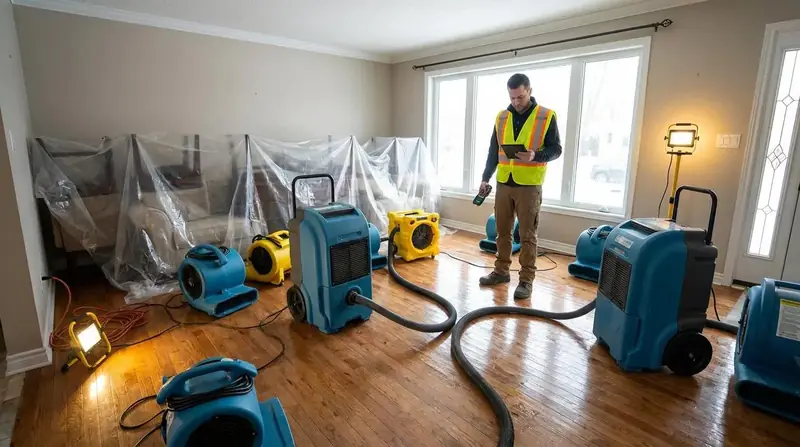
For Townsend and Walland owners
Stop the water at its source, keep out of wet rooms with live power and photograph the damage before moving anything. Townsend water damage restoration often involves cabins and second homes where a leak runs unseen. We take requests from Townsend (37882) and Walland (37886) in Blount County.
Which Townsend and Walland addresses do you take requests from?
Requests are accepted for Townsend (ZIP 37882) and Walland (ZIP 37886), both in Blount County. A restoration team that serves the area confirms they can reach your address when they call.
These are small places. Wikipedia reports 550 residents in Townsend and 281 in Walland at the 2020 Census. The roads, cabins and second homes around them are a different matter, and many of those properties belong to people who live somewhere else.
Why do cabins and second homes near the Smokies get hit hard?
Because the owner is usually not there when the water starts. Townsend calls itself the "Gateway to Cades Cove" and is one of three gateways to Great Smoky Mountains National Park, so a lot of its housing is built for visitors and part-time owners. A leak in an occupied house is found fast. A leak in a cabin that sits empty on a weekday can run until the next guest or cleaner walks in.
- Water heaters and washer hoses in lower-level utility rooms, where nobody looks.
- Hot tub and deck plumbing that leaks into the space below.
- Loft and upper-level bathrooms that drip through the great-room ceiling.
- Lockouts. A restoration team cannot start if no one can open the door, so leave access instructions with a local manager.
Our appliance leak guide lists the fixtures to inspect on every turnover.
How do you keep a vacant cabin from freezing?
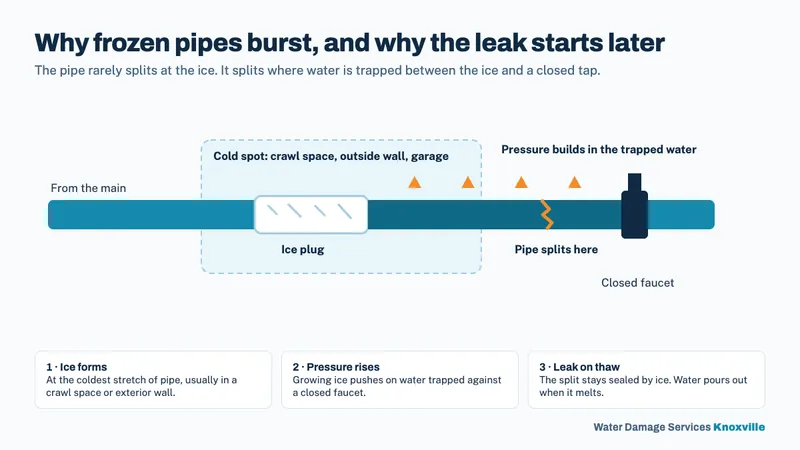
The American Red Cross says to leave the heat no lower than 55 F when you are away in cold weather, keep the thermostat at the same setting day and night, and let cold water drip from faucets served by exposed pipes. Those three steps cost little and prevent most winter splits.
The Red Cross lists supply pipes in unheated areas such as basements, crawl spaces, attics, garages and kitchen cabinets as most at risk. Mountain cabins often have all five.
- Set the thermostat to 55 F or higher before you leave and check it stays there.
- Open cabinet doors under sinks on exterior walls.
- Let a trickle run from faucets on exposed lines.
- Give a neighbor or manager the main shutoff location.
- Install a leak or temperature sensor that texts your phone.
If a pipe does split, the burst pipe guide walks through the first steps.
What does the Little River mean for Townsend and Walland homes?
The Little River runs through both places. It rises on the north slopes of Kuwohi, flows east to west through Tuckaleechee Cove, and then splits Miller's Cove into eastern and western sections at Walland, according to Wikipedia. That makes it the main thing to watch in a hard rain.
River or creek water that enters a building is treated as Category 3, grossly contaminated, under the IICRC S500 standard. Soaked carpet, padding and drywall are usually removed rather than dried. Standard homeowners policies exclude flood damage, so check whether you hold a separate flood policy. See the flood cleanup guide and look up an address on the FEMA Flood Map Service Center.
Ready.gov warns that six inches of moving water can knock a person down, and a foot can sweep a vehicle away. Do not walk or drive through it to check on a property.
How does the cove landscape shape water problems?
Townsend sits in Tuckaleechee Cove, a limestone window between Bates Mountain on the north and Rich Mountain on the south. Walland sits in Miller's Cove, walled off to the north by Chilhowee Mountain. Both are bowls with slopes on at least two sides.
That has a practical effect. Rain that falls on a mountainside has to go somewhere, and houses at the base of a slope or beside a creek can see water arrive faster than the sky suggests. A flood map shows mapped flood zones, not every path runoff can take, so a house outside a mapped zone can still take on water.
- Keep culverts and ditches near the driveway clear of leaves.
- Point downspouts away from the foundation and the crawl space vents.
- Check a crawl space after heavy rain, not just in dry weather.
Our crawl space water removal guide covers pumping and drying under the floor.
What should I tell the restoration team when I call from out of town?
Say who can open the door and what you know about the water. Many Townsend and Walland callers live elsewhere, so clear information saves a trip.
| Detail | Why the restoration team asks | How to get it |
|---|---|---|
| Who has a key or code | Work cannot start without access | Property manager, cleaner or a neighbor |
| Where the main shutoff is | The source has to be stopped first | Ask the manager to send a photo |
| Inside source or outside water | It sets the water category and the gear needed | Look for a pipe, fixture or creek line |
| Whether power is on | Wet electrics change how the crew enters | Check the panel from a safe, dry spot |
| Directions and road condition | Mountain roads and gravel drives can be hard to find | Landmarks, the last turn and gate details |
What is different about Walland and Miller's Cove?
Walland is quieter and more spread out than Townsend, with farms and homes scattered along the Little River and the foot of Chilhowee Mountain. Wikipedia describes Miller's Cove as an enclosed valley in the northwestern foothills of the Smokies, with Hurricane Mountain and Bates Mountain separating it from Tuckaleechee Cove.
Longer driveways and fewer neighbors mean a leak can go unnoticed, and a restoration team may need clear directions to find the house. Mention if the road is gravel, steep or shared. If you rent the place out, say when the next guests arrive so the drying plan can be scheduled around them.
How do Townsend roads and US 321 affect access?
US 321, also called Lamar Alexander Parkway and Wears Valley Road, is the main route. It connects Townsend to Walland and Maryville to the northwest and to Pigeon Forge through Wears Valley to the east-northeast. Walland sits in the river valley that US 321 follows, and the national park boundary is about 15 miles south of it.
Give the restoration team a route in from US 321, not just a street name. If you are near Maryville, our Maryville page covers the closer Blount County side, and Pigeon Forge and Sevierville cover the Sevier County side.
What should I do first when I find water in a Townsend cabin?
Find the source and stop it, then keep people and pets out of wet areas. Photograph the damage before anything is moved, and call your insurer. Triple-I advises taking reasonable steps to prevent more damage while holding off on permanent repairs until the adjuster has seen the loss.
- Save every receipt for what you spend.
- Do not throw out damaged items until the adjuster visits.
- Dry wet areas in 24 to 48 hours, which is the EPA's guidance for preventing mold.
For urgent leaks, start with emergency water damage restoration. Our insurance claims guide explains how rental and second-home policies are usually handled.
Sources: Townsend, Tennessee (Wikipedia, citing the 2020 Census); Walland, Tennessee (Wikipedia, citing the 2020 Census); American Red Cross, frozen pipes; IICRC S500; Ready.gov floods; Triple-I, settling claims; EPA, A Brief Guide to Mold, Moisture and Your Home.