The short version
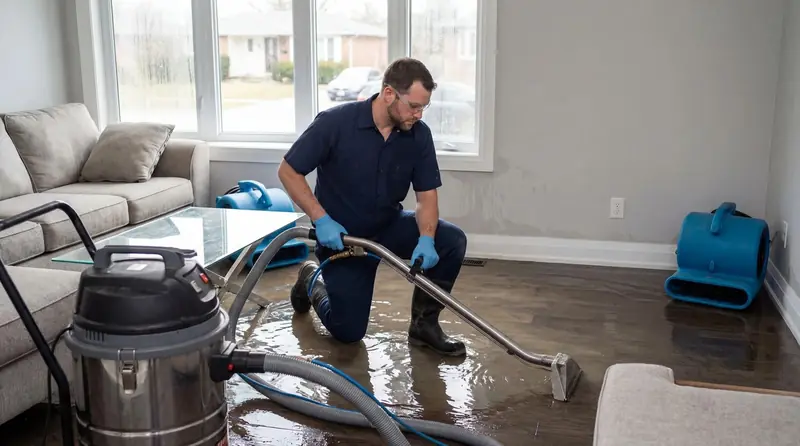
Water removal means pumping and extracting standing water before drying starts. A wet vac handles small clean spills on hard floors. Water in carpet pad, under hardwood, or in a basement or crawl space needs pumps and extraction tools, followed by dehumidifiers until the materials read dry.
When is water removal a job for a professional?
Use this as a rough guide. If you tick anything in the right-hand column, a wet vac and a box fan will not get the moisture out.
| Usually fine to handle yourself | Usually needs extraction equipment |
|---|---|
| Clean water on tile, vinyl or sealed concrete | Water soaked into carpet and pad |
| One small room, caught within an hour | Several rooms, or water that sat overnight |
| Less than about an inch, easy to reach | Standing water in a basement or crawl space |
| You can see where all the water went | Water ran under walls, cabinets or hardwood |
What equipment is used to remove water?
- Submersible pumps for basements and crawl spaces with more than a couple of inches of standing water.
- Truck-mounted or portable extractors that pull water from carpet and pad with strong suction. A truck mount sits outside and runs hoses in.
- Weighted extraction tools that a technician stands or rides on to press water out of carpet and pad.
- Hardwood drying mats that pull moisture up through the boards before they cup.
- Dehumidifiers and air movers once the bulk water is out, to dry what is left in the materials.
Extraction is the cheapest part of drying. Every gallon pulled out with a pump or wand is a gallon a dehumidifier does not have to pull from the air over several days.
How is water removed from basements and crawl spaces?
Many homes around Knoxville sit on a crawl space or a part-finished basement dug into a slope. Both collect water: from a burst line, from a failed sump pump, or from groundwater after days of heavy rain.
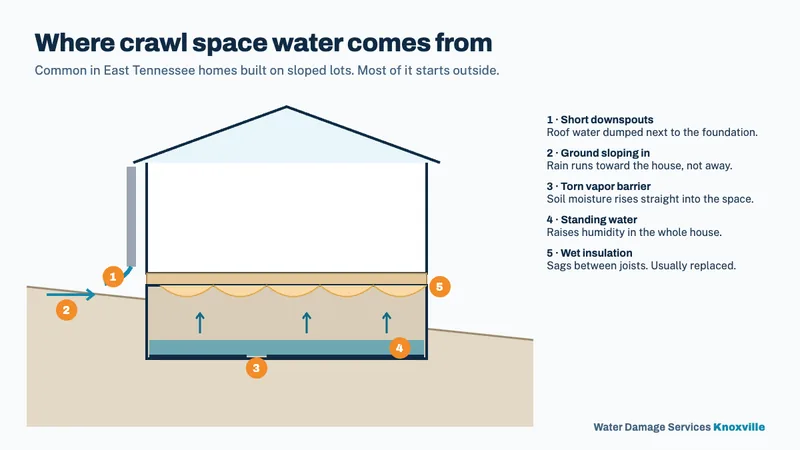
Crawl spaces are easy to forget because nobody goes down there. Water can sit under the house for weeks, raise the humidity inside and soften the subfloor. Signs include a musty smell, cupping floors, sagging insulation under the floor and condensation on ducts.
- Ask whether the provider will pump the crawl space and also dry it, not just pump it.
- Wet fiberglass insulation between floor joists usually has to come out.
- A torn or missing vapor barrier on the ground lets moisture straight back in.
For a full walk-through of basement water, from sump failures to finished basements, see basement flooding cleanup.
If water keeps coming back after rain, the fix is drainage or grading outside, not more drying inside. A restoration provider can dry it, but a drainage contractor solves the cause.
Can wet carpet, pad and hardwood be saved?
Carpet can often be dried in place after clean-water leaks if extraction starts quickly. The pad underneath is cheap and holds water like a sponge, so it is usually replaced.
Hardwood starts to cup as it absorbs water from below. Caught early, drying mats and dehumidifiers can bring many floors back flat. Leave it too long and boards crown or split. Do not sand a cupped floor until it has fully dried.
Laminate and vinyl plank often trap water underneath. Some planks can be lifted and re-laid. Laminate with a fibreboard core that has swollen will not go back.
How is standing water removed safely?
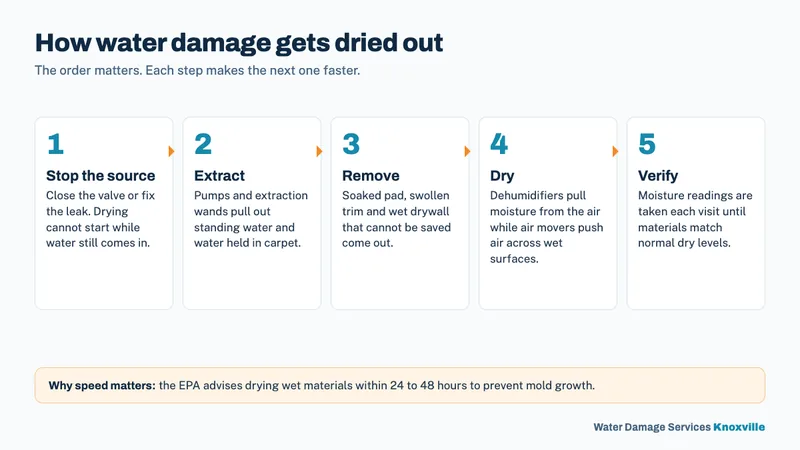
Standing water removal starts with safety: power off to the wet area, the source stopped, and the water category checked. Then the crew pumps deep water, extracts what is left from floors and carpet, and lifts out soaked materials. Drying equipment goes in only after the bulk water is gone.
- Make it safe. Breakers for the wet area are switched off, ideally by someone standing on dry ground.
- Pump the deep water. A submersible pump handles basements and crawl spaces with several inches of water.
- Extract the rest. Wands and weighted tools pull water out of carpet, pad and hard floors.
- Remove what holds water. Pad, wet insulation and swollen baseboards come out so the structure can dry.
- Set drying equipment and take readings. The crew records moisture levels to compare at each visit.
Most water extraction jobs in Knoxville basements follow this order. Crawl space water removal does too, but in a tight space. The crew usually pumps the water, pulls out wet insulation between the joists, and runs a dehumidifier under the house. A torn vapor barrier is replaced or repaired, or the ground keeps feeding moisture back in.
Should you rent a dehumidifier or hire professional drying?
A rented or household dehumidifier can finish off a small clean-water spill that has already been mopped up. It cannot pull water out of carpet pad, wall cavities or subfloors fast enough to beat the EPA's 24 to 48 hour drying window. For anything soaked, professional extraction and drying equipment does the heavy lifting.
| Rented or household dehumidifier | Professional drying | |
|---|---|---|
| Best for | One small room, surface water already removed | Soaked carpet, walls, subfloors, basements, crawl spaces |
| Extraction | None. You need a wet vac first. | Pumps and extractors remove bulk water first |
| Moisture checks | Guesswork unless you buy a meter | Meter readings logged at each visit |
| Insurance paperwork | Your own photos and receipts | Drying logs and equipment lists for the claim |
If you try it yourself, empty the tank often, close the room, and run it with fans pointed at the wet surfaces. If the smell or the stains are still there after a few days, the water is deeper than you can reach.
How long does water removal take?
The EPA advises that wet materials be dried within 24 to 48 hours to prevent mold growth, which is why extraction comes first. Pumping and extraction are usually done in the first visit, often in a few hours. The drying that follows takes longer and depends on the materials. Clean-water jobs commonly need a few days of equipment. Plaster walls, thick subfloors and hardwood can take longer.
Leaving the equipment running is part of the job. Turning dehumidifiers off at night because of the noise slows everything down.
Why does drying take days, and what humidity is the goal?
Drying takes days because water soaked into wood, drywall and concrete has to evaporate out slowly, and the air can only hold so much moisture. Dehumidifiers keep the air dry so materials keep releasing water. The EPA recommends indoor humidity below 60 percent, ideally between 30 and 50 percent.
Three things set the pace: how much water got into the materials, how dense those materials are, and how well the room is closed up so the dehumidifiers are not drying the outdoors. In a humid Knoxville summer, opening windows can bring more moisture in than it lets out.
A cheap hygrometer shows the room's relative humidity. If it stays above 60 percent with equipment running, tell the provider.
What are the signs that drying is not finished?
Drying is not finished if the room still smells musty, floors are cupped or soft, baseboards or paint are bubbling, or moisture readings have stopped falling. A crew should take final readings that match dry areas of the same material before pulling equipment. Ask to see those numbers.
- A musty or sour smell that comes back when the house is closed up
- Hardwood still cupped, or laminate edges still swollen
- Paint blistering or drywall feeling soft near the floor
- Condensation on windows or cold pipes in the wet area
- Readings that are higher than an unaffected wall in the same house
Closing walls or laying new flooring over damp materials traps the moisture. That is how mold and a second repair bill start.
What should I ask before extraction starts?
- Which category of water is this, and what does that mean for my carpet and pad?
- Will you take moisture readings each day, and can I have copies?
- What will you remove, and what will you try to dry in place?
- How do you bill: insurance price list, hourly or a fixed quote?
- Who should I call if an alarm goes off on the equipment overnight?
Still not sure whether you need removal or a full restoration job? Our emergency restoration guide covers the first visit step by step.
Sources: EPA, A Brief Guide to Mold, Moisture and Your Home; IICRC S500.