For Farragut homeowners
Stop the water, keep clear of wet electrics and photograph the damage. In Farragut, water damage is most often a finished basement problem: a failed sump pump, a leaking water heater or a drain backup. Check now whether your policy covers sewer and drain backup. We take requests from ZIP 37934 and nearby West Knoxville.
Which Farragut addresses do you take requests from?
We take requests from Farragut ZIP code 37934 and the West Knoxville ZIPs around it, including Concord and Hardin Valley addresses. A restoration provider confirms whether they can reach your address when they call.
Farragut is a town in western Knox County with 23,506 residents at the 2020 Census. It incorporated in 1980 and sits between Blackoak Ridge to the north and the Tennessee River's Fort Loudoun Lake to the south. Much of it is larger family homes, many with finished basements and lower levels.
Why are finished basements the biggest water risk in Farragut?
Because the most expensive materials sit at the lowest point. A finished basement has carpet and pad, drywall, insulation, built-in cabinets and often a bathroom or wet bar. Water from a failed water heater, a sump pump that stopped or a washer upstairs reaches all of it.
- Sump pump failure. Pumps fail in storms, often during a power cut. A battery backup and a high-water alarm cost far less than a basement rebuild.
- Water heaters in finished space. A tank that fails behind a closet door can soak a whole lower level before anyone hears it.
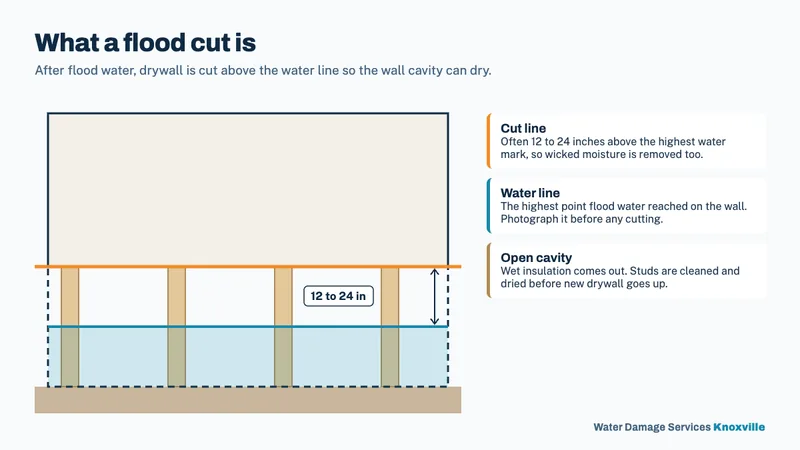
- Wall cavities. Water wicks up drywall and into insulation, so a wet floor usually means a wet wall too.
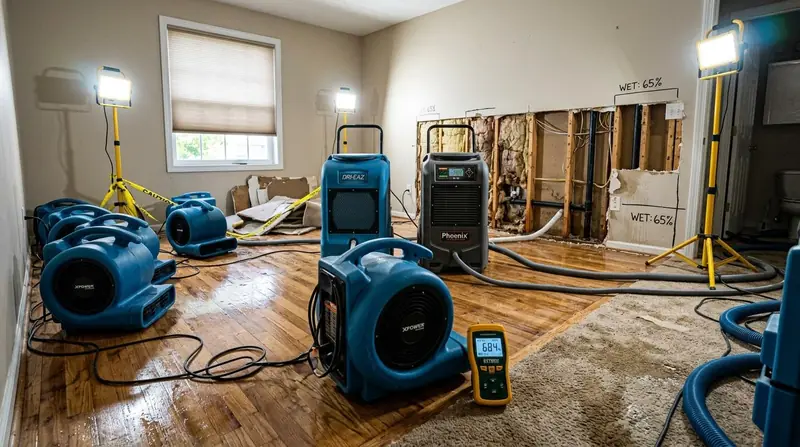
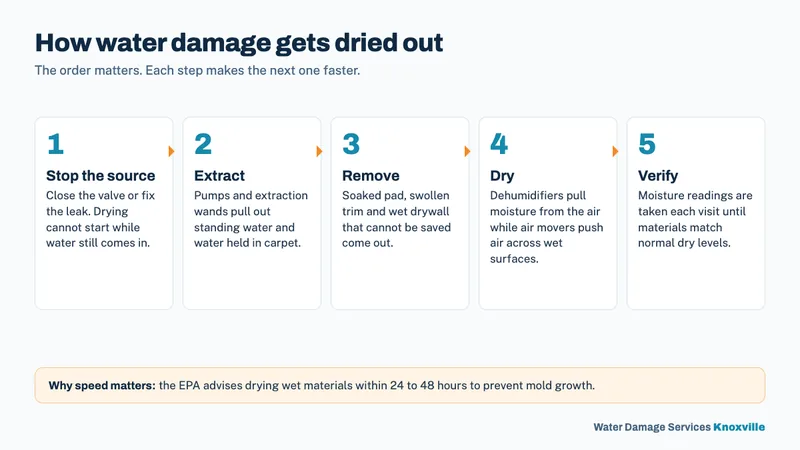
Drying a finished basement nearly always means removing the bottom of the drywall and the carpet pad so air can reach the framing. Our water removal guide covers what can usually be saved.
Is a sewer or drain backup covered by homeowners insurance?
Often not, unless the policy has a sewer and drain backup endorsement. Basements with floor drains and sump pits are where this matters most. Water that comes up through a drain is treated differently from a burst pipe, and differently again from outside flood water.
Check your policy for the endorsement and its limit now, before you need it. If you have had a backup, report it to your insurer and photograph the drain and the water line on the walls. Backup water is usually Category 2 or 3 under the IICRC S500 standard, so soaked carpet and pad are removed.
Does Fort Loudoun Lake flood Farragut homes?
For most homes, no. Fort Loudoun Lake is a TVA reservoir with managed water levels. Flash flooding and runoff after heavy rain are the bigger risks, especially for homes on slopes where water runs toward the foundation or a walk-out door.
Knox County takes part in the National Flood Insurance Program. Its stormwater office notes that properties outside mapped flood zones still flood from runoff, blocked drains and undersized pipes. You can view flood zones on the KGIS map and read more on the Knox County floodplain page.
What are the most common water damage calls in Farragut?
- Sump pump failures and groundwater in finished basements
- Water heater leaks in basement closets and garages
- Washer and upstairs bathroom leaks coming through ceilings
- Floor drain backups during heavy rain
- Irrigation and outdoor spigot leaks running into lower-level walls
Water still coming in? Start with emergency water damage restoration. Nearby guides: Lenoir City and Powell.
What gets kept or removed when a Farragut finished basement floods?
In a flooded Farragut finished basement, what stays depends mostly on the water category. Clean water from a supply line lets a crew dry much of the room in place. Grey water from a washer or drain usually means the carpet pad goes. Sewage or outside water means most porous materials it touched are removed.
The IICRC S500 standard sorts water into three categories. This table shows what usually happens to common basement materials. The crew's moisture readings and the time the water sat decide each case.
| Material | Category 1 (clean) | Category 2 (grey) | Category 3 (sewage, outside water) |
|---|---|---|---|
| Carpet | Often dried in place | Sometimes cleaned and dried | Removed |
| Carpet pad | Sometimes dried, often replaced | Removed | Removed |
| Drywall | Dried if caught early | Bottom section often cut out | Cut above the water line |
| Wall insulation | Usually removed if soaked | Removed | Removed |
| Particleboard cabinets | Kept if they have not swollen | Often replaced | Replaced |
Clean water left for a day or two can be treated as grey water, so call early. Concord and Hardin Valley basements follow the same rules.
How should Farragut homeowners maintain a sump pump?
Farragut homeowners should test the sump pump before storm season and after any long power cut, because pumps tend to fail during the storms they exist for. A basic check takes a few minutes: pour water into the pit, watch the pump start, and confirm the water leaves the house and drains away.
- Pour a bucket of water into the pit. The float should rise and the pump should start.
- Check that the pump shuts off once the water drops.
- Clear debris from the pit and the pump's intake screen.
- Walk the discharge line outside. It should be clear, not frozen, and point away from the foundation.
- Listen for the check valve closing. Water flowing back into the pit means it may be worn.
- Test the battery backup and the high-water alarm if you have them.
If the pump runs but water still rises, it may be undersized or the discharge may be blocked. Our basement flooding guide covers cleanup.
Can HOA irrigation or sprinkler leaks flood a Farragut basement?
Yes. In Farragut neighborhoods with HOA-managed or in-ground irrigation, a broken sprinkler line near the house can soak the soil against a basement wall. Water then seeps through the wall or a walk-out door. It often shows up first as damp carpet along one wall with no plumbing leak inside.
- Shut off the irrigation system at its own valve or controller.
- Photograph wet soil, pooled water and the sprinkler heads near the house.
- Check your HOA covenants. Who pays usually depends on whether the line is common area or your lot.
- Report it to your insurer and the HOA in writing, with the date you first saw water.
Outdoor spigots with a split pipe inside the wall cause a similar pattern, often after a freeze.
When does mold in a Farragut finished basement need a professional?
Mold in a Farragut finished basement needs a professional when it covers more than about 10 square feet, roughly a 3 ft by 3 ft patch, or when sewage or contaminated water caused it. Below that size, the EPA says most homeowners can handle cleanup themselves.
- Dry wet materials within 24 to 48 hours to stop mold from starting.
- Keep basement humidity below 60 percent, ideally between 30 and 50 percent.
- Do not paint or caulk over mold. The EPA warns against it.
- Mold behind baseboards often means wet drywall and insulation inside the wall.
A musty smell in a finished basement with no visible mold is worth a moisture check, since growth often starts behind the drywall first.
Sources: Farragut, Tennessee (Wikipedia, citing the 2020 Census); Knox County Stormwater; IICRC S500; EPA, A Brief Guide to Mold, Moisture and Your Home; EPA, Mold Cleanup in Your Home.