For South Knoxville homeowners
Shut off the water, stay clear of wet outlets and photograph the damage. On a hillside lot, runoff usually reaches the basement or crawl space first. When you call, give your cross street and the nearest bridge or route. Some addresses are in unincorporated Knox County, so check where permits go. We take requests from ZIP 37920 and nearby Knoxville ZIPs.
Which South Knoxville addresses do you take requests from?
Requests come in from South Knoxville ZIP code 37920, which takes in Island Home Park and Colonial Village, and from neighboring Knoxville ZIPs such as 37902 downtown, 37914, 37915, 37916, 37917 and 37919. A restoration provider confirms whether they can reach your street when they call you back.
According to Wikipedia's South Knoxville article, the area is the section of the city south of the Tennessee River, with 18,516 residents recorded as of the 2000 Census. Parts of it were annexed by Knoxville in 1917. The Colonial Village article places that neighborhood in the same 37920 ZIP.
Does the Tennessee River flood homes in South Knoxville?
River flooding is rarely what sends water into a South Knoxville home. The river along this stretch is part of Fort Loudoun Lake, a reservoir held back by a dam downstream at Lenoir City. Most calls here start with storm runoff off the hills or a failed pipe, water heater or appliance indoors.
Wikipedia's Fort Loudoun Lake entry describes the lake running about 50 river miles from Fort Loudoun Dam up to Knoxville. Living on the river side of the city does not make a mapped flood zone a given. Knox County's stormwater office points out that homes outside mapped zones still take on water from runoff, blocked drains, sinkholes and undersized pipes.
- Look up your parcel on the KGIS map to see whether it falls in a mapped flood zone.
- The Knox County floodplain page explains the county's part in the National Flood Insurance Program.
- If water came in from outside, call your insurer early. Surface water is generally a flood policy question, not a standard homeowners one.
Why do hillside homes in South Knoxville get water in the basement?
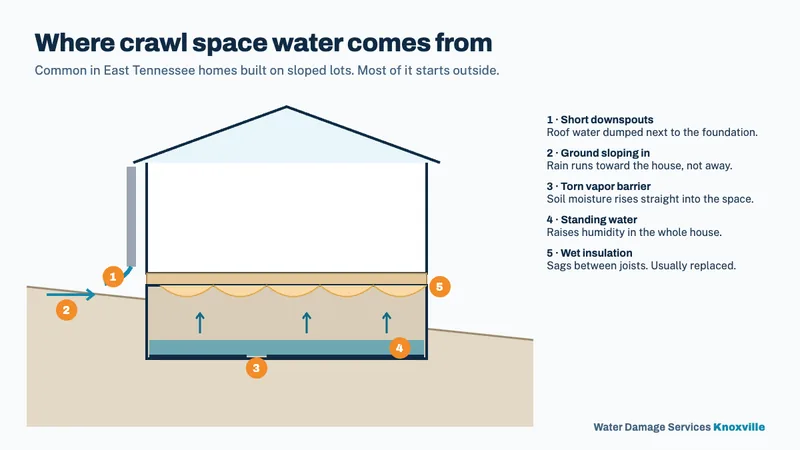
On a sloped South Knoxville lot, rain runs downhill toward whatever sits lowest, and that is often the back wall of a basement or the floor of a crawl space. Short downspouts, clogged gutters and soil that tilts toward the house send roof water straight at the foundation.
Homes built into a hillside often have one side underground and the other open to daylight. The buried wall collects water pressing against it after a long rain, and the water shows up as a damp stripe along the floor, a wet corner or a puddle near the drain. Houses lower down the street can also receive runoff from the yards above them.
| Where water gets in | What you notice | First step |
|---|---|---|
| Uphill foundation wall | Wet line where the wall meets the floor after rain | Extend downspouts and check the grading on the uphill side |
| Basement or garage door at the low side | Water spreading across the floor from the doorway | Clear the outside drain and keep the door threshold free of debris |
| Crawl space vents near ground level | Musty smell indoors, standing water under the house | Look in with a flashlight and keep away from any wiring in the water |
| Floor drain backing up | Dirty water rising from the drain during heavy rain | Stop using sinks and toilets and treat the water as contaminated |
Outside surface water counts as Category 3 under the IICRC S500 standard, so soaked carpet and pad usually come out rather than being dried. Our basement flooding guide walks through what that cleanup involves.
What should you tell a crew coming across the river to South Knoxville?
When you call from South Knoxville, give your street address, the nearest cross street, and which bridge or main route is closest to you. Wikipedia lists four bridges linking the area to downtown: Gay Street, Henley, James C. Ford Memorial and James E. "Buck" Karnes. Clear directions help a provider plan the trip.
Arrival times depend on the provider, traffic on the bridges and how many calls are waiting, so nobody can promise a time in advance. What you can do is make the visit easy once the crew is on its way.
- Which side of the house. On a hillside lot, say whether the crew should use the street-level door or the lower basement entrance.
- Parking. Mention steep driveways, narrow streets or tight turns that make it hard to bring in a van with pumps and hoses.
- The source. Say whether the water came from a pipe, an appliance or outside. That changes what gear they bring.
- Power. Tell them if the power is off or if water reached the electrical panel.
If water is still pouring in, start with our emergency water damage restoration page while you wait.
Are South Knoxville homes old or new, and does it change the cleanup?
South Knoxville mixes homes from very different decades on the same street. Many houses are older, from the decades after parts of the area joined the city in 1917, and newer infill homes sit beside them. The age of a house shapes how water moves through it and which materials need the closest look.
In a neighborhood like this, a single block can hold a house on a raised crawl space, a mid-century home on a slab and a recent build with a finished basement. Each one handles a leak in its own way:
- Raised homes on crawl spaces let water drain below the floor, where it can sit unseen and raise humidity in the rooms above.
- Slab homes push water sideways under baseboards and into the next room, so the wet area is often bigger than it looks.
- Finished basements hide water behind drywall, framing and carpet, and drywall wicks water upward from the floor.
- Additions and renovations join old and new framing, and leaks often appear first at that seam.
Whatever the age, the EPA's guide to mold and moisture says to dry water-damaged areas and items within 24 to 48 hours to prevent mold growth. Ask the provider for moisture readings so you know when a wall or floor is actually dry.
Who handles permits for water damage repairs in South Knoxville?
It depends on which side of the city line your South Knoxville address falls. Some homes with a Knoxville mailing address are in unincorporated Knox County, so permits for rebuilding go to the county rather than the City of Knoxville. Check your parcel before any structural, electrical or plumbing work starts.
- The city or county permit office can tell you which one covers your address.
- Drying and cleanup on their own do not usually need a permit. Rebuilding walls, rewiring or replacing plumbing may.
- If you are unsure, call the city or county permit office before the contractor opens walls.
What are the most common water damage calls in South Knoxville?
South Knoxville calls tend to follow the hills and the age of the housing. Runoff into basements and crawl spaces after heavy storms comes up often, along with indoor plumbing failures that have nothing to do with the weather at all.
- Storm runoff entering basements and lower levels on sloped lots
- Standing water and damp insulation in crawl spaces
- Water heater and washing machine leaks in basements and utility rooms
- Supply lines splitting in unheated crawl spaces during cold snaps
- Upstairs bathroom leaks staining the ceiling below
- Floor drains backing up during heavy rain
For a stain or sag overhead, see our ceiling water damage guide. For water that came in from outside, read the flood cleanup guide.
How do South Knoxville homeowners stay safe during heavy rain?
During a heavy storm in South Knoxville, stay out of moving water on roads and in low yards, and keep away from a flooded basement while the power is on. Ready.gov warns that six inches of moving water can knock a person down and one foot can sweep a vehicle away.
Low points on hillside streets can collect fast-moving runoff during a downpour. A few habits help:
- Never drive through water covering the road, even on a familiar route to a bridge.
- If a basement is flooding, switch off the power at the panel only if you can reach it without standing in water.
- Photograph the water line on walls and the path the water took before moving anything.
- Once the rain stops, clear gutters and check that downspouts empty well away from the foundation.
More on safe steps is on the Ready.gov flood page. Other areas covered are listed on our service areas page, and the homepage explains how a request reaches a provider.
Sources: South Knoxville (Wikipedia, citing the 2000 Census); Colonial Village, Knoxville (Wikipedia); Fort Loudoun Lake (Wikipedia); Knox County Stormwater; IICRC S500; EPA, A Brief Guide to Mold, Moisture and Your Home; Ready.gov, floods.