
For Rutledge and Grainger County homeowners
For water damage restoration in Rutledge, TN, shut off the water, photograph everything and start drying in the first 24 to 48 hours. Mountain runoff, creek water and lake water count as flood-type water, which usually needs a professional. We take requests from Rutledge, Bean Station, Blaine, Washburn, Thorn Hill and Powder Springs.
Which Grainger County addresses do you take water damage requests from?
Requests come in from Rutledge (37861), Bean Station (37708), Blaine (37709), Washburn (37888), Thorn Hill (37881) and Powder Springs (37848). A restoration team confirms whether they can reach your road when they call, since distances in a rural county are long. North of Clinch Mountain, see Tazewell and Rogersville.
Rutledge is the county seat and had 1,321 residents at the 2020 Census, according to Wikipedia. Grainger County as a whole had 23,527, and Wikipedia says 84.4% of them live in rural areas.
How does Clinch Mountain shape water problems in the county?
Clinch Mountain splits Grainger County in two, and each side drains differently. Wikipedia puts Rutledge, Blaine, Bean Station and Joppa on the southern side, and Washburn, Powder Springs and Thorn Hill on the northern side.
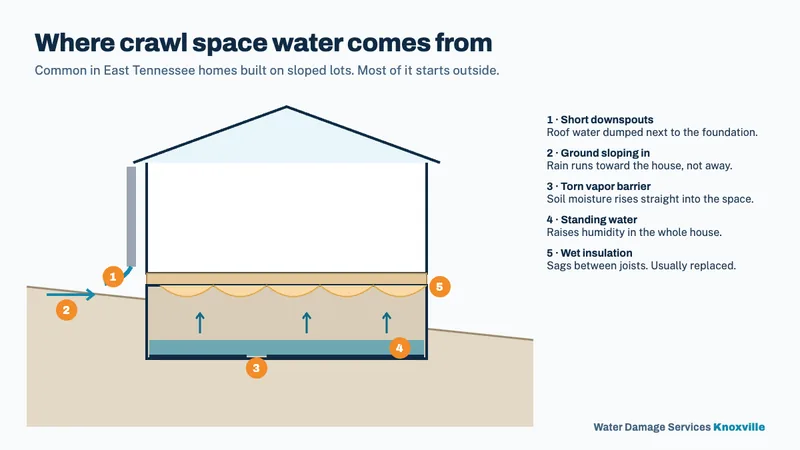
Rutledge sits near the middle of Richland Valley, a narrow valley about 35 miles long at the southern base of the mountain. Richland Creek runs through most of it on the way to Cherokee Lake. Rain that falls on the mountain gathers in the valley, then moves along it and past the houses built there. A foundation below a slope takes that water first, and a crawl space is often the place it ends up. Our crawl space guide explains what to check.
What is different about Bean Station and Cherokee Lake?
Bean Station is a lake town built on ground that moved. In the early 1940s TVA flooded the original town for Cherokee Dam, and Wikipedia says nearly 150 of about 200 families had to leave. The town shifted to the new junction of US 11W and US 25E.
The town limits include Wyatt Village beside an arm of Cherokee Lake, and part of Tate Springs near Briar Fork Creek. Wikipedia says Cherokee Lake has nearly 400 miles of shoreline and a normal yearly level swing of about 27 feet. Houses and docks near that edge deal with wet ground, humidity and storm runoff.
The Tate Springs resort, a mineral springs hotel that closed in 1941, left only cabins, a bathhouse and a springhouse. Old outbuildings like those often have failing roofs, which let rain in slowly. Read roof leak and storm damage if water is coming from above.
What should Blaine homeowners know?
Blaine lies in the southwest corner of the county, at US 11W, State Route 61 and Indian Ridge Road. Wikipedia says Clinch Mountain and nearby ridges rise to the north and northeast. The city had 2,084 residents in 2020 and 893 housing units, 7.6% of them vacant.
Blaine is 19 miles from Knoxville, and Wikipedia calls it a suburb of the city. Every house there sits under the same ridge runoff, whatever its age. If your lower level takes on water after hard rain, the cause is usually outside the house, and our basement flooding guide walks through it. Neighbors to the south and west have their own pages: Halls Crossroads and Maynardville.
What about Washburn, Powder Springs and Thorn Hill north of the mountain?
The northern towns face Norris Lake instead of Cherokee Lake. Wikipedia says the Clinch River, impounded by Norris Dam, bounds the county on the northwest. Both dams moved families: of 875 families relocated for the Cherokee Project, 434 came from Grainger County.
These communities are small and spread out, and a restoration team may need extra time to reach them. Ask about travel when they call, and do not wait to start protecting the house.
- Shut off the water at the main valve or at the pump if you are on a well.
- Move dry belongings out of the wet area and lift furniture legs onto foil or blocks.
- Photograph the damage before moving anything.
- Open interior doors and run fans if the power is safe to use.
How do the Grainger County towns compare?
This table sticks to what Wikipedia reports. Where the article gives no 2020 housing count, the cell says so.
| Place (ZIP) | Setting | Housing units, share vacant |
|---|---|---|
| Rutledge (37861) | Richland Valley at the base of Clinch Mountain | Not stated for 2020 |
| Bean Station (37708) | Cherokee Lake arms; town moved in the 1940s | Not stated |
| Blaine (37709) | Southwest corner; ridges north and northeast | 893, 7.6% vacant |
| Washburn (37888), Thorn Hill (37881), Powder Springs (37848) | North of Clinch Mountain, toward Norris Lake | Not stated |
| Grainger County | Clinch River and Norris Lake to the northwest, Holston River and Cherokee Lake to the southeast | 11,644, 17.0% vacant |
Why do empty farmhouses and weekend cabins leak the longest?
Because nobody is there to see it. Wikipedia counts 17.0% of the county's housing units as vacant, a much higher share than the 6.9% it reports for Clinton in Anderson County. Seasonal cabins, inherited farmhouses and rental properties make up a good part of that.
A small supply line leak under an empty house can run for weeks. Keep the heat on in cold weather; the American Red Cross says to leave it no lower than 55 F when you are away. Shut off the water to a property you leave. Read our burst pipe guide for where lines usually fail.
Is the water clean, or is it a bigger job?
Look at the source. The IICRC S500 standard classes water by where it came from, and the class changes the work.
- Category 1: supply line water. Drying in place is usually possible.
- Category 2: appliance overflow. Porous materials may need to come out.
- Category 3: sewage, creek water and outside surface water. Call a professional, as the EPA advises.
If your home is on a septic system instead of town sewer, a backup is a Category 3 event too. See sewage backup cleanup.
Does insurance cover creek, lake and runoff water?
Generally no. The Insurance Information Institute says standard homeowners and renters policies exclude flood, and the NAIC says damage from ground water, rain runoff or snow melt is typically not covered. Plumbing and roof leaks usually are.
Ask your agent which side your loss falls on before you authorize work. Our insurance claims guide lists what to photograph and save.
What should I do in the first 24 to 48 hours?
Dry the structure quickly. The EPA says to dry water-damaged areas and items in the first 24 to 48 hours to prevent mold growth, and to keep indoor humidity below 60 percent, ideally between 30 and 50.
Call your insurer, then call a restoration team and ask what readings they will take and how they will log them. Read emergency water damage restoration for the longer checklist and mold after water damage if you see growth. Also nearby: Morristown and Jefferson City.
Sources: Rutledge, Tennessee; Bean Station, Tennessee; Blaine, Tennessee; Grainger County, Tennessee; Cherokee Lake; Clinch Mountain (all Wikipedia, citing the 2020 Census); Clinton, Tennessee (vacancy comparison); EPA, A Brief Guide to Mold, Moisture and Your Home; IICRC S500; Triple-I, disasters covered by homeowners insurance; NAIC homeowners insurance; American Red Cross, frozen pipes.