The short version
Turn off power to any fixtures in the wet ceiling, put a bucket under the lowest point and pierce it so the water drains in a controlled way. Then find the source: when it drips tells you whether it is the roof, a bathroom, the AC or a supply line. Sagging or soft drywall should be replaced.
What should I do when water is coming through the ceiling?
Make the room safe first, then release the water in a controlled way. A drywall ceiling holding water can come down without warning, so the order matters.
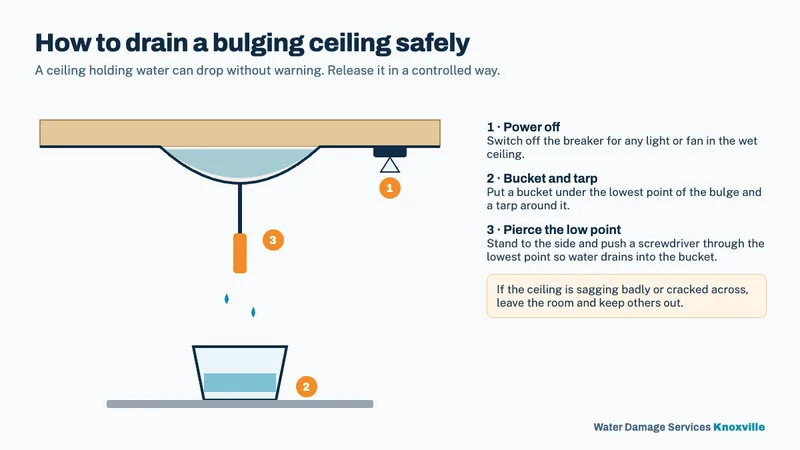
- Turn off the power at the breaker for any light, fan or outlet in or under the wet ceiling.
- Move furniture, rugs and electronics out of the way and lay down a tarp or towels.
- Put a bucket under the lowest point of any bulge.
- Pierce the low point with a screwdriver, standing to the side, so water drains into the bucket instead of bringing the ceiling down.
- Find and stop the source above. If it is a pipe or fixture, close the nearest valve or the main.
What are the warning signs a ceiling may collapse?
A ceiling holding water usually gives warning before it falls. Watch for a bulge that is growing, cracks spreading across it, tape or seams pulling loose, screw or nail heads popping, and a sagging area that feels soft. Any of these means keep everyone out of the room.
- A bulge with water you can see or hear moving above it.
- New cracks along joints, or around a light fixture or fan.
- Drips coming from several points at once.
- Plaster that sounds hollow or has pulled away from the lath.
A small bulge can be drained at the low point as shown above. If the ceiling is cracked across or sagging badly, shut the door, switch off power to that room and call for help.
How can I tell if a ceiling water stain is new or old?
A fresh stain feels damp or cool, looks darker in the middle, and grows or changes shape over a few days. An old stain is dry to the touch, has a hard brown or yellow ring at the edge, and stays the same size. Several rings inside each other mean the leak has come back more than once.
- Press gently near the stain. Soft or spongy drywall is still wet.
- Trace the outline in pencil and check it after the next rain, shower or AC cycle. If it grows, the leak is active.
- Get moisture readings with a meter, or ask a restoration provider to take them.
An old, dry stain from a leak that was fixed can be primed and painted. A fresh stain means water is still getting in, so find the source first.
How can I tell where a ceiling leak is coming from?
Watch when it drips or when the stain grows. The timing narrows the source before anything is cut open. Water also travels along joists and pipes, so the stain is not always directly under the leak.
| It drips or spreads when | Likely source | Who fixes the source |
|---|---|---|
| Only during or after rain | Roof, flashing, chimney, skylight or vent boot | Roofer |
| Someone showers or bathes upstairs | Shower pan, tub overflow, grout or drain seal | Plumber |
| A toilet upstairs is flushed | Wax ring under the toilet, or its supply line | Plumber |
| The air conditioning is running | Clogged condensate line or overflowing drain pan in the attic | HVAC technician |
| All the time, day and night | Pressurized supply line or fitting | Plumber. Shut the water off now. |
Why do attic air handlers cause ceiling leaks?
Many East Tennessee homes have the air conditioning air handler in the attic. In summer it removes moisture from the air and drains it through a condensate line. When that line clogs with algae or debris, water backs up into a drain pan, and when the pan fills or rusts through, it runs straight onto the ceiling below.
These leaks show up in the hot, humid months and stop when the AC is off. A float switch that cuts the AC when the pan fills, and a yearly line cleaning, prevent most of them.
Why is my upstairs bathroom leaking through the ceiling?
The usual causes are a failed wax ring under the toilet, a leaking shower pan, cracked grout or caulk around the tub, a loose drain connection, or a supply line under the sink. If the stain grows only after someone showers or flushes, the bathroom above is the source.
- Toilet: a toilet that rocks, or staining around its base, points to the wax ring.
- Shower or tub: run water only into the drain, then only against the walls. Whichever test leaks shows the source.
- Sink: check under the vanity for a damp cabinet floor or a dripping supply line.
Stop using that fixture until a plumber fixes it. Drain water is not as clean as a supply line leak, so dry the ceiling promptly and replace soaked insulation and soft drywall rather than painting over them.
Can a water-damaged ceiling be saved?
- A small stain from a quick, clean leak can often be dried, sealed with a stain-blocking primer and repainted.
- Sagging, soft or crumbling drywall has lost its strength and should be cut out and replaced.
- Wet insulation above the ceiling holds water against the drywall and the framing. It usually needs to come out so the space can dry.
- Plaster ceilings in older homes dry more slowly and can separate from the lath. Have them checked before anyone stands underneath.
A restoration provider can confirm the ceiling and framing are dry with a moisture meter before anything is closed up or painted. Painting over damp drywall traps moisture and lets the stain come back.
Repair or replace the drywall?
| Ceiling condition | Usual approach | Why |
|---|---|---|
| Dry stain, firm drywall | Stain-blocking primer and paint | The board kept its strength |
| Small soft or cracked area | Cut out and patch | Lets the space above dry and removes weak board |
| Large sag or several stains | Replace the affected panels | Wet board loses strength and will not flatten again |
| Mold on or above the drywall | Remove and replace | The EPA advises against painting over mold |
Is mold on the ceiling after a leak a problem?
Yes, because it means the ceiling stayed wet too long and the mold will keep growing while there is moisture. The EPA advises drying water-damaged materials within 24 to 48 hours to prevent mold. If mold covers less than about 10 square feet, the EPA says you can usually clean it yourself. Larger patches need a professional.
- Fix the leak first, or the mold comes back.
- Moldy drywall and insulation are usually cut out and replaced, not cleaned.
- Do not paint or caulk over moldy surfaces. The EPA warns against it.
- Keep indoor humidity below 60 percent, ideally 30 to 50 percent, as the EPA recommends.
Who pays when the leak comes from the unit above?
In apartments and condos, it depends on the cause and the building rules. Usually the owner of the unit where the leak started, or their insurer, handles the damage it caused, and the association's policy covers common elements. Tell the building manager straight away so they can shut off water to the unit or the stack, photograph everything, and report the loss to your own insurer as well.
For roof leaks, most homeowners policies cover sudden storm damage but not leaks from wear and tear. Photograph the roof damage from the ground if it is safe, and keep notes of the storm date.
Does insurance treat a roof leak differently from a plumbing leak?
Often, yes. Most homeowners policies cover sudden damage, such as a storm tearing off shingles or a supply line bursting. They usually do not cover slow leaks from worn roofing, failed flashing or a drip that went on for months. The cause, and how long it ran, decide the claim.
| Leak source | Often covered | Often not covered |
|---|---|---|
| Roof | Wind or hail damage, a fallen tree | Worn shingles, old flashing, poor upkeep |
| Plumbing | A sudden burst or split supply line | A slow drip or a pipe that corroded over time |
According to the Insurance Information Institute, water damage and freezing made up 22.6% of homeowners insurance losses in 2023. Photograph the damage, note the date, and call your insurer before major repairs.
When should I call a restoration provider?
Call when the ceiling is sagging, when insulation above it is wet, when water has run into walls or flooring below, or when the leak went on for more than a few hours. If the leak came from a burst pipe in the attic or an upstairs wall, our burst pipe guide covers the first steps, and emergency water damage restoration covers how the drying works.
Sources: IICRC S500; EPA mold and moisture guide; EPA, Mold Cleanup in Your Home; Insurance Information Institute, Homeowners Insurance Facts.