For Lenoir City homeowners
Close the main valve, keep clear of wet electrics and photograph the damage. Most water damage in Lenoir City comes from plumbing and appliance failures, often in finished lower levels or second homes where leaks run unnoticed. We take requests from Lenoir City, Loudon, Greenback and Philadelphia.
Which Lenoir City addresses do you take requests from?
Requests come in from Lenoir City ZIP codes 37771 and 37772, and from Loudon (37774), Greenback (37742) and Philadelphia (37846). The provider confirms whether they can reach your address when they call you.
Lenoir City sits on the Tennessee River southwest of Knoxville and is part of the Knoxville metro area. It had 10,117 residents at the 2020 Census, up from 8,642 in 2010, so a good share of homes here are newer builds.
What water problems do Lenoir City lake homes have?
The Tennessee River and TVA's Fort Loudoun and Watts Bar reservations form the city's southern edge, and Fort Loudoun Dam sits just south of town. Lakefront and lake-view homes bring their own water problems.
- Walk-out basements on slopes that take in groundwater or surface runoff after long spells of rain.
- Lower-level bathrooms and wet bars where a failed supply line runs into finished space nobody checks daily.
- Second homes that sit empty for weeks, so a leak runs much longer before anyone finds it.
Lake levels on Fort Loudoun are managed by TVA, so the main reservoir does not behave like a free-flowing river. For most houses, the bigger risks are plumbing failures and storm runoff, not the lake itself. Docks and boathouses are a separate matter from the house, and are often treated differently by insurers.
Do newer Lenoir City homes still get water damage?
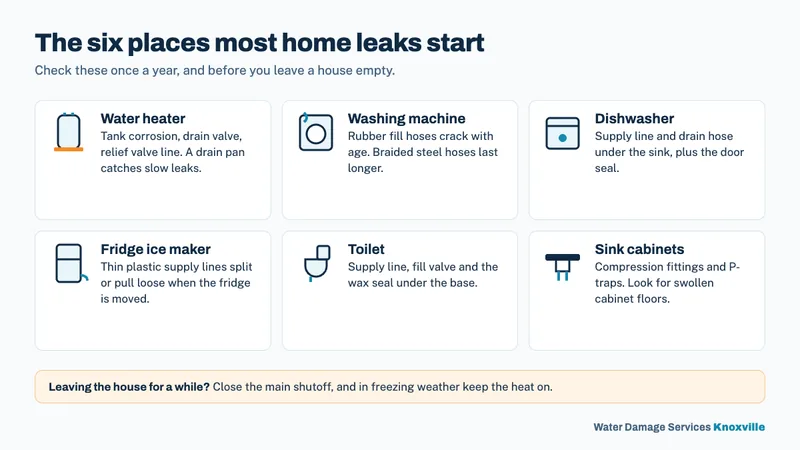
Newer homes have newer pipes, but the parts that fail most often are the same in any house: washing machine hoses, water heater tanks and valves, toilet and ice maker supply lines, and dishwasher connections. Braided steel hoses and a water heater drain pan are cheap ways to cut the risk.
Slab and crawl space foundations are both common around Lenoir City. On a slab, water spreads under flooring and into walls. Over a crawl space, it can drip through the subfloor and sit under the house. Our water removal guide explains what each one usually needs.
Does Town Creek flood homes in Lenoir City?
Town Creek runs through Lenoir City to the Tennessee River. Like other small creeks in the area, it can rise quickly in heavy rain, and low ground near it takes surface water first. Water from outside is treated as contaminated, and it is a flood insurance matter rather than a standard homeowners claim. See our flood cleanup guide for the process.
How do I shut off the water in Lenoir City?
Most homes in the city get water from the Lenoir City Utilities Board (LCUB). Find your main shutoff inside the house before you need it. If it will not close, the meter has a curb valve, and LCUB can help. Use the contact details on your LCUB bill or the LCUB website. Homes outside the city limits may be on a different water utility, so check your bill.
What are the most common water damage calls in Lenoir City?
- Water heater and washer failures in finished lower levels
- Groundwater or runoff in walk-out basements after long rain
- Supply line leaks in second homes found days later
- Water under laminate and vinyl plank on slab floors
- Burst pipes in garages and crawl spaces during hard freezes
If water is still moving, start with emergency water damage restoration.
How is a flooded walk-out basement dried in a Lenoir City lake home?
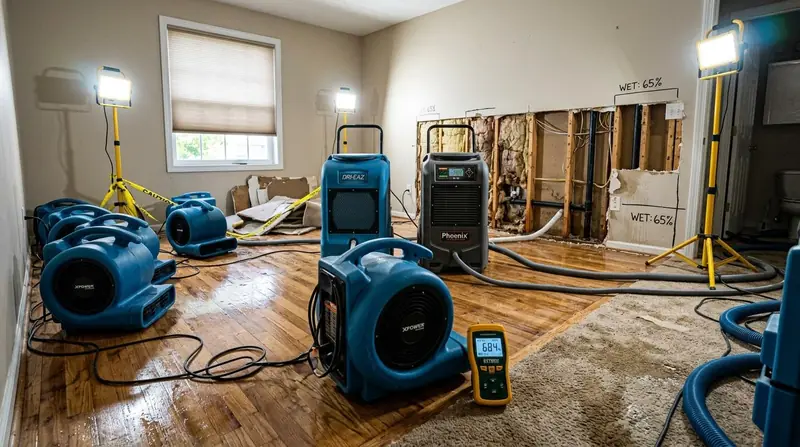
A flooded walk-out basement in a Lenoir City lake home is dried in stages: water extraction, removal of wet carpet pad and drywall, then dehumidifiers and air movers until moisture readings are normal. Where the water came from decides how much has to come out.
| Water source | IICRC category | Usual approach |
|---|---|---|
| Burst pipe or supply line | Category 1, clean | Extract and dry most materials in place |
| Washer or dishwasher overflow | Category 2, grey | Remove carpet pad, clean, then dry |
| Runoff or rising water from outside | Category 3, grossly contaminated | Remove soaked porous materials, clean, then dry |
Fort Loudoun Lake runs about 50 river miles from Fort Loudoun Dam at Lenoir City up to Knoxville, according to Wikipedia. Lake homes built into a slope usually have the walk-out level on the downhill side, where runoff collects.
The EPA advises drying within 24 to 48 hours to prevent mold, so start basement water removal early.
Is a slab or crawl space home in Lenoir City harder to dry?
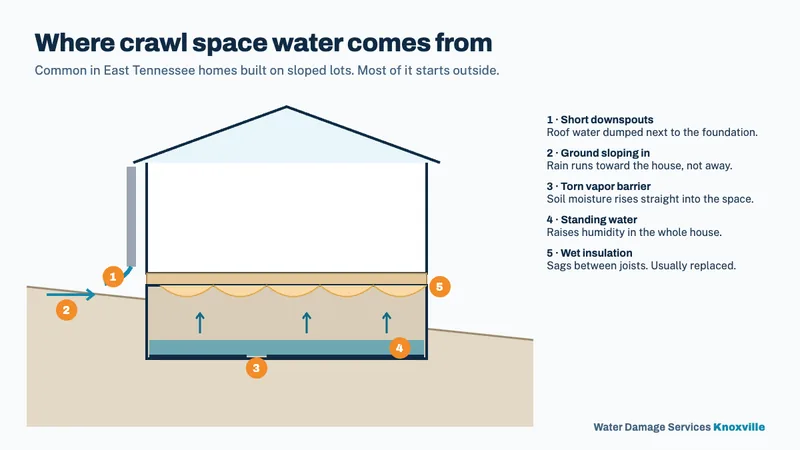
Neither is easy, but they fail differently. In a Lenoir City slab home, water spreads sideways under flooring and wicks into the bottom of walls. In a crawl space home, water drips through the subfloor and sits under the house, soaking insulation and raising humidity in the rooms above.
| Slab home | Crawl space home | |
|---|---|---|
| Where water goes | Under flooring and into wall bottoms | Through the subfloor into the crawl space |
| Hidden risk | Wet pad and drywall behind baseboards | Wet insulation, standing water, mold on joists |
| Usual work | Pull baseboards, lift flooring, dry walls | Pump water, remove insulation, dehumidify |
| Early signs | Cupping or lifting floor planks | Musty smell, soft floor, condensation |
If your newer subdivision home has vinyl plank or laminate over a slab, lift a plank near the wet area. Water often sits underneath even when the surface looks dry.
What changes for water damage in Tellico, Loudon, Greenback and Philadelphia?
Homes in Loudon (37774), Greenback (37742) and Philadelphia (37846), and Tellico area homes with one of those or a Lenoir City ZIP, can send a request. The water damage steps are the same as in town. What changes is the shutoff, the utility and the wait.
- Water source: a home on a private well shuts off at the well pump breaker and the valve near the pressure tank, not at a utility meter.
- Utility: homes outside Lenoir City limits may get water from a utility other than LCUB. The number is on your bill.
- Distance: rural and lakeside roads can add travel time, so shut off the water and move furniture off wet floors while you wait.
The provider confirms whether they can reach your address. For a split supply line or frozen pipe, see burst pipe water damage.
How should Lenoir City second-home owners prepare for winter?
Lenoir City second-home owners should keep the heat no lower than 55 F, at one setting day and night, or shut off and drain the water before leaving. The American Red Cross gives the 55 F guidance for homes left empty in cold weather. Ask someone to check the house after hard freezes.
The Red Cross lists the pipes most at risk: supply lines in basements, crawl spaces, attics, garages and kitchen cabinets. A lake home can have several of those on its lower level alone.
- Insulate pipes in the garage and crawl space.
- Let cold water drip from faucets on exposed pipes during a deep freeze, if the heat stays on.
- Fit an automatic shutoff valve with leak and temperature sensors.
- Leave a key and the shutoff location with a neighbor.
The cost of skipping this is real. The Insurance Information Institute puts the average water damage and freezing claim at $15,400 for 2019 to 2023.
Sources: Lenoir City, Tennessee (Wikipedia, citing the 2010 and 2020 Census); Lenoir City Utilities Board; Fort Loudoun Lake (Wikipedia); IICRC S500; EPA mold and moisture guide; American Red Cross frozen pipes guide; Insurance Information Institute.