The short version
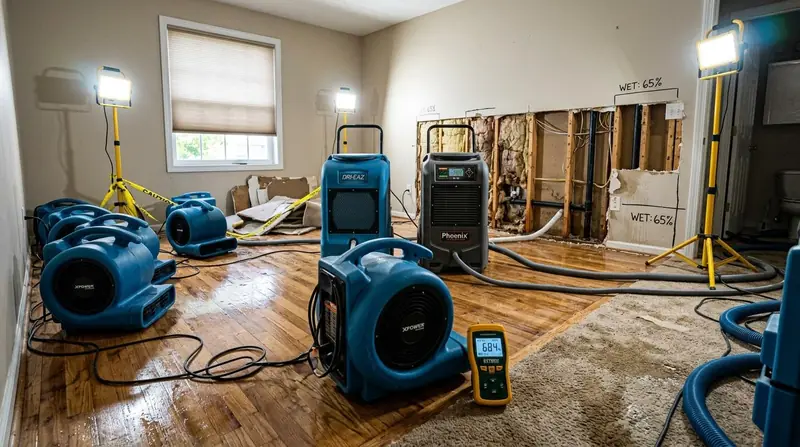
For commercial water damage restoration, stop the source, check safety and power, protect people and stock, photograph the damage, then notify the insurer and the owner or landlord. Restoration teams differ in whether they handle large commercial jobs, so confirm directly. Your commercial policy decides what is covered.
What should a business do first after water damage?
Stop the source, make the space safe, protect people and stock, document everything, then notify the insurer and the building owner or landlord. Do these in order. Most of the first hour is about limiting how far the water spreads.
- Stop the source. Close the nearest shutoff valve or the main. If the water comes from a sprinkler system, the system may need to be shut down by whoever maintains it, so call them and the fire department's non-emergency line for advice.
- Check safety and power. Do not stand in water near electrical panels, outlets or equipment. Switch off power to wet areas at the breaker only if you can reach it dry, and otherwise call an electrician. Ready.gov notes that six inches of moving water can knock a person down, so keep people away from fast or deep water.
- Protect people and stock. Move staff and customers out of wet areas. Lift inventory, records and electronics off the floor, if it is safe to do so.
- Take photos and video of the damage, the source and the affected stock before anything is moved or thrown out.
- Notify the insurer and the landlord or owner. Triple-I advises contacting your agent or company immediately and holding off on major permanent repairs until the adjuster has assessed the damage.
- Call a restoration team and ask whether it takes commercial jobs of your size.
The steps for a plumbing break are close to those in the burst pipe guide. For the whole sequence, see emergency water damage restoration.
How is commercial water damage different from a home loss?
The water behaves the same, but the situation around it is more complicated. A business has multiple parties, ongoing operations, bigger spaces and building systems that a house does not have. Those differences change how the work is planned.
- More than one party. A tenant, an owner and a property manager may each be responsible for part of the building, and each may have a different insurer.
- Business interruption. Every day closed can cost more than the repair. That pushes plans toward working around operating hours.
- After-hours access. Work may need to happen at night or on weekends, with keys, alarms and security arranged ahead.
- Shared walls, ceilings and floors. Water travels to neighboring units and the floors below.
- Sprinkler and fire systems. A discharge can release a large volume quickly.
- Larger drying setups. More floor area and bigger rooms mean more equipment, and often more electrical capacity.
Because of this, a commercial job usually starts with a longer conversation about access, occupants and scope than a home job does.
Which water risks apply to which type of property?
Each property type has typical sources and its own planning needs. The table below is a general guide, not a prediction for any building. A plumber, building engineer or your insurer can tell you what applies to yours.
| Property type | Typical water sources | What to plan for |
|---|---|---|
| Office | Supply lines, restroom fixtures, rooftop equipment, ceiling leaks | Servers, records and shared suites on the floors below |
| Retail store | Roof leaks, storefront and parking lot runoff, supply lines | Stock on lower shelves, flooring and display fixtures |
| Restaurant | Dishwashers, ice machines, grease trap and floor drain backups, supply lines | Food safety questions, kitchen equipment and drain-related contamination |
| Apartment building or multi-family | Unit plumbing, water heaters, appliance leaks, roof | Several tenants and units, shared walls and ceilings, resident communication |
| Church or school | Roof and gutter failures, restrooms, older supply lines, storm runoff | Large rooms, a fixed schedule for services or classes |
| Warehouse | Roof leaks, sprinkler discharge, dock door runoff, floor drains | Pallets and stock, concrete floors, high ceilings |
Rental properties share many of these issues. See apartment and condo water damage for the tenant and unit side.
What happens when a sprinkler system discharges?
A sprinkler discharge puts a lot of water into the building very fast, and the cause can be accidental. Triple-I lists accidental discharge or overflow from automatic fire-protective sprinkler systems among the named perils on standard forms. For a business, the policy still decides what is covered.
Shutting the system down and getting it re-armed is a job for the fire protection contractor who maintains it, not for a restoration team. Once the water is off, extraction and drying can start. Tell the insurer whether the discharge was accidental, caused by a fire, or caused by damage to a pipe, because the cause shapes the claim. Fire damage, if any, is a separate matter from this water damage page.
Does commercial insurance cover water damage?
It may, but a commercial policy is not a homeowners policy, and the policy decides. Commercial policies differ in what they cover, what they exclude and what they ask of you after a loss. Read yours, or ask your agent, before you assume anything.
Three facts apply to many policies. Triple-I says flood damage is excluded under standard homeowners and renters policies and needs separate flood cover, and the same question is worth asking about your commercial policy. Triple-I also says sewer backups are not covered under a typical homeowners policy and are bought as a separate product or endorsement. And Triple-I notes that policies will not cover damage from lack of maintenance. Ask your agent whether any of these apply to your coverage, and whether it includes lost income while you are closed.
The general claim steps in the insurance claims guide are written for homes, but the habits carry over: photograph first, save receipts, keep damaged items until the adjuster visits.
Who is responsible, the tenant or the owner?
The lease and the source of the water decide, so read the lease and tell the owner early. A tenant is not automatically responsible for a pipe in the wall, and an owner is not automatically responsible for a tenant's stock. Do not guess.
Notify the landlord or property manager in writing as soon as you know, and keep a copy. Ask who will arrange drying of the structure, who will handle contents, and who the insurers are on each side. If you are the property manager of several units, keep one record of every unit affected. A lawyer can explain lease questions; this site cannot.
Can a restoration team handle a large commercial job?
Some can and some cannot, so confirm directly before you rely on anyone. Companies differ in whether they take commercial work, how large a job they handle and what services they offer. Ask the restoration team whether it takes a building like yours.
When you call, give the size of the affected area, the type of property and the water source. Ask about after-hours access and how the restoration team will work around occupied space. If a restoration team cannot take the job, ask who they would suggest. The guide to choosing a restoration company has the questions to ask and the red flags to watch for.
What does drying a commercial building involve?
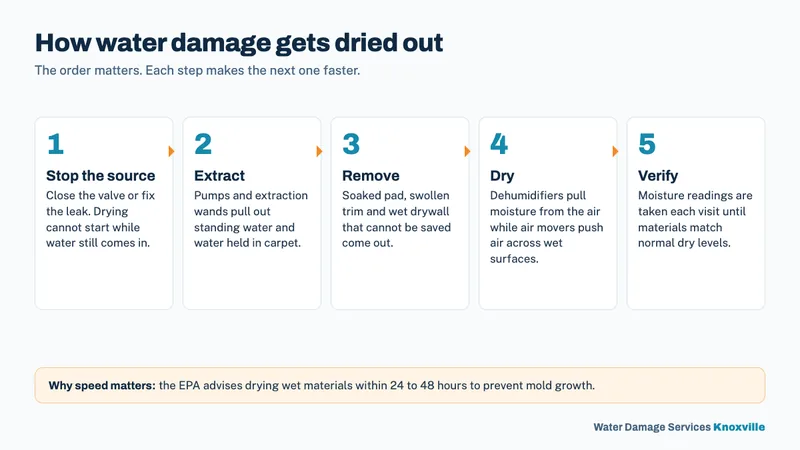
The same steps as at home, at a larger scale: stop the source, extract, remove what cannot be saved, dry with dehumidifiers and air movers, and verify with moisture readings. The EPA advises drying wet materials in 24 to 48 hours to prevent mold, so the time pressure is the same.
Larger floor plates mean more equipment and sometimes more electrical circuits than the building has spare. Concrete floors and masonry walls dry more slowly than they look. Ask for readings on each visit, as you would at home. See structural drying for how moisture is tracked and water mitigation for what the work includes.
What if the water is from a storm or a sewer?
Treat it as contaminated until a professional says otherwise. IICRC S500 puts sewage, rising flood water from rivers and streams, and outside surface water in Category 3. The EPA says to call in a professional experienced with buildings damaged by contaminated water.
In a restaurant or a building with floor drains, a backup can bring contaminated water into occupied space, so keep people and food areas clear. See sewage backup cleanup and flood cleanup for more. Knox County says properties outside mapped flood zones still flood from runoff, blocked drains, sinkholes and undersized pipes, so a building with no flood zone mark is not exempt.
How can I prepare a plan before it happens?
Write down where the shutoffs are, who to call and what to protect, and make sure the right people have it. A one-page plan saves the first, most expensive minutes of a water loss.
- Shutoff locations. Mark the main water valve, valves to each unit or area, and the water heater supply. Label them and photograph them.
- Sprinkler contacts. Record who maintains the system and how to reach them.
- Contact list. Include the plumber, electrician, landlord or owner, property manager, insurer and agent, with policy numbers.
- Access. Know who holds keys and alarm codes after hours.
- Priority items. List the records, equipment and stock to move first, and keep them off floors where you can.
- Regular checks. Look at ceilings, restrooms, roof drains and equipment rooms for early signs. The prevention guide lists common leak points.
A property manager can run through the plan with staff once a year so it does not live in one person's head.
Sources: Triple-I, Which disasters are covered by homeowners insurance; Triple-I, Settling insurance claims after a disaster; IICRC S500; EPA mold and moisture guide; EPA, Mold cleanup in your home; Ready.gov, Floods; Knox County Stormwater, Floodplain.