The short version
To prevent water damage, learn where the main shutoff is and test it, insulate and protect pipes before a freeze, check appliance hoses and the water heater each season, and keep gutters, grading and the sump pump working. If a leak happens anyway, shut the water off and start drying quickly.
How do I prevent water damage in my home?
Know where your water shuts off, check the parts that leak most often, and keep rain moving away from the house. Most water damage starts small: a worn hose, a clogged gutter, a pipe in a cold crawl space. A short routine each season catches these before they turn into a wet floor.
The rest of this guide goes through that routine in order, from the main valve to the roof. Triple-I notes that policies will not cover damage from lack of maintenance, so these checks also protect your claim.
Where is my emergency water shut off valve, and how do I test it?
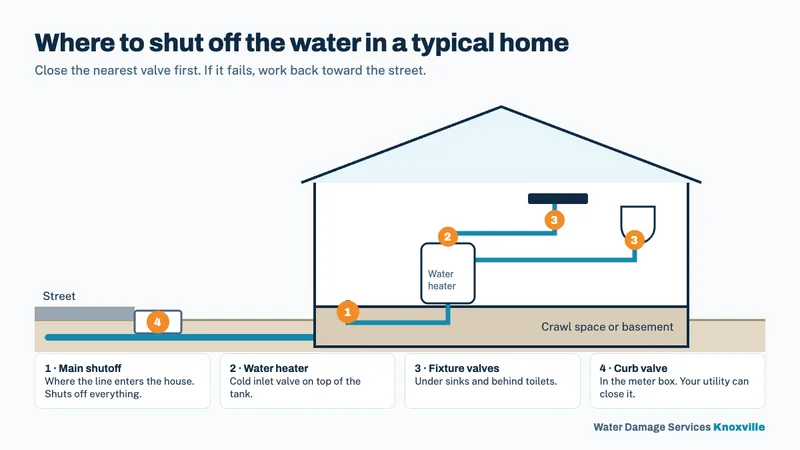
The main shutoff is usually where the water line enters the house: in a crawl space, a basement, a garage or a utility closet. Find it on a calm day, not while water is running across the floor.
- Locate the main valve and make sure nothing is stacked in front of it.
- Turn it fully closed. A lever handle should sit crosswise to the pipe. A round wheel handle turns clockwise.
- Open a faucet and confirm the flow stops.
- Open the valve again slowly and check for drips at the stem.
- Label it with a tag so everyone in the house can find it.
A valve that is stiff, will not close all the way or leaks at the handle needs a plumber before you rely on it. The curb valve in the meter box belongs to the utility, which can close it if your own valve fails.
Do I need to test the fixture valves too?
Yes. The small valves under sinks and behind toilets let you stop one leak without turning off the whole house. They are also the ones that seize from lack of use.
Turn each one closed and open it again a little at a time, and check the stem for drips. Do the same for the cold inlet valve on top of the water heater. If a fixture valve will not turn, leave it alone and ask a plumber. A forced valve can snap and start the leak you were trying to prevent.
How do I winterize pipes before an East Tennessee cold snap?
Protect the pipes the Red Cross lists as most at risk: supply lines in unheated basements, crawl spaces, attics, garages and kitchen cabinets. Many Knoxville-area homes have plumbing in crawl spaces or exterior walls with thin insulation, so a short hard freeze is enough to cause trouble.
- Disconnect garden hoses and close the indoor valve to outdoor spigots where your house has one.
- Insulate exposed pipes in crawl spaces, garages and attics.
- Open the cabinet doors under sinks on exterior walls so room heat reaches the pipes.
- Let cold water drip from faucets served by exposed pipes during the freeze, as the Red Cross advises.
- Keep the thermostat at the same setting day and night.
- Close crawl space vents and garage doors during the cold, and seal drafts near pipes.
If a pipe does freeze, the burst pipe guide covers how to thaw it safely and what to do if it splits.
How do I protect a vacation home or cabin left empty in winter?
For a vacation home freeze plan, either keep the heat on or shut off the water and drain the lines. The Red Cross says that when you are away in cold weather, leave the heat no lower than 55 F and let cold water drip from faucets served by exposed pipes.
Many cabins and rentals in Sevier County sit empty between guests, so a failure can run for days before anyone sees it. Ask a neighbor, a property manager or a plumber to look in. Some insurers set conditions on freeze damage in an unoccupied home, so read the vacancy wording in your policy before the season starts.
Which appliance hoses, supply lines and water heater parts should I check?
Check the connections that sit under constant pressure: the washing machine fill hoses, the dishwasher supply line, the ice maker line behind the fridge, toilet supply lines and the water heater. Look for bulges, cracks, rust, weeping at the fittings and swollen cabinet floors.
Do not guess at a hose's age. If it looks worn, or you cannot tell when it was installed, ask a plumber about replacing it. Braided steel hoses are a common upgrade for washers. A drain pan under the water heater catches a slow leak, and its relief valve line should end somewhere safe.
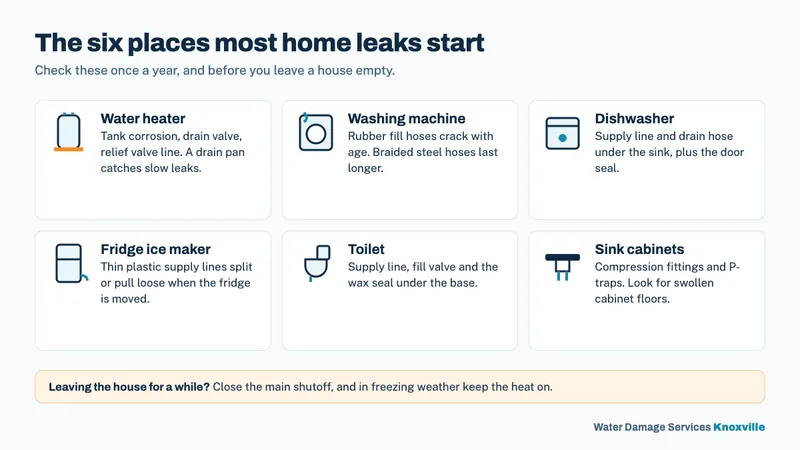
When one of these does fail, the appliance leak guide explains what to do and what drying involves.
Are water leak sensors and automatic shutoff valves worth it?
They can be, because they notice a leak when nobody is home. A leak sensor is a small device placed on the floor that sounds an alarm or sends a phone alert when it gets wet. An automatic shutoff valve goes further and closes the water line itself.
Place sensors where leaks start and where water collects:
- Beside the water heater and the washing machine.
- Under kitchen and bathroom sinks and behind the dishwasher.
- Near the sump pit and in a crawl space or low basement corner.
- Under the fridge if it has an ice maker.
A sensor only helps if someone hears it. Check the batteries each season and test it with a damp cloth. For an automatic shutoff valve, ask a plumber which type suits your line and whether it will work with your plumbing.
How do I prevent basement flooding with gutters, downspouts and grading?
Move roof water away from the foundation before it can soak the soil next to the wall. When gutters overflow or downspouts drop water at the corner of the house, that water finds the wall-to-floor joint and the basement gets wet.
- Clean gutters in fall and after heavy storms.
- Extend downspouts so they discharge well away from the foundation.
- Check that the soil slopes away from the house, and fill low spots where water sits.
- Keep window wells clear and covered, with their drains open.
- Watch where the neighbor's runoff goes during a hard rain.
Knox County notes that properties outside mapped flood zones still flood from runoff, blocked drains and undersized pipes. You can look up an address on the Knox County floodplain page. If water already comes in, see basement flooding cleanup.
How do I check my sump pump before storm season?
Pour water into the pit and watch the pump start, run and shut off. That one test shows you the float, the motor and the discharge in a minute.
Also look at the pit for debris, listen for a rattle or grinding, and walk outside to confirm water is leaving through the discharge line and not backing up or freezing. Test the backup too, if you have one, and make sure a power cut cannot silence the alarm. Pumps often fail when the storm and the power outage arrive together, which is why a backup matters.
The sump pump failure guide goes through causes, troubleshooting and backup options in detail.
What should I check on the roof and in the attic after a storm?
Look for lifted or missing shingles, damaged flashing around chimneys and vents, and stains on the ceiling or on the underside of the roof deck. From the ground with binoculars is safer than climbing a wet roof.
In the attic, check for damp insulation, dark patches on the wood and drips after rain. A roof leak often shows up away from where it enters, so trace stains uphill. NAIC says a leak in the roof is typically covered, while damage from ground water, rain runoff or snow-melt is not, so photograph what you find. For a leak that is already inside, see ceiling water damage repair.
What should I check each season?
A short seasonal pass covers almost every common cause. Use this table as a starting list and adjust it for your house.
| Season | What to check | Why |
|---|---|---|
| Fall | Gutters, downspouts, hose bibs, crawl space vents, pipe insulation, heating | Prepares the house for the first hard freeze and for leaf-clogged gutters |
| Winter | Faucet drip during cold snaps, thermostat setting, empty rooms and cabinets, vacant property visits | Frozen pipes split where water is trapped, and the leak shows up on thaw |
| Spring | Sump pump test, roof and attic after storms, grading, window wells, outdoor spigots | Spring rain loads the soil and tests every drainage path |
| Summer | Appliance hoses, water heater, under-sink fittings, leak sensor batteries, humidity | Slow leaks and high humidity feed hidden damage and mold |
The EPA advises keeping indoor humidity below 60 percent, ideally between 30 and 50 percent, which also keeps damp spots from turning into mold. Crawl spaces need the same attention, and the crawl space water guide covers what to look for under the floor.
What do I do the moment I find a leak anyway?
Stop the water, make the area safe, and start drying. Prevention lowers the odds of a leak. It does not remove them.
- Close the nearest valve, or the main shutoff if you are unsure.
- Turn off power to wet areas at the breaker, but only if you can reach the panel without standing in water.
- Photograph the leak and the damage before moving anything.
- Call your insurer and take reasonable steps to protect the property, as Triple-I advises. See the insurance claims guide.
- Start extraction and drying. The EPA says to dry water-damaged areas in the first 24 to 48 hours to prevent mold. A restoration team can be reached through emergency water damage restoration.
Restoration teams differ, so confirm what the one you hire does before any work starts.
Sources: American Red Cross, Frozen Pipes; EPA mold and moisture guide; Triple-I, Which disasters are covered by homeowners insurance; Triple-I, Settling insurance claims after a disaster; NAIC, Homeowners Insurance; Knox County Stormwater.