For Greeneville and Greene County homeowners
For water damage restoration in Greeneville, TN, shut off the main valve, photograph everything and start drying in the first 24 to 48 hours. Creek water and runoff are flood-type water and usually need a professional. We take requests from Greeneville, Mosheim, Afton, Chuckey, Midway and Mohawk.
Which Greene County addresses do you take requests from?
Requests come in from Greeneville (37743, 37744 and 37745), Mosheim (37818), Afton (37616), Chuckey (37641), Midway (37809) and Mohawk (37810). The restoration team confirms whether they can drive to your address when they call. Restoration teams differ on how far they drive, so some will take the job and some will not.
Greeneville is the county seat and had 15,479 residents at the 2020 Census. For neighboring areas, see Morristown to the west, Newport to the southwest and Rogersville to the north.
Why does the Nolichucky River matter for Greeneville homes?
The river runs a few miles south of town, and the whole valley drains toward it. Wikipedia describes Greeneville as sitting in the Ridge-and-Valley, between Bays Mountain to the northwest and the Bald Mountains to the southeast. Water that falls on those slopes has to go somewhere, and a low lot is where it lands.
Nolichucky Dam, south of Greeneville, was built in 1912 as a power project and sold to TVA in 1939. Wikipedia says TVA stopped generating power there in the 1970s because of silt in Davy Crockett Lake, and still maintains the dam and uses it for flood control. Even so, a dam does not stop a storm from filling a creek. Water from a creek or a runoff is Category 3 under the IICRC S500 standard, so read flood cleanup before you touch anything.
Smaller streams matter just as much as the big one. Wikipedia says Big Limestone Creek and Lick Creek both join the Nolichucky in Greene County, and that a 2018 downtown plan for Greeneville includes a greenway along Richland Creek. If a creek runs near your street, ask a neighbor how it behaves after a long rain, because maps do not always show the low spots.
What older buildings does Greeneville have?
Quite a few. Greeneville was recognized as a town in 1786, which makes it the second oldest in Tennessee, and a Greeneville Historic District was established in 1974. Wikipedia counted 7,503 housing units in town at the 2020 Census, and 11.7% of them were vacant.
Age and vacancy matter in different ways. Old buildings have old plumbing and old roofs, and empty ones can leak for a long time before anyone notices.
- Houses built before 1978 may contain lead paint. The EPA's Renovation, Repair and Painting rule applies to paid work that disturbs it.
- Downtown buildings with apartments above shops let a leak run through several units. See apartment and condo water damage.
- Vacant rentals need a plan. Our burst pipe guide explains why a small leak left running becomes a large one.
How is Mosheim different from Greeneville?
Mosheim sits at the foot of a ridge. Wikipedia says the town lies along the base and southern slopes of Big Ridge, in the headwaters of Mosheim Branch, a tributary of Little Chucky Creek. It began around 1800 as Blue Springs, named for a spring that still flows through town.
A town built along a slope and beside a spring is a town where water moves above and below the ground. Mosheim had 2,479 residents in 2020. Wikipedia also notes that its ZIP codes are split: most of it is 37818, but parts fall in 37711, 37743 and 37809, so tell the restoration team your street address and not just the post office name.
What should owners in Chuckey and Afton watch for?
Chuckey lies on the Nolichucky River itself, and Afton is a spread-out community north of US 11E. Neither is a town with a compact center, so farmhouses and rural lots are common. A farmhouse can be very old: Wikipedia describes Glaze Hall in Chuckey, a brick house built between 1843 and 1849 on a rise above the river, and says the Chuckey depot dates to 1906.
Houses like that are usually well built and also very old, so roofs, chimneys and window flashing are the usual places water gets in. A leak at a chimney wets the wall beside it for a long time before a stain shows.
- Walk the attic or the top-floor ceilings after any hard rain.
- Check where gutters empty. Downspouts that end at the foundation feed the crawl space.
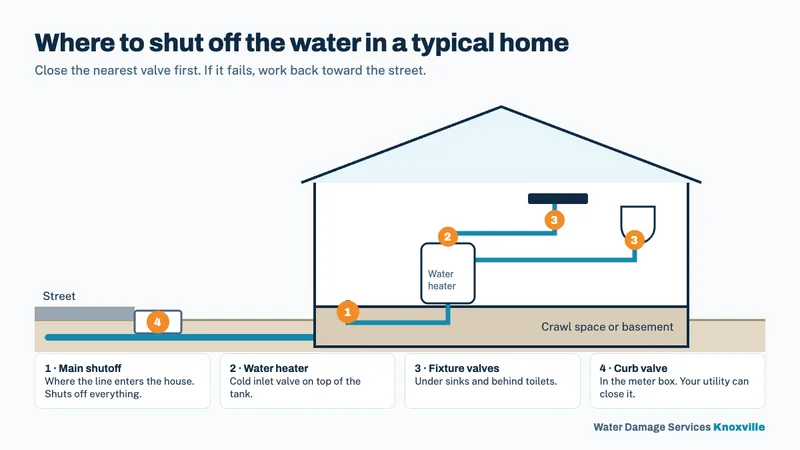
- Know where the main shutoff is, and leave the water off when a house is empty.
- Photograph damage before anything is moved, then call your insurer.
Which Greene County places have the older housing?
The table uses only what Wikipedia says about each place. Housing counts are given where the article has them.
| Place (ZIP) | What Wikipedia says | 2020 Census |
|---|---|---|
| Greeneville (37743) | County seat; recognized 1786; Historic District since 1974 | 7,503 housing units, 11.7% vacant |
| Mosheim (37818) | Foot of Big Ridge; began as Blue Springs around 1800 | 2,479 residents |
| Chuckey (37641) | On the Nolichucky River; depot built 1906 | Not stated |
| Afton (37616) | Unincorporated; parts annexed by Greeneville and Tusculum | Not stated |
What does a storm do to a Greene County roof?
A big storm can open a roof in minutes, and the rain comes in after. On April 27, 2011, Wikipedia says an EF3 tornado hit Camp Creek, south of Greeneville, and damaged or destroyed over 175 homes. A second EF3 struck Horse Creek, southeast of town, and damaged or destroyed another 60 to 65.
That is an extreme event, but the lesson is common. Cover any open roof as soon as it is safe, keep the receipts, and read roof leak and storm water damage for what to photograph before a tarp goes up.
Wet floors are the other common case in older farmhouses and town houses alike. Water damaged floor repair covers hardwood, laminate and subfloors, and wet carpet drying covers the pad.
How do I tell if a leak is clean water or something worse?
Look at where it came from. The IICRC S500 standard puts supply lines and burst pipes in Category 1, washer or dishwasher leaks in Category 2, and sewage or outside surface water in Category 3.
- Category 1. A supply line or water heater. Dry quickly and most materials can be saved.
- Category 2. An appliance overflow. Porous materials such as carpet pad often need removal.
- Category 3. Sewage, creek water or runoff. The EPA advises calling a professional experienced with contaminated water.
If a drain has backed up, read sewage backup cleanup.
What will insurance cover near a river or creek?
A sudden plumbing leak is usually covered, but flood damage is not. The Insurance Information Institute says flood is excluded under standard homeowners and renters policies and needs a separate policy. The NAIC adds that ground water, rain runoff and snow melt are typically not covered either.
If you cannot tell which category your loss falls into, call your agent before signing a work order. The insurance claims guide lists what to save.
What should I do in the first 24 to 48 hours?
Stop the water, protect people, then start drying. The EPA says to dry water-damaged areas and items in the first 24 to 48 hours to prevent mold growth.
- Shut off the main water valve, and the power to wet areas if that is safe.
- Photograph and video the damage before moving anything.
- Call your insurer and ask what they need before work starts.
- Call a restoration team and ask how they will measure moisture and log drying.
- Keep indoor humidity below 60 percent, ideally 30 to 50, as the EPA advises.
The emergency page has a longer checklist, and mold after water damage covers what to do if growth has started. Restoration teams differ on which towns they cover, so confirm when they call.
Before you sign anything, read how to choose a restoration company and ask the restoration team for moisture readings at the start and at the finish. The structural drying guide explains what those readings mean, and drywall water damage repair covers what usually has to come out. For a wider look, see Jefferson City.
Sources: Greeneville, Tennessee; Mosheim, Tennessee; Afton, Tennessee; Chuckey, Tennessee; Nolichucky River (all Wikipedia, citing the 2020 Census where noted); EPA, A Brief Guide to Mold, Moisture and Your Home; IICRC S500; Triple-I, disasters covered by homeowners insurance; NAIC homeowners insurance.