The short version
Water mitigation stops water damage from spreading. A crew inspects, extracts standing water, removes wet materials that cannot be dried, sets dehumidifiers and air movers, and records daily moisture readings. The EPA advises drying wet areas in the first 24 to 48 hours. Rebuilding, called restoration, comes after.
What is water mitigation?
Water mitigation is the work that stops water damage from getting worse. It means extracting standing water, removing materials that cannot be saved and drying the structure with dehumidifiers and air movers. Water mitigation is the first phase of the job. Rebuilding comes after.
People also call it water damage mitigation, emergency water mitigation or structural drying. The goal is the same in every case: get the building dry before wet drywall, subfloor and framing start to grow mold or break down. The EPA advises drying water-damaged areas and items in the first 24 to 48 hours to prevent mold growth.
What follows is a plain explanation of what a mitigation job involves, so you know what to expect and what to ask.
Is water mitigation the same as water damage restoration?
No. Mitigation limits the damage and dries the building. Restoration repairs and rebuilds what the water damaged. One restoration team often does both, but they are different phases with different goals, and insurers treat them differently.
| Mitigation | Restoration | |
|---|---|---|
| Goal | Stop the spread, remove water, dry the structure | Put the property back to its pre-loss condition |
| Timing | Starts as soon as the source is stopped and the property is safe to enter | Starts after the structure reads dry |
| Typical work | Extraction, removing wet pad and drywall, drying equipment, moisture readings | New drywall, insulation, flooring, trim, paint |
| Insurance angle | Policies expect you to take reasonable steps to prevent further damage; keep every receipt | Usually waits for the adjuster's assessment and written line-by-line bids |
The insurance row comes from guidance by the Insurance Information Institute (Triple-I). The rest is how the two phases generally work. Restoration teams differ in what they offer, so confirm directly whether one company will handle both. The water damage glossary explains terms you will see on a work authorization.
What does a water mitigation crew do on the first visit?
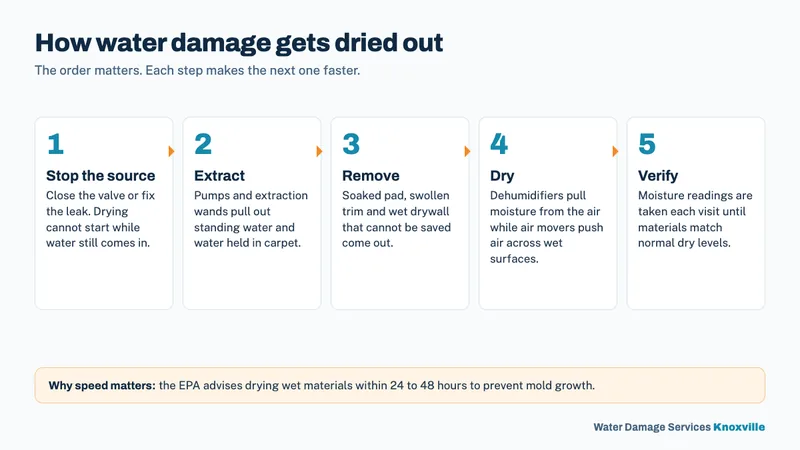
The first visit is inspection, water extraction, tearing out what cannot dry and setting equipment. A good restoration team also records the starting conditions so the job can be measured against them. Expect the steps below, though the order shifts with the damage.
- Stop the source and make the area safe. A plumber or you close the valve first. The restoration team checks for electrical hazards and slip risks.
- Inspect and classify the water. Category 1 is clean water from a supply line or burst pipe. Category 2 is grey water from a washer, dishwasher or toilet overflow without waste. Category 3 is grossly contaminated: sewage, rising flood water from rivers and streams, and outside surface water. These are the IICRC S500 categories.
- Map the moisture. A moisture meter and, often, a thermal camera show how far the water traveled into walls, subfloor and ceilings. Readings are taken at marked points so they can be repeated.
- Extract standing water. Pumps and extraction wands pull water from floors and carpet. See water removal and extraction for more on this step.
- Remove what cannot be dried. Soaked pad, swollen trim and saturated drywall often come out. After a flood, the drywall may be cut above the water line so the cavity can dry.
- Set drying equipment. Air movers push air across wet surfaces. Dehumidifiers pull moisture out of the air.
- Record daily readings. Each visit adds moisture readings to a dry log until the materials are dry.
The category matters more than most people expect. Category 3 water usually means porous materials such as carpet and pad are removed, not dried. For sewage, read sewage backup cleanup and do not handle it yourself. The EPA says to call a professional experienced with buildings damaged by contaminated water.
How does moisture mapping and wet-material removal work?
Moisture mapping is the survey that decides what stays and what goes. Water wicks upward in drywall and travels along framing, so the damp area is often larger than the stain you can see. The map shows the real edge of the wet zone.
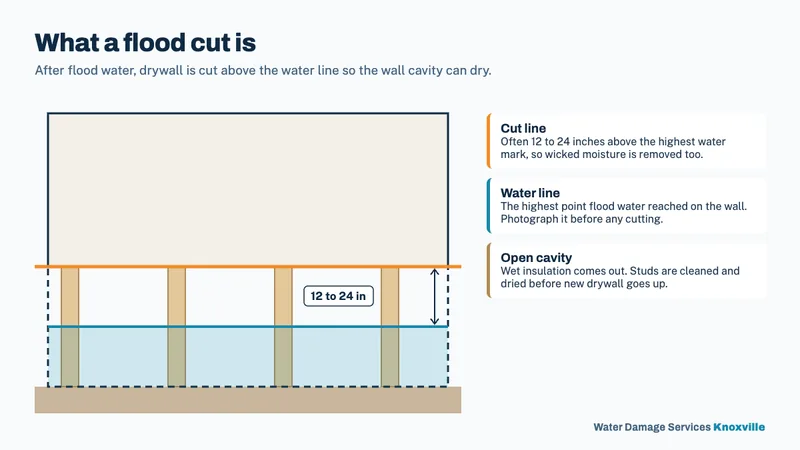
Removing wet material feels drastic, but it speeds drying and cuts the risk of hidden mold. Ask the restoration team to photograph the wall or floor before removal and to show you the meter readings that justified it. If you are covered, that record also helps your insurer.
How long does water mitigation take, and how do you know it is done?
Drying should begin in the first 24 to 48 hours, which is the EPA's window for preventing mold growth. How long the building then takes to dry depends on the water category, the materials and how far the water spread. Ask the restoration team for the dry-log target rather than a guess up front.
The job is done when the readings say so, not when the equipment has run for a set number of days. A restoration team should compare wet areas against readings from an unaffected area of the same material and stop when they match. The EPA advises keeping indoor humidity below 60 percent, ideally between 30 and 50 percent relative humidity, so that is the range to expect in the air once drying finishes.
Equipment should come out when the dry log shows the structure is dry. If it is still running with no readings to explain why, ask what number it is trying to reach.
What is a dry log, and what should it show?
A dry log is the daily record of moisture readings, equipment and conditions. It is the proof that drying worked and the main defense if an insurer or a neighbor questions the bill. Ask to see it at every visit.
- Moisture readings at the same marked spots each day, with the date.
- Indoor humidity and temperature so you can compare against the EPA range above.
- Equipment on site: how many air movers and dehumidifiers, and where.
- Equipment changes: anything added, moved or removed, with the reason.
- Photos of the affected areas before, during and after.
Can I rent a dehumidifier instead of hiring water mitigation?
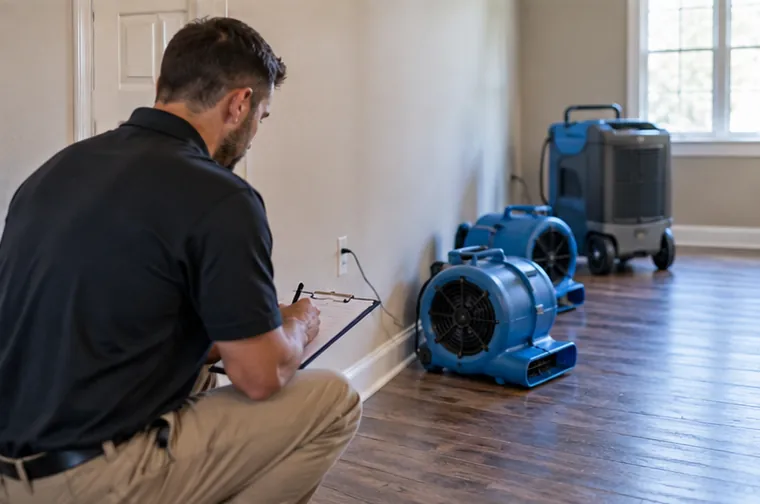
For a small, clean spill caught fast, yes, often. For anything bigger, a rented dehumidifier alone usually is not enough, because water in walls, subfloor and insulation is out of reach of a household unit.
| Situation | DIY with a rented dehumidifier | Professional drying |
|---|---|---|
| Small clean spill on a hard floor, dried quickly | Often fine: mop, run fans, watch it | Not usually needed |
| Water soaked carpet and pad | Risky: pad holds water under the carpet | Better: extraction and pad removal |
| Water inside walls or under flooring | No way to measure what is wet | Needed: moisture meters and targeted drying |
| Grey or black water | Unsafe to handle yourself | Needed |
| Insurance claim involved | No dry log to show the adjuster | Readings and photos support the claim |
If you do go the DIY route, the EPA's 24 to 48 hour window still applies. Check for hidden dampness afterward, and call a restoration team if a musty smell or a spot that will not dry shows up. The mold after water damage guide covers what to look for.
How much does water mitigation cost?
National figures put water extraction at a few dollars a square foot and whole jobs in the low thousands. According to Fixr (updated January 31, 2025), water damage restoration overall runs from $1,200 to $5,000, with a national average of $3,000. These are national figures. Knoxville quotes vary with the damage, the restoration team and the season.
| Fixr national range | Cost |
|---|---|
| Extraction, clean water, per sq ft | $3.75 to $4.25 |
| Extraction, gray water, per sq ft | $4.10 to $6.50 |
| Extraction, black water, per sq ft | $7 to $7.50 |
| Class 1 damage (flat range) | $150 to $400 |
| Class 2 damage (flat range) | $500 to $1,000 |
| Class 3 damage (flat range) | $1,000 to $3,000 |
Source: Fixr, "Water Damage Restoration Cost," updated January 31, 2025. This site cannot tell you what any restoration team will charge. For a fuller breakdown, see water damage restoration cost in Knoxville.
Does insurance pay for water mitigation?
Often, when the water came from a covered source. The NAIC says water damage from a home's plumbing is typically covered, while damage from ground water, rain runoff or snow-melt is not. Triple-I adds that standard policies exclude flood and that sewer backups usually need a separate endorsement.
Triple-I's advice after a loss is practical.
- Contact your agent or insurer immediately.
- Take reasonable steps to protect the property from further damage. Mitigation is exactly that.
- Hold off on major permanent repairs until the adjuster has assessed the damage.
- Photograph or video the damage, and do not throw out damaged items until the adjuster has visited.
- Save receipts for what you spend and submit them for reimbursement.
- Get written bids with materials and prices listed line by line.
Read the next section before you sign anything. See water damage insurance claims in Knoxville for the full claim sequence.
How do I read a mitigation invoice and spot problems?
A good invoice lists every charge on its own line with a quantity. A bad one shows a single lump sum. Homeowners often complain online about surprise bills and even liens after a mitigation job, and most of those fights start with an invoice nobody could check.
Ask for these before you pay or sign off:
- Line items. Extraction, demolition, equipment and labor each priced separately.
- Equipment counts and days. How many air movers and dehumidifiers, on site for how many days. Match them to the dry log.
- The dry log. Daily readings that justify keeping the equipment running.
- Photos of the removed materials and the affected rooms.
- Insurance coordination. Whether the restoration team bills the insurer directly or you, and what happens if the insurer pays less.
Warning signs include a total quoted over the phone with no inspection, pressure to sign before the adjuster is called, and equipment still running with no readings to explain it. If a claim is wrongly denied, the Tennessee Department of Commerce and Insurance takes complaints through its online form for policies written in Tennessee.
What should I ask before signing a work authorization?
Read it first, and do not sign a blank or partly filled form. A work authorization is a contract. It may include an assignment of benefits, a clause that lets the restoration team bill your insurer directly, or terms about liens if you do not pay.
- Is the scope limited to mitigation, or does it commit me to restoration too?
- Is pricing per item, per day or a flat total, and what changes it?
- Who pays if my insurer covers only part of the bill?
- Does the form assign my insurance benefits to the restoration team?
- Will I get a dry log and photos at the end?
- When will equipment come out, and what reading decides that?
Restoration teams differ on all of these. Confirm directly rather than assume. The restoration team sets its own terms and this site is not a party to the contract.
What happens after water mitigation?
Once the structure reads dry, equipment comes out and the rebuild can start. That means insulation, drywall, flooring, trim and paint. Your insurer's adjuster usually inspects before permanent repairs begin, so do not start rebuilding on your own.
Keep the dry log, photos and invoices with your claim file. If something musty appears weeks later, the log shows what was dried and how. For a basement with repeated water, see basement flooding cleanup. If water is still coming in, start with emergency water damage restoration.
Knox County takes part in the National Flood Insurance Program, and properties outside mapped flood zones still flood from runoff, blocked drains, sinkholes and undersized pipes. Flood maps are on KGIS.
Sources: EPA mold and moisture guide; EPA, Mold Cleanup in Your Home; IICRC S500; Fixr, Water Damage Restoration Cost; Triple-I, Settling insurance claims after a disaster; Triple-I, Which disasters are covered; NAIC, Homeowners Insurance; Tennessee Department of Commerce and Insurance; Knox County Stormwater, Floodplain.