For Clinton and Anderson County homeowners
For water damage restoration in Clinton, TN, shut off the main valve, photograph everything and start drying in the first 24 to 48 hours. Ridge runoff and creek water count as flood-type water, which usually needs a professional. We take requests from Clinton, Norris, Oliver Springs, Andersonville and Rocky Top.
Which Anderson County addresses outside Oak Ridge do you take requests from?
Requests come in from Clinton (37716 and 37717), Norris (37828), Oliver Springs (37840), Andersonville (37705), Rocky Top (37769) and Briceville (37710). A restoration team confirms whether they can reach your address when they call. Oak Ridge has its own page: see water damage in Oak Ridge. North of Rocky Top, Campbell County is covered on the LaFollette and Jacksboro page, and Morgan County on the Wartburg page.
Clinton is the county seat of Anderson County and had 10,056 residents at the 2020 Census. The other four places are much smaller, and each has a different kind of housing and a different relationship to water.
Why does the Clinch River matter for Clinton homes?
Clinton sits right on the Clinch River, and the stretch beside town is technically part of Melton Hill Lake. That lake was created by Melton Hill Dam, about 35 miles downstream, so the water level is a managed one. Wikipedia also notes that the city is ringed by long, narrow ridges, with Lost Ridge inside a bend of the river.
Ridges mean runoff. Rain that runs off a slope ends up against foundations and in crawl spaces, and that is a more common cause of wet floors than the river itself. If water came in from outside the house, it is flood-type water, which the IICRC S500 standard classes as Category 3. Read flood cleanup before you touch it.
What kinds of older buildings does Clinton have?
Clinton has been a town since 1801, when it was founded as Burrville, and the railroad and coal years of the 1890s turned it into a real downtown. Wikipedia lists a Southern Railway depot from that decade and a sock mill, Magnet Knitting Mills, that opened in 1906. That history says the town has old commercial and residential blocks. It does not say how old any given house is, so look up your own.
- Houses from before 1978 may have lead paint. The EPA's Renovation, Repair and Painting rule covers paid work that disturbs it.
- Old plumbing tends to fail at joints. Our burst pipe guide shows where to look.
- Older downtown buildings often have apartments above shops, so a leak can run through several units.
How is Norris different from the rest of the county?
Norris is a planned town. TVA built it in 1933 for the workers building Norris Dam on the Clinch River, and it had 1,599 residents in 2020. Wikipedia says the houses followed twelve basic designs, each with a porch and a fireplace, built from local wood and stone, and that they were among the first all-electric homes.
The town was added to the National Register of Historic Places in 1975 as a district of 340 buildings. That has a practical meaning for a wet house. Ask the restoration team to describe how they will dry the structure in place, and check the rules for your property before anything is torn out. Original fireplaces and stone also matter: a chimney that leaks around the flashing wets the wall beside it for a long time before a stain shows.
What should owners near Norris Lake and Rocky Top watch for?
Rocky Top took the name Lake City in 1936, after Norris Dam created Norris Lake, and carried it until it formally became Rocky Top on June 26, 2014. The town lies in the hills of northern Anderson County, with I-75 running through its two exits. Wikipedia counts 811 housing units there, and 13.3% of them were vacant at the 2020 Census.
That vacancy number is a reminder for owners who live elsewhere. A rental or second home that sits empty can leak for weeks before anyone sees it.
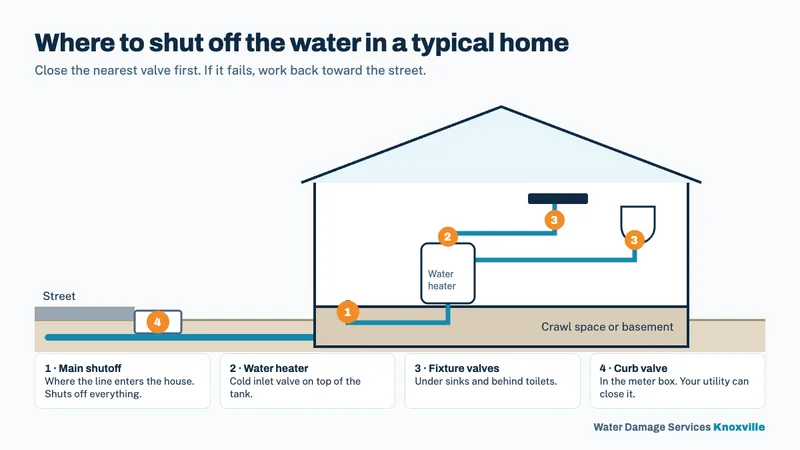
- Know where the main shutoff is, and leave the water off when the place is empty.
- Keep the heat on in cold weather. The American Red Cross says to leave it no lower than 55 F when you are away.
- Ask a neighbor or property manager to walk through after a hard freeze or storm.
- Photograph any damage before anything is moved, then call your insurer.
Which Anderson County towns have the most older housing?
Most of them, in different ways. The table below uses only what Wikipedia says about each place and what the 2020 Census counted.
| Town (ZIP) | What Wikipedia says | Housing units, share vacant |
|---|---|---|
| Clinton (37716) | On the Clinch River; founded 1801; ringed by narrow ridges | 4,756, 6.9% vacant |
| Norris (37828) | TVA planned town of 1933; historic district since 1975 | 768, 8.3% vacant |
| Oliver Springs (37840) | Founded 1821; mineral springs; Walden Ridge just beyond the hilltops | 1,508, 8.2% vacant |
| Rocky Top (37769) | Coal Creek stream; Norris Lake since the 1930s | 811, 13.3% vacant |
| Andersonville (37705) | Reached from Clinton by State Route 61 | Not stated |
What is the water situation in Oliver Springs?
Oliver Springs was founded in 1821 as Winter's Gap, and its name comes from natural mineral springs that drew resort visitors for decades. The big hotel burned in 1905 and the town covered the springs instead of rebuilding. Wikipedia says old water conduits and reservoirs can still be seen on the site.
The town sits where the Ridge-and-Valley meets the Cumberland Plateau, with Walden Ridge just beyond the hilltops. Slopes that steep move water fast. Gutters that dump at the foundation, or a driveway that tilts toward the garage, will deliver water to the same place every storm. Fixing the grading is cheaper than repeated drying, and our basement flooding guide explains how outside water gets in.
How do I tell if a leak is clean water or something worse?
Look at where it came from. The IICRC S500 standard puts supply lines and burst pipes in Category 1, washer or dishwasher leaks in Category 2, and sewage or outside surface water in Category 3. The category decides what can be dried and what must be thrown away.
- Category 1. A supply line or a failed water heater. Dry quickly.
- Category 2. A washer or dishwasher overflow. Porous materials often need removal.
- Category 3. Sewage, creek water or runoff. The EPA advises calling a professional experienced with contaminated water.
For a drain that has backed up, read sewage backup cleanup.
What will insurance cover in a river and lake town?
A sudden plumbing leak is usually covered, but flood damage is not. The Insurance Information Institute says flood is excluded under standard homeowners and renters policies and needs a separate policy. The NAIC adds that ground water, rain runoff and snow melt are typically not covered either.
Living near the Clinch River or Norris Lake does not change the rule. If you are unsure which category your loss falls into, call your agent before you sign a work order. Our insurance claims guide lists what to photograph and save.
What should I do in the first 24 to 48 hours?
Stop the water, protect people, then start drying. The EPA says to dry water-damaged areas and items in the first 24 to 48 hours to prevent mold growth, so the clock matters.
- Shut off the main water valve, and the power to wet areas if you can do it safely.
- Photograph and video everything before moving it.
- Call your insurer, and ask what they need before work starts.
- Call a restoration team and ask what they will measure and how they will document drying.
- Keep indoor humidity below 60 percent, ideally 30 to 50, as the EPA recommends.
The emergency page has a longer checklist, and mold after water damage covers what to do if growth has started. Restoration teams differ on which towns they drive to, so confirm coverage when they call. Nearby guides: Powell and Karns and Hardin Valley.
Sources: Clinton, Tennessee; Norris, Tennessee; Oliver Springs, Tennessee; Rocky Top, Tennessee (all Wikipedia, citing the 2020 Census); EPA, A Brief Guide to Mold, Moisture and Your Home; IICRC S500; Triple-I, disasters covered by homeowners insurance; NAIC homeowners insurance; American Red Cross, frozen pipes.