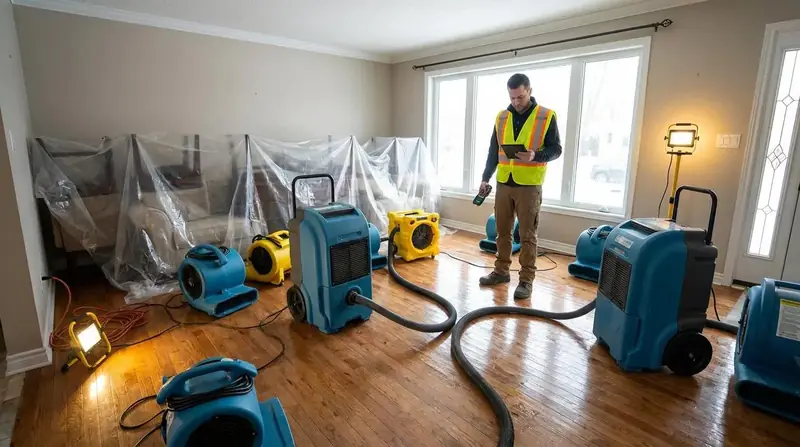
For Alcoa-area homeowners
In Alcoa, Louisville, Rockford and Friendsville, shut off the main valve, turn off power to wet rooms and photograph everything before cleanup. Say whether the water came from a pipe or from the Little River, since river water is Category 3 and usually means removing soaked porous materials.
Which Alcoa, Louisville, Rockford and Friendsville addresses do you take requests from?
Requests come in from Alcoa (ZIP 37701), Louisville (37777), Rockford (37853) and Friendsville (37737), all in Blount County. The restoration team confirms whether they can reach your address when they call you.
Alcoa is the largest of the four, with 10,978 residents at the 2020 Census, according to Wikipedia. Louisville had 4,384, Friendsville 896 and Rockford 822. For Maryville, Townsend and Walland, use our Maryville page.
How did Alcoa's company-town layout shape its homes?
Alcoa began as a planned town for aluminum plant workers, and that plan still sets the street pattern. The city was known as North Maryville until it was incorporated as Alcoa in 1919, named for the Aluminum Company of America.
By 1914 the company had completed its first land purchase and started building the smelter and 150 houses for employees. Wikipedia counts 3,358 people living in 700 houses by 1920. In the early 1950s the company began selling its housing to employees, so these houses have had many private owners since.
What that means for a leak: the oldest houses date to the company's first building push in the 1910s, and plumbing, flooring and wall materials may have been replaced piecemeal. Ask the restoration team to check what is behind a wet wall before deciding how much to open.
Which Alcoa neighborhoods did the original plan name?
The original plan had four sections, and the old names still help when you are describing where you live. This is how Wikipedia lays them out.
| Section | Where it sits | Nearby landmark |
|---|---|---|
| Vose | North part of the planned town | Around Springbrook Park |
| Springbrook | North part of the planned town | Around Springbrook Park |
| Bassel | South part of the planned town | Around the South Plant |
| Hall | South part of the planned town | Around the South Plant |
| Oldfield | Between the planned town and Maryville, annexed later | Closest to Maryville |
When you call, give the cross streets and the nearest park or plant, since several Alcoa streets sit within a short drive of Maryville ones.
Does the Little River flood homes in Alcoa and Rockford?
The Little River can put water into low ground, and it is the river to watch for both towns. Wikipedia says it rises near the heart of the Smokies, flows through the eastern section of Alcoa and empties into the Tennessee River near Louisville.
River water that enters a house is Category 3 under the IICRC S500 standard, and Triple-I says flood damage is excluded under standard homeowners policies. See our flood cleanup guide and check an address on the FEMA Flood Map Service Center.
Stay out of moving water. Ready.gov says six inches of moving water can knock a person down.
What is the low head dam in Rockford, and why does it matter?
Wikipedia describes a low head dam beside the old Rockford Manufacturing Company, a yard cordage factory, as a dangerous feature on the Little River and the site of numerous fatalities. Treat it as a reason to keep clear of the water near it, in flood or not.
Rockford is named for a rocky ford over the Little River that early travelers used between Knoxville and Maryville, and it incorporated in the early 1970s to avoid being annexed by Alcoa or Maryville. It is a small place, with 822 residents and 386 housing units, 10.4 percent vacant. If you must check a property near the river after a storm, go with another person and stay on dry, solid ground.
How do the airport corridor and commercial strips change a water damage call?
If the wet property is a shop, office or rental, tell the restoration team that first. Wikipedia says the Hall Road Viaduct, finished in the 1940s, and the later growth of McGhee Tyson Airport led to commercial expansion in Alcoa.
The business side matters because insurance, tenants and landlords all enter the picture. Who owns the damaged contents? Who pays for the drying? Use our insurance claims guide to document the loss, and ask the restoration team whether they take commercial jobs, since restoration teams differ.
Why does a close-set neighborhood change how you handle a leak in Alcoa?
Alcoa is almost entirely urban, so a leak in one house can reach a neighbor's. Wikipedia reports 99.3 percent of residents in urban areas, with 4,632 households and 4,961 housing units across 15.92 square miles, and 6.6 percent of those units vacant.
That density has practical effects once water is moving:
- Tell the neighbors if water may be crossing a shared line, a fence-line drain or a wall you share.
- Ask the restoration team to check the ceiling or wall on the other side of any wet wall, not only the room you can see.
- If you rent, tell the landlord at once and photograph the damage before anything is moved.
- Keep every receipt. Triple-I says to save receipts for what you spend and submit them for reimbursement.
The Maryville-Alcoa Greenway links Springbrook Park to Maryville, and the two cities run into each other, so the Maryville page covers the neighboring streets across the line.
What water problems come with Louisville's Fort Loudoun Lake setting?
Louisville sits along the northern edge of Blount County, with Fort Loudoun Lake forming its northern border. Wikipedia gives the town a total area of 17.05 square miles, of which 13.18 percent is water.
The town was a flatboat and steamboat port after its settlement in the early 1800s. It was incorporated in 1851, and its downtown became a national historic district in 1974. If your Louisville house is in that older core, expect the restoration team to ask about age and materials. Newer homes in the surrounding area, along SR 334 (Louisville Road) and SR 333, tend to have the usual failure points. The cost guide covers what drives a bill.
Why do Friendsville and Rockford callers need a plan for distance?
Friendsville is entirely rural by census definition, and Rockford is half rural, so the restoration team may have further to drive than for Alcoa. Wikipedia places Friendsville along SR 333 (Miser Station Road), from Fort Loudoun Lake in the north to US 321 (Lamar Alexander Parkway).
Boat launches at Gallahar Creek and Whispering Cove put lake traffic near the town, and Pellissippi State Community College has a Blount County campus there. Use those as landmarks when you give directions. Residents in both towns skew older: median age is 48.0 in Friendsville and 49.8 in Rockford, and 27.6 percent of Rockford residents are 65 or older. Ask a relative or neighbor to be on the phone and at the house when the restoration team arrives.
What should you do first when water gets into an Alcoa-area home?
Stop the water, make the house safe and document the damage before cleaning up. In this order:
- Shut off the main valve. If it will not close, call your water utility to close the curb valve.
- Turn off power to wet rooms at the panel. Do not step into standing water near outlets.
- Photograph and film the damage. Triple-I says not to throw out damaged items until the adjuster visits.
- Call your insurance agent, then see emergency water damage restoration to reach a restoration team.
- Start drying. The EPA says to dry wet areas and items within 24 to 48 hours.
A frozen or split pipe is the other common start. The burst pipe guide covers it, and the full list of towns is on our service areas page.
Sources: Alcoa, Tennessee (Wikipedia); Louisville, Tennessee (Wikipedia); Rockford, Tennessee (Wikipedia); Friendsville, Tennessee (Wikipedia); IICRC S500; Ready.gov, floods; Triple-I, disasters covered by homeowners insurance; Triple-I, settling insurance claims; EPA, A Brief Guide to Mold, Moisture and Your Home.