For Jefferson City and Jefferson County homeowners
For water damage restoration in Jefferson City, TN, shut off the water, photograph everything and start drying in the first 24 to 48 hours. Lake overflow and runoff count as flood-type water, which usually needs a professional. We take requests from Jefferson City, Dandridge, New Market and White Pine.
Which Jefferson County addresses do you take water damage requests from?
Requests come in from Jefferson City (37760), Dandridge (37725), New Market (37820) and White Pine (37890). Strawberry Plains (37871) is covered on the Knoxville list, which you can find on our service areas page. The restoration team confirms whether they can reach your street when they call.
Jefferson City had 8,419 residents at the 2020 Census, according to Wikipedia. It sits between two TVA lakes and two valleys, so the likely source of water is not the same from one end of the county to the other.
How do Cherokee Lake and Douglas Lake affect homes here?
Both lakes are managed reservoirs, so a sudden lake flood is rarely the cause of a wet house. Cherokee Lake, on the Holston River, touches the northwest edge of Jefferson City. Douglas Lake, on the French Broad River, runs along Dandridge and the southern side of White Pine.
The shoreline is the bigger issue. Wikipedia says Cherokee Lake has nearly 400 miles of shoreline and a normal yearly level swing of about 27 feet. Boat docks, lake cabins and walkout basements sit close to that edge, and the soil around the basin is described as silt loam, slate and red clay. Clay-heavy ground soaks up rain slowly, so a downpour tends to run toward the foundation instead of into the yard.
If water reached your house from the outside, treat it as flood-type water and read flood cleanup first.
Why is downtown Dandridge behind a levee?
Most of downtown Dandridge sits below the high-water mark of Douglas Lake, and a stone levee holds the lake back. Wikipedia explains that Douglas Dam, finished in 1943, would have put almost the whole downtown under water. Residents petitioned for relief, and TVA built a levee behind Town Hall that runs along Main Street.
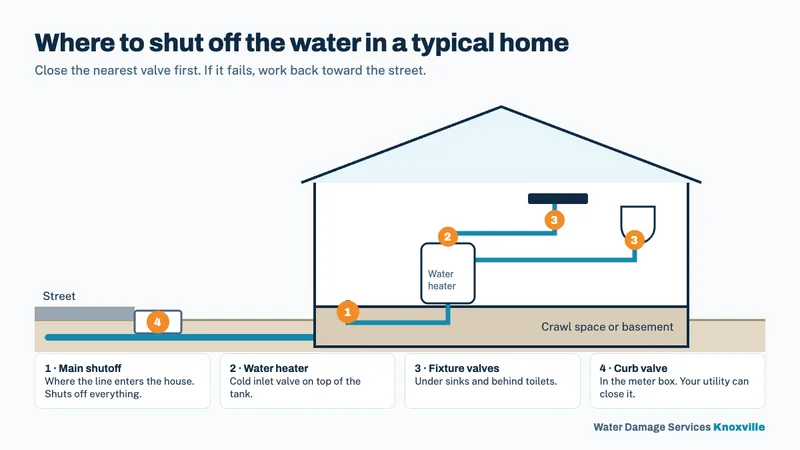
The levee guards against the lake. It does nothing for a failed water heater, a clogged drain or rain that collects in a low lot. Owners of older storefronts and houses near Main Street should know where their main shutoff is.
What is different about renting and older housing in Jefferson City?
Jefferson City has a lot of rental housing, and that changes who calls about damage. Carson-Newman University, founded in 1851, sits next to downtown, and Wikipedia gives the city a median age of 32.6. The 2020 Census counted 3,541 housing units, with 13.1% vacant and a rental vacancy rate of 12.3%.
Empty rentals share one risk with empty lake cabins: nobody is there to see a drip. Tenants and landlords each have a part in the response.
- Tenants should photograph the damage, shut off the water if they can, and tell the landlord in writing. Our guide for apartments and condos covers who pays for what.
- Landlords should ask the restoration team how they will document drying before any repair starts.
- Houses built before 1978 may have lead paint, and the EPA's Renovation, Repair and Painting rule applies to paid work that disturbs it.
What does the Lost Creek valley mean for New Market?
New Market lies in the valley of Lost Creek, a tributary that flows west to the Holston River. Water from surrounding land gathers in valleys like that one. Houses at the bottom of a slope, or below a driveway that tilts toward the garage, take runoff first.
The town has older buildings too. Wikipedia lists New Market Presbyterian Church, built in 1885 and on the National Register of Historic Places since 1998. A building like that should be dried in place and handled carefully, so ask the restoration team about their plan before any wall is opened. For a wet lower level, our basement flooding guide shows how outside water gets in.
What should White Pine owners near I-81 and Douglas Lake know?
White Pine has been rebuilt once already. A fire in 1905 destroyed much of downtown, and the town did not incorporate again until 1915. Later, I-81 pulled businesses out to the interchanges, so some older downtown buildings now sit quiet or have changed use.
Wikipedia puts the southern and southeastern edge of town on Douglas Lake. A building that stands unused for a while can develop a roof or plumbing leak that nobody notices. Walk through any vacant property after storms, and read roof leak and storm damage if water is coming from above.
How do the Jefferson County towns compare?
The table lists what Wikipedia says about each place. Housing figures are the 2020 Census counts where the article gives them.
| Town (ZIP) | Water setting | Housing units, share vacant |
|---|---|---|
| Jefferson City (37760) | Edge of Cherokee Lake; formerly Mossy Creek | 3,541, 13.1% vacant |
| Dandridge (37725) | Douglas Lake shore; stone levee behind downtown | 1,339, 10.2% vacant |
| New Market (37820) | Lost Creek valley, flows to the Holston River | Not stated |
| White Pine (37890) | Douglas Lake along the south and southeast edge | Not stated |
How do I tell clean water from contaminated water?
Start with the source, because the IICRC S500 standard sorts water into three categories by where it came from. The category decides what the restoration team can dry and what has to be thrown out.
- Category 1: a supply line or burst pipe. Most materials can be dried.
- Category 2: a washer, dishwasher or toilet overflow without waste. Carpet pad and similar porous items often come out.
- Category 3: sewage, rising river or lake water, and outside surface water. The EPA advises calling a professional experienced with contaminated water.
A backed-up floor drain is Category 3. See sewage backup cleanup before you step into it.
Will insurance pay when the lake or runoff is the cause?
Usually not. The Insurance Information Institute says flood damage is excluded from standard homeowners and renters policies and needs a separate policy, and the NAIC says ground water and rain runoff are typically not covered either. Water from a leaking pipe or roof is generally covered.
A home next to Cherokee Lake or Douglas Lake gets no special rule. Ask your agent which side your loss falls on before you sign a work order, and read the insurance claims guide for what to document.
What should I do first when water gets in?
Stop the source, stay safe, and begin drying. The EPA says to dry water-damaged areas and items in the first 24 to 48 hours to prevent mold growth.
- Turn off the main valve, and the power to wet rooms only if you can reach the panel safely.
- Take photos and video before anything is moved or thrown out.
- Phone your insurer and ask what they need before work begins.
- Call a restoration team and ask which readings they will take and how they will log drying.
- Aim to keep indoor humidity under 60 percent, ideally 30 to 50, as the EPA recommends.
The emergency page has a fuller checklist, and mold after water damage helps if growth has started. Coverage areas vary by company, so ask when they call. Nearby pages: Morristown, Seymour, Sevierville, Rutledge and Newport.
Sources: Jefferson City, Tennessee; Dandridge, Tennessee; New Market, Tennessee; White Pine, Tennessee; Douglas Lake; Cherokee Lake (all Wikipedia, citing the 2020 Census); EPA, A Brief Guide to Mold, Moisture and Your Home; IICRC S500; Triple-I, disasters covered by homeowners insurance; NAIC homeowners insurance.