For Powell homeowners
Shut off the water, keep away from wet electrics and photograph everything. Powell is unincorporated, so Knox County handles drainage, floodplain and permit questions. Most damage here comes from runoff off the ridges and water in crawl spaces. We take requests from ZIP 37849, Heiskell and nearby North Knoxville.
Which Powell addresses do you take requests from?
We take requests from Powell ZIP code 37849, and from nearby Heiskell (37754) and the North Knoxville ZIPs around Halls and Karns. A restoration provider confirms whether they can reach your address when they call.
Powell is not a city. It is an unincorporated community, recorded as a census-designated place, in Knox County, with 13,802 residents at the 2020 Census. It runs along the Emory Road corridor between Halls and Karns, just north of Knoxville.
Who handles stormwater and permits in Powell?
Knox County does. Because Powell is unincorporated, there is no town government. Drainage complaints, floodplain questions and building permits for repairs go to Knox County, not the City of Knoxville.
- Flood zone maps are on the KGIS map under the planning and zoning layers.
- The Knox County floodplain page explains the county's role in the National Flood Insurance Program and how to report drainage problems.
- Rebuilding after water damage may need a county permit, especially for structural or electrical work.
Why does Powell's valley location matter for water damage?
Powell lies in the Beaver Creek valley, between Copper Ridge and Beaver Ridge, two of the long narrow ridges typical of the Ridge-and-Valley Appalachians. Rain that falls on the ridges runs downhill toward the valley floor, where Beaver Creek runs and where many homes and roads sit.
Knox County's stormwater office notes that properties outside mapped flood zones still flood from runoff, blocked drains, sinkholes and undersized pipes. In a valley like Powell's, that is the more common risk than the creek leaving its banks. Homes at the foot of a slope, and homes with crawl spaces or basements, see it first.
What can Powell homeowners do before the next heavy rain?
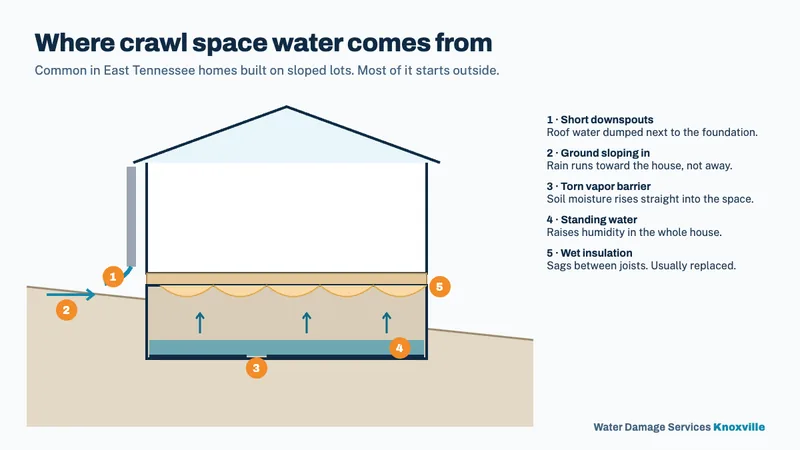
- Extend downspouts so roof water lands several feet from the foundation.
- Check that the ground slopes away from the house on every side.
- Look in the crawl space after a big storm for standing water, sagging insulation or a torn vapor barrier.
- Test the sump pump if you have one, and consider a battery backup.
- Check whether your policy includes sewer and drain backup cover.
What are the most common water damage calls in Powell?
- Water and high humidity in crawl spaces after heavy rain
- Burst pipes in crawl spaces and garages during freezes
- Water heater and washer leaks in older and newer homes alike
- Runoff entering basements and lower levels at the foot of slopes
- Slow leaks under sinks and showers that soften subfloors
For standing water under the house, see water removal and extraction. If water is still coming in, start with emergency water damage restoration. Nearby guides: Farragut and Oak Ridge.
What is the difference between crawl space drying and encapsulation in Powell?
In Powell, crawl space drying fixes water damage that has already happened, while encapsulation tries to stop moisture coming back. Drying pumps out water, removes wet insulation and runs equipment until readings are normal. Encapsulation seals the crawl space with a heavy liner and controls humidity. They solve different problems.
| Question | Crawl space drying | Encapsulation |
|---|---|---|
| When it happens | After a leak, burst pipe or runoff event | After the space is dry, as an improvement |
| What it involves | Extraction, removing wet insulation, dehumidifiers and air movers | Sealed liner on the floor and walls, closed vents, often a dehumidifier |
| What it fixes | The current water and wet materials | Ongoing ground moisture and humidity |
| Insurance | Sudden water damage may be covered | Usually treated as an upgrade. Ask your insurer. |
Encapsulating over a wet crawl space traps the problem. The space has to be dried first, and the runoff from the Beaver Creek valley ridges still has to be directed away from the house.
What happens when runoff floods a Powell basement or crawl space?
When runoff from the ridges enters a Powell home, it is treated as contaminated water. The IICRC S500 standard puts outside surface water in Category 3, so soaked carpet, pad and insulation are usually removed rather than dried. Insurance is different too: outside flood water is generally a flood policy matter, not homeowners.
- Do not walk or drive through moving water. Ready.gov warns that six inches of moving water can knock a person down, and one foot can sweep a vehicle away.
- Keep away from wet outlets and the electrical panel until power is off.
- Photograph the water line on walls and the path the water took into the house.
- Call your insurer early. Ask whether you have flood cover through the NFIP or a private policy.
See our flood cleanup guide and basement flooding guide for what the cleanup involves.
Does a private well change water damage cleanup in Powell?
Yes, in a few practical ways. If your Powell, Heiskell, Halls or Karns home runs on a private well instead of public water, the shutoff works differently. With a well, there is no utility curb valve to fall back on, so you need to know where your own shutoff is and how to switch off the well pump.
- Public water. Close the main shutoff. If it fails, your water utility can close the curb valve at the meter.
- Private well. Turn off the breaker for the well pump, then close the valve after the pressure tank.
- Wellhead under water. If flood water reached the wellhead, do not drink the water until it has been tested. Your local health department can advise on testing.
- Pump and tank in the crawl space. Have the electrics checked before turning the pump back on.
Tell the restoration provider which type you have when they call, since it changes how they stop the water.
Sources: Powell, Tennessee (Wikipedia, citing the 2020 Census); Knox County Stormwater; IICRC S500; Ready.gov, floods.