The short version
After a sump pump failure, keep out of standing water until the power is safe, stop adding water, photograph the pit, and call your insurer and a restoration team. Pumps usually fail from power loss, a stuck float, a clogged intake or a blocked discharge. Sump overflow water is treated as contaminated until confirmed.
What should I do first when my sump pit overflows?
Stay out of the water until the power is safe, then deal with the source. Standing water in a basement can reach outlets, appliances and the panel, and water that has come up through a pit may be contaminated.
- Do not walk into standing water if outlets, cords, a furnace or the electrical panel could be touched by it.
- Turn off power to the basement at the breaker only if the panel is dry and you can reach it without stepping in water. Otherwise call your electric utility or an electrician.
- Stop adding water. Pause the washer and dishwasher and keep the tub and sinks off.
- Photograph the water line and the pit before anything is moved.
- Call your insurer and ask about your water backup endorsement.
- Call a restoration team for extraction and drying.
Ready.gov warns that six inches of moving water can knock a person down. Outside the house, never wade through moving water to reach a pump or a valve.
Why do sump pumps fail when the basement floods?
A sump pump fails when something stops it from starting, running or pushing water out. Rain is when the load is highest, so a weakness that went unnoticed in dry weather shows up as a flooded floor.
- Power loss. Storms that bring heavy rain often knock out power, and a pump on household current stops with it.
- A float switch that sticks or tangles. The pump never learns the pit is full.
- A clogged intake. Silt, gravel or debris blocks the pump from drawing water in.
- A blocked or frozen discharge line. The pump runs, but the water has nowhere to go and drains back into the pit.
- An undersized pump. It runs constantly and still loses to the inflow.
- Age and wear. A pump that has run for many seasons can burn out, often without warning.
The basement flooding guide gives the quick version. The sections below cover what to check and what to do next.
How do I troubleshoot a sump pump that stopped working?
Work from the safest check to the least safe, and call a professional as soon as electricity and water are in the same space. Use this table to match what you see to a likely cause.
| Symptom | Likely cause | Safe check | Who to call |
|---|---|---|---|
| Pump silent, pit full | No power, tripped breaker or GFCI, or a stuck float | Check whether other outlets and lights work. Do not reach into a full pit while the pump is plugged in. | Electrician, then plumber |
| Pump hums but does not move water | Clogged intake or a seized motor | Unplug it first. Look for debris at the base only if the cord is out and the area is dry. | Plumber or sump specialist |
| Pump runs, water stays high | Blocked, frozen or disconnected discharge line, or a pump too small for the inflow | Walk outside and look at the discharge outlet for ice, soil or a kinked hose. | Plumber or drainage contractor |
| Pump cycles on and off repeatedly | Water flowing back after each cycle, or a float set too low | Listen for water falling back into the pit when it stops. | Plumber |
| Loud rattling or grinding | Worn bearings or debris in the impeller | Note when it started, and unplug it if it sounds like metal on metal. | Plumber |
| Pit full, pump looks fine, drain smells | Sewer or drain backup, not just groundwater | Stay out of the water and do not use the plumbing. | Plumber, then a restoration team |
Never pull a pump out of a full pit while it is plugged in. If the pit is rising and you cannot tell why, stop and call.
Why does a sump pump stop during a power outage?
Because most sump pumps run on household electricity, and the outages that follow storms arrive with the rain. The pit keeps filling while the pump sits idle, and a basement can go from damp to flooded while the family is asleep.
A circuit that trips on ground fault, a loose plug or a breaker that was switched off for other work can look just like a power outage. Check those before assuming the pump itself is dead. For homes in rural parts of East Tennessee where outages run long after a storm, a backup power source for the pump is worth planning for.
What backup options keep a sump pump working?
The common choices are a battery backup pump, a water-powered backup pump and a generator. Each handles a different part of the risk, and a plumber or sump specialist can say which fits your pit and house.
| Backup | How it works | What to know |
|---|---|---|
| Battery backup pump | A second pump with its own battery takes over when the main pump or power fails | The battery has limited run time and needs testing and eventual replacement |
| Water-powered backup | Uses household water pressure to push pit water out, with no electricity | Needs a working water supply, and local rules and your plumber decide whether it is allowed |
| Generator | Supplies power to the main pump and other essentials during an outage | Must be set up safely, outdoors and away from the house, and does not help if the pump itself has failed |
Pair any of these with a high-water alarm that you can hear or that sends a phone alert. A pump that fails quietly in a finished basement is the expensive kind of failure.
Is sump pump failure covered by insurance?
It depends on the cause, the water source and the exact wording of your policy. Triple-I says flood damage is excluded under standard homeowners and renters policies, and that sewer backups are not covered under a typical homeowners policy. That cover is bought as a separate product or an endorsement.
Call your insurer and ask whether your water backup or sewer backup endorsement includes sump overflow. Get the answer in writing if you can. Triple-I also notes that policies do not cover damage from lack of maintenance, so keep records of pump tests and service.
For the full process, from the first call to appraisal rights, see the water damage insurance claims guide. Hold off on permanent repairs until the adjuster has assessed the damage, keep receipts, and photograph everything.
What water category is a sump pump overflow?
Treat it as contaminated until a restoration team says otherwise. Under IICRC S500, Category 1 is clean water such as a supply line, Category 2 is grey water, and Category 3 is grossly contaminated water, including sewage and outside surface water.
Groundwater and runoff that has come in from outside fall under the outside surface water line in Category 3. A pit that has overflowed through a floor drain or alongside a sewer backup is a Category 3 situation as well. The restoration team confirms the category on site, and it decides what can be saved. The sewage backup guide covers the contaminated case.
How is a basement dried after a sump pump failure?
The standing water comes out first, then wet materials are removed or dried, then the space is dried and checked. The EPA says to dry water-damaged areas and items in the first 24 to 48 hours to prevent mold growth.
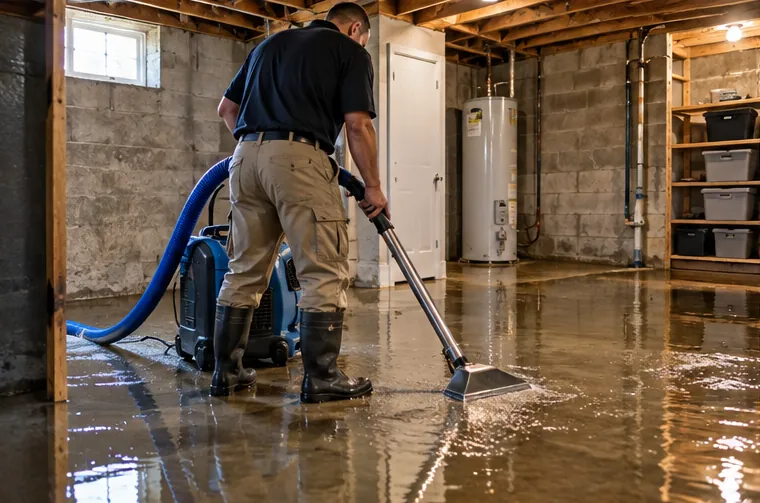
- Extraction removes standing water with pumps and wet vacuums.
- Removal of wet materials takes out carpet, pad and wet drywall or insulation that cannot be dried or that was soaked by contaminated water.
- Drying uses air movers and dehumidifiers, with moisture readings taken to show progress.
- Cleaning and disinfecting of hard surfaces, especially after Category 3 water.
- Final readings confirm that materials are dry before anything is rebuilt.
Read more about water removal and extraction and water mitigation. If the water came from outside the house, flood cleanup explains that process. Restoration teams differ in what they offer, so confirm the scope with the one you hire.
What can be saved and what has to go?
Hard surfaces and items that did not soak in contaminated water are the best candidates. Porous materials that sat in Category 3 water usually are not.
The CDC says to clean up and dry out fully and quickly, in the first 24 to 48 hours, and to remove soaked carpets and upholstery that cannot be dried right away. Keep photos of anything you throw out. Triple-I advises that you do not discard damaged items until the adjuster has visited. If mold shows up, see mold after water damage.
Ask the restoration team to note where the water entered and how high it rose. That detail helps the plumber judge whether the pump was overwhelmed or simply stopped, and it helps the adjuster understand what happened. Do not run the pump again to clear leftover water until the electrical side of the basement has been checked and is dry.
How do I keep my sump pump from failing again?
Test it, give it a backup, and keep the water path clear. The water damage prevention guide has the full seasonal checklist.
- Pour water into the pit before storm season and watch the pump start, run and stop.
- Clear debris from the pit and make sure the float moves freely.
- Check the discharge outlet outside for ice, soil and kinks, and make sure water flows away from the house.
- Add a battery or water-powered backup, and a high-water alarm.
- Ask a plumber whether the pump is the right size for the inflow in your pit.
- Move roof water away from the foundation with extended downspouts and clear gutters.
Knox County notes that properties outside mapped flood zones still flood from runoff, blocked drains and undersized pipes. You can check an address on the Knox County floodplain page.
Sources: Triple-I, Which disasters are covered by homeowners insurance; Triple-I, Settling insurance claims after a disaster; IICRC S500; EPA mold and moisture guide; CDC, About Mold and Your Health; Ready.gov, Floods; Knox County Stormwater.