
For Newport and Cocke County homeowners
For water damage restoration in Newport, TN, shut off the main valve, photograph everything and start drying in the first 24 to 48 hours. Water from the Pigeon River or a mountain creek is flood-type water, which usually needs a professional. We take requests from Newport, Cosby, Parrottsville, Del Rio, Bybee and Hartford.
Which Cocke County addresses can request water damage help?
Requests come in from Newport (37821 and 37822), Cosby (37722), Parrottsville (37843), Del Rio (37727), Bybee (37713) and Hartford (37753). The restoration team you hire confirms whether they can reach your road when they call, because restoration teams differ on how far into the mountains they drive. Greene County, to the east, has its own Greeneville page.
Newport is the county seat and had 6,868 residents at the 2020 Census. Cocke County as a whole had 35,999, so most calls come from rural valleys, coves and hillsides rather than from town streets.
Why does Newport sit so close to river water?
Newport sits on the Pigeon River, where Wikipedia says the Smoky Mountain foothills drop into the French Broad drainage. The French Broad passes about a mile north of the city limits, and the Pigeon, French Broad and Nolichucky meet roughly 10 miles northwest, in what is now the northeastern end of Douglas Lake.
Three rivers draining high country make for fast, muddy rises. Water that comes from a river or creek is Category 3 under the IICRC S500 standard, so it is not clean water that can simply be mopped up. Our flood cleanup guide covers what to do and what to leave alone.
What did the 1886 Pigeon River flood teach the town?
It taught that a calm creek can turn violent after rain you never saw. Wikipedia tells how a cloudburst in the Balsam Mountains, near the Pigeon's source, sent the river into a torrent in spring 1886 and burst a timber company's log dams. Locals had warned the company that torrential rain in the high elevations can turn mountain streams into raging whitewater.
The same article on the Pigeon River records long, severe flooding from the storms of September 2004 and more damage from Hurricane Helene in 2024, mostly upstream in North Carolina. For a homeowner here the lesson is practical: a sunny afternoon in Newport does not mean the water upstream has stopped rising.
How do the mountain valleys of Cosby, Hartford and Del Rio change the risk?
These communities sit in narrow valleys where one creek or river collects everything that falls on the slopes. Cosby runs along Cosby Creek, which starts on the crest of the Smokies and empties into the Pigeon near Newport. Hartford lies in a narrow valley on the Pigeon itself, and Del Rio is built around the French Broad and Big Creek.
Wikipedia describes mountains rising on all sides of Hartford and Del Rio, some of them thousands of feet above the valley floor. Steep ground sheds rain fast, and a house at the bottom takes it.
- Check where the downspouts empty. Water pooled against a foundation finds the crawl space.
- Walk the lot after a heavy rain and note where water runs, not just where it stands.
- Look under the house. Our crawl space water removal guide explains why a wet crawl space needs drying and not just pumping.
Which Cocke County communities are most exposed?
All of them in some way, but for different reasons. The table uses only what Wikipedia reports for each place.
| Community (ZIP) | Water and terrain, per Wikipedia | Size |
|---|---|---|
| Newport (37821, 37822) | On the Pigeon River; French Broad one mile north; steep low cliffs under the main town | 6,868 residents; 3,437 housing units, 11.5% vacant |
| Cosby (37722) | Narrow valley along Cosby Creek, with the national park at its southern edge | 807 residents |
| Parrottsville (37843) | Northeastern Cocke County, on US 321 | 217 residents |
| Del Rio (37727) | Where the French Broad meets Big Creek; mountains on all sides | Not a separate census place |
| Hartford (37753) | Narrow Pigeon River valley inside the Cherokee National Forest | Not a separate census place |
| Bybee (37713) | No Wikipedia article was used for this ZIP | Not stated |
Do vacation cabins and empty houses create special problems?
Yes, because nobody is there to see a leak. Cocke County had 17,808 housing units in 2020 and 14.4% of them were vacant, a higher share than in Newport itself. Wikipedia does not say why, but a county of mountain cabins and seasonal homes is a reasonable guess.
A line that lets go in an empty cabin can run for days. The steps below cost almost nothing.
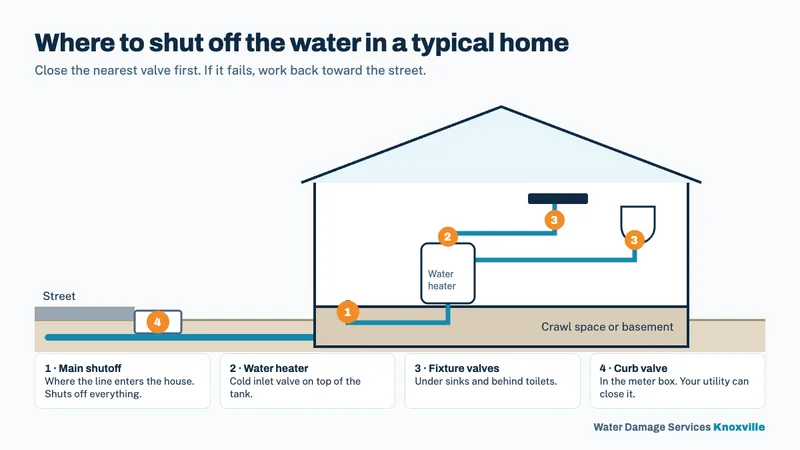
- Learn where the main shutoff is and close it when you leave for more than a weekend.
- Keep the heat on in freezing weather. The American Red Cross says to leave it no lower than 55 F when you are away.
- Ask a neighbor to check the place after a hard freeze or a storm.
- If you find water, photograph it before anything is moved and call your insurer.
What about older homes in Newport?
Newport was incorporated in 1812, so the center of town has old buildings, and Wikipedia has a section on historic structures in the area. It does not give ages for individual houses, so find out your own before work starts.
Homes built before 1978 may contain lead paint. The EPA's Renovation, Repair and Painting rule covers paid work that disturbs it, so ask the restoration team how they will contain dust when walls are opened. Old supply lines fail at joints; the burst pipe guide shows where to look first.
Is the water clean, or does it count as flood water?
Where it came from decides everything. The IICRC S500 standard puts a broken supply line in Category 1, a washer or dishwasher leak in Category 2, and sewage, river water and outside surface water in Category 3.
- Category 1. A supply line or water heater. Drying in place is usually possible if it starts quickly.
- Category 2. An appliance overflow. Porous materials often have to come out.
- Category 3. Creek water, runoff or sewage. The EPA says to call a professional experienced with contaminated water.
In a valley home, creek water that came in the door is Category 3 even if it looks clear. For a drain backup, see sewage backup cleanup.
Will insurance pay for a river or creek flood?
Usually not. The Insurance Information Institute says flood is excluded under standard homeowners and renters policies and needs a separate policy. The NAIC adds that ground water, rain runoff and snow melt are typically not covered either.
A burst pipe in the same house is a different claim, so how the water got in matters. Call your agent before you sign a work order, and read our insurance claims guide for what to photograph.
What should I do in the first 24 to 48 hours?
Stop the water, stay safe and start drying. The EPA says to dry water-damaged areas and items in the first 24 to 48 hours to prevent mold growth.
- Shut off the main water valve, and the power to wet areas if that is safe.
- Photograph and video everything before moving it.
- Call your insurer and ask what they need before work starts.
- Call a restoration team and ask what they will measure and how they log drying.
- Keep indoor humidity below 60 percent, ideally 30 to 50, as the EPA recommends.
The emergency page has a longer checklist, and mold after water damage covers what to do if growth has started. Nearby guides: Gatlinburg, Sevierville, Jefferson City and Morristown.
Sources: Newport, Tennessee; Cocke County, Tennessee; Cosby, Tennessee; Parrottsville, Tennessee; Del Rio, Tennessee; Hartford, Tennessee; Pigeon River; French Broad River (all Wikipedia, citing the 2020 Census); EPA, A Brief Guide to Mold, Moisture and Your Home; IICRC S500; Triple-I, disasters covered by homeowners insurance; NAIC homeowners insurance; American Red Cross, frozen pipes.