The short version
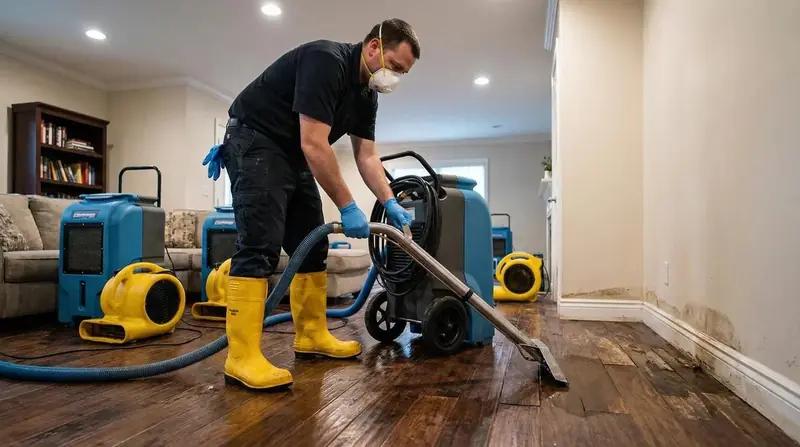
Close the main shutoff valve, switch off power to wet areas if it is safe, and open the lowest faucet to drain the lines. Photograph the damage, then call a plumber for the pipe and a restoration provider for the water. Wet materials need to be dry within 24 to 48 hours to avoid mold.
What should I do the moment a pipe bursts?
Stop the water, make the area safe, then drain what is left in the lines. In that order, these steps take about ten minutes and limit most of the damage.
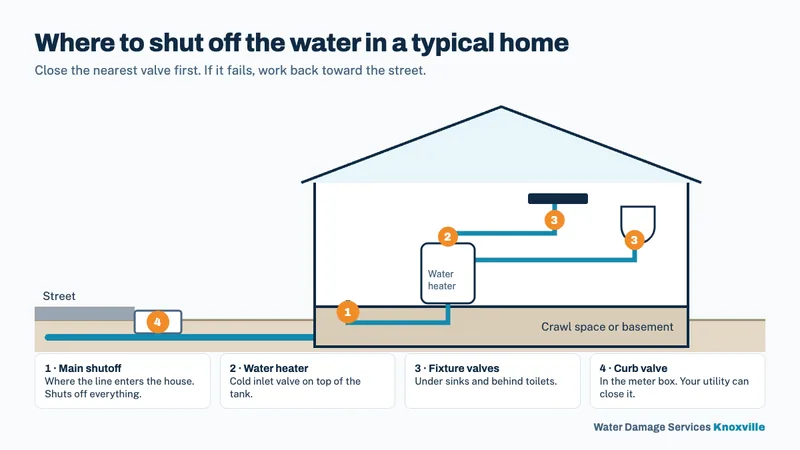
- Close the main shutoff valve. It is usually where the water line enters the house: in the crawl space, basement, garage or a utility closet.
- Turn off power to wet areas at the breaker, but only if you can reach the panel without standing in water.
- Open the lowest faucet in the house and an upstairs faucet. This drains the water still in the pipes so less of it reaches the break.
- Protect the water heater. If the supply will stay off for hours, turn a gas heater to its pilot or off setting, or switch off an electric heater at the breaker, so it does not heat an empty tank.
- Photograph the break and the damage before anything is cleaned up or repaired.
Why do pipes burst in East Tennessee winters?
Because many homes here were not built for long hard freezes. Pipes run through crawl spaces, exterior walls, garages and attics with little insulation. The Red Cross lists exactly these spots, along with kitchen cabinets on outside walls, as the pipes most at risk of freezing.
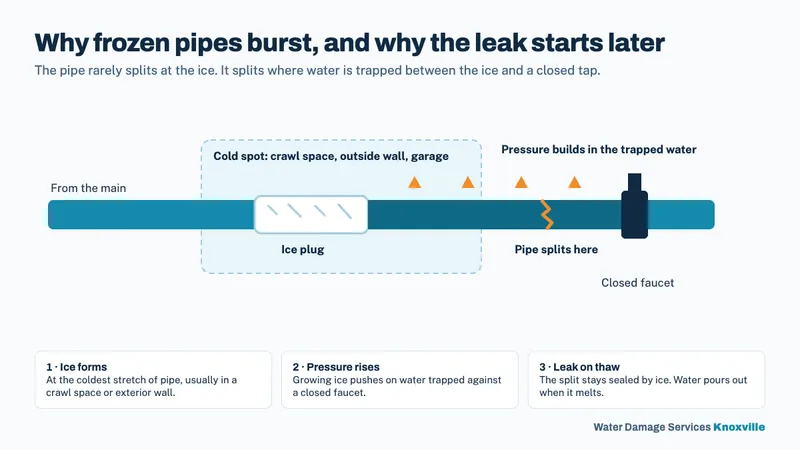
A frozen pipe rarely splits where the ice is. It splits further along, where water is trapped between the ice and a closed faucet and pressure builds. The ice keeps the crack sealed, which is why the leak usually shows up when temperatures rise and the pipe thaws.
How do I thaw a frozen pipe safely?
If a faucet gives only a trickle in freezing weather, a pipe feeding it is probably frozen but not yet split. The Red Cross advises keeping the faucet open and applying gentle heat to the frozen section.
- Use an electric heating pad, a hair dryer, a portable space heater kept away from anything flammable, or towels soaked in hot water.
- Never use a blowtorch, kerosene or propane heater, charcoal stove or any open flame. The Red Cross lists these as unsafe.
- Keep heating until full water pressure returns, then check every faucet in the house for other frozen sections.
- If you cannot reach or thaw the frozen section, call a plumber.
Which pipes burst most often, and where?
| Where the pipe runs | Why it is at risk | What to check after a break |
|---|---|---|
| Crawl space | Open vents and cold air under the floor | Subfloor, floor insulation, ductwork |
| Exterior wall | Thin insulation between pipe and outside | Wall cavity, cabinets, baseboards |
| Garage | Usually unheated, door opened in the cold | Water heater area, walls shared with the house |
| Attic | Coldest part of the house in winter | Ceilings below, insulation, light fixtures |
| Outdoor spigot | Hose left attached traps water in the line | The wall behind the spigot, often a basement or crawl space |
Who fixes the pipe and who fixes the water damage?
Usually two different trades. A plumber repairs or replaces the broken pipe. A restoration provider extracts the water and dries the house. Both can start right away, and drying should not wait for the plumbing repair if the water is already shut off.
Tell the restoration provider where the break was and how long the water ran. A pipe in an exterior wall usually means opening the bottom of the wall so the cavity can dry. See water removal and extraction for what happens next, and ceiling water damage if the break was in an attic or upstairs.
How can I tell if a pipe is leaking inside a wall?
Check the water meter with every fixture off. If it still moves, water is leaking somewhere. Other signs are a water bill that jumps for no reason, paint that bubbles, swollen baseboards and a damp patch that never dries. A hidden leak can run for weeks before it shows.
To run the meter test:
- Turn off every faucet, the washer, the dishwasher and the ice maker. Make sure no toilet is refilling.
- Find the meter, usually in a box near the street, and note the reading or watch the small leak indicator dial.
- Leave all water off for a while, then check again. If the reading changed or the dial turned, there is a leak.
Then close the main shutoff and repeat the test. If the meter stops, the leak is inside the house. If it keeps moving, the leak is on the line between the meter and the house.
Water damage from a burst pipe in a wall usually means opening the lower part of the wall so the cavity and insulation can dry.
What are the signs of a slab leak?
A slab leak is a leaking water line under a concrete floor. The common signs are a warm spot on the floor, the sound of running water when nothing is on, damp flooring with no leak above it, and a meter that moves with every fixture off. A warm spot usually points to a hot water line.
- Warm patches on tile or wood, often noticed barefoot.
- Running water sounds under the floor or behind a wall when the house is quiet.
- Damp carpet or lifting flooring with no plumbing above it.
- Low water pressure, or a water heater that seems to run more than usual.
A plumber finds a slab leak with listening and pressure-testing equipment before breaking any concrete. Once it is repaired, a restoration provider dries the flooring and the bottoms of nearby walls.
Why do copper, galvanized, PEX and CPVC pipes fail?
Each pipe material fails in its own way. Copper can develop pinhole leaks. Old galvanized steel rusts from the inside. PEX most often leaks at its fittings. CPVC turns brittle with age and cracks more easily in the cold. Knowing what your pipes are made of tells you where to look for the next leak.
| Pipe material | How it usually fails | What you see |
|---|---|---|
| Copper | Pinhole leaks from corrosion, often in older lines | A fine spray or drip, green staining on the pipe |
| Galvanized steel | Rust builds up inside and eats through the wall | Low pressure, rusty water, leaks at threaded joints |
| PEX | Leaks at crimp or push-fit fittings | Drips at connections rather than along the pipe |
| CPVC | Gets brittle with age, cracks if bumped or frozen | A sudden split or snapped fitting, often in cold weather |
When one pinhole or corroded joint fails, others on the same run are often close behind. Ask the plumber whether to repair one spot or replace the section.
Does homeowners insurance cover a burst pipe?
Sudden, accidental pipe bursts are often covered, both the water damage and the cost of opening walls to reach the pipe. The repair of the pipe itself may or may not be. Your policy wording decides.
Many policies exclude freeze damage in a house left empty unless the heat was kept on or the water was shut off and drained. That matters for cabins, rentals and second homes. The Red Cross advises leaving the heat at no lower than 55°F when you go away in cold weather.
How do I file an insurance claim for a burst pipe?
Stop the water, document the damage, then call your insurer before major repairs. Start drying right away and keep every receipt, because policies usually expect you to prevent further damage. The adjuster will want to see the damage, the broken pipe and when it happened.
- Photograph and video the break, the standing water and every damaged room before cleanup.
- Keep the broken section of pipe if the plumber cuts it out.
- Call your insurer and write down the claim number and the adjuster's name.
- Start drying now. The EPA advises drying wet materials within 24 to 48 hours to prevent mold.
- List damaged items and save every invoice, including the plumber and the restoration provider.
According to the Insurance Information Institute, about one in 60 insured homes has a water damage or freezing claim each year. The average claim in that category was $15,400 across 2019 to 2023.
How do I stop pipes freezing next winter?
- Keep the thermostat at the same temperature day and night during a cold snap, as the Red Cross recommends.
- Let cold water drip from faucets served by exposed pipes when it is very cold.
- Open kitchen and bathroom cabinet doors on outside walls so warm air reaches the pipes.
- Insulate pipes in crawl spaces, garages and attics, and disconnect garden hoses before the first freeze.
- Check the National Weather Service cold safety page and local forecasts when a hard freeze is coming.
Sources: American Red Cross, Frozen Pipes; National Weather Service, Cold Safety; EPA mold and moisture guide; Insurance Information Institute, Homeowners Insurance Facts.