
For Wartburg and Morgan County homeowners
For water damage restoration in Wartburg, TN, shut off the main valve, photograph everything and start drying in the first 24 to 48 hours. River and creek water counts as flood-type water, which usually needs a professional. We take requests from Wartburg, Coalfield, Deer Lodge, Rugby, Lancing, Oakdale, Petros and Sunbright.
Which Morgan County towns and ZIPs do requests come from?
Requests come in from Wartburg (37887), Coalfield (37719), Deer Lodge (37726), Rugby (37733), Lancing (37770), Oakdale (37829), Petros (37845) and Sunbright (37872). Oliver Springs (37840) is covered on the Clinton page. The restoration team you hire confirms they can reach your address when they call. Scott County, to the north, is on the Oneida and Huntsville page.
Morgan County had 21,035 residents at the 2020 Census, and Wartburg, the county seat, had 848 of them. Most of the county is rugged and thinly settled, so a call can come from the end of a long gravel road.
Why does Wartburg get so much runoff?
Wartburg sits among the Crab Orchard Mountains on the eastern edge of the Cumberland Plateau. Wikipedia says Bird Mountain rises from the edge of the city and stretches about 10 miles east to a 3,142-foot summit in Frozen Head State Park. Rain on that slope has one place to go, and it goes downhill toward town.
The Emory River starts near the top of Bird Mountain and runs just north of Wartburg. The Obed River joins it a little west of town. Water from either one is Category 3 under the IICRC S500 standard, so read our flood cleanup guide before touching anything it reached.
What do the Emory and Obed rivers do in heavy rain?
They rise quickly. The Obed is a National Wild and Scenic River, and Wikipedia calls Daddys Creek and Clear Creek, which feed it, whitewater streams during periods of high flow. That is another way of saying the water arrives fast when it rains on the plateau.
Most houses in town are not on the rivers themselves. The common problem is smaller: a ditch that overflows, a culvert that backs up, or a slope that sends water against a wall. Our basement flooding guide explains how outside water finds its way in.
What does Morgan County's coal history mean for a wet house?
It means old buildings, old pipes and hills that have been disturbed. Coalfield takes its name from coal mining, and Wikipedia describes camps there. Petros is described as historically a coal mining town and is the home of the former Brushy Mountain State Penitentiary, now a tourist attraction. The Emory River article says the area around its headwaters saw extensive strip mining for coal.
None of that tells you how old your own house is. It does suggest checking before you assume.
- Houses built before 1978 may contain lead paint. The EPA's Renovation, Repair and Painting rule covers paid work that disturbs it.
- Older plumbing tends to fail at joints. The burst pipe guide shows where to look.
- Many hillside homes have crawl spaces under them. See crawl space water removal.
How do plateau towns like Sunbright and Rugby differ?
They sit high, in creek country, far from a hardware store. Sunbright lies on the Cumberland Plateau, drained by White Oak Creek into the upper Big South Fork watershed, and Wikipedia counts 238 housing units there with 11.8% vacant. Rugby is a Victorian colony founded in 1880, with preserved buildings that include a Queen Anne cottage built in 1884.
A historic building raises a practical question for a wet one. Ask the restoration team how they plan to dry the structure in place, and check any preservation rules for your property before walls or floors come out.
How do Morgan County communities compare?
They differ most in size and setting. The table uses only what Wikipedia reports.
| Community (ZIP) | Setting, per Wikipedia | 2020 Census |
|---|---|---|
| Wartburg (37887) | County seat; Crab Orchard Mountains; Emory River just north | 848 residents; 380 housing units, 12.4% vacant |
| Coalfield (37719) | Coal mining name; on SR 62 toward Oliver Springs | 2,361 residents |
| Oakdale (37829) | On the Emory River; slope down to a river flood plain | 203 residents |
| Petros (37845) | Historic coal mining town on SR 116 | 459 residents |
| Sunbright (37872) | Plateau town on US 27; White Oak Creek | 519 residents; 238 housing units, 11.8% vacant |
| Rugby (37733) | Victorian colony on the plateau | Unincorporated |
| Deer Lodge (37726), Lancing (37770) | No Wikipedia article used for these ZIPs | Not stated |
What is different about Oakdale and other river-bottom homes?
Oakdale is the clearest case. The town lies along the Emory River, and Wikipedia says its western side slopes down from State Route 299 to a flood plain beside the river. A house on the low side has the river on one side and a hillside draining toward it on the other.
If river water reached the house, it is flood damage, which standard homeowners insurance excludes. Talk to your agent early, and read about sewage backups too if a septic system or sewer line was under water.
What risks come with vacant and rural homes?
A leak in a house nobody visits can run a long time. Morgan County had 8,502 housing units in 2020, and 12.3% were vacant. Wartburg itself was 12.4% vacant.
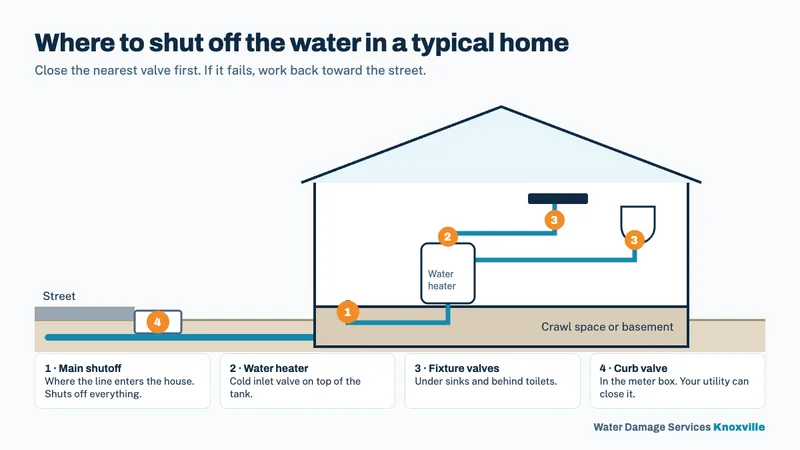
- Know where the main shutoff is and close it when the house will sit empty.
- Keep the heat on in cold weather. The American Red Cross says to leave it no lower than 55 F when you are away.
- Ask a neighbor or relative to look in after a hard freeze or a storm.
- Photograph any damage before anything is moved, then call your insurer.
What does insurance cover on a mountain property?
A sudden plumbing leak is usually covered, but flood is not. The Insurance Information Institute says flood is excluded under standard homeowners and renters policies and needs a separate policy. The NAIC adds that ground water, rain runoff and snow melt are typically not covered.
Wind is a separate matter. Wikipedia records a tornado on November 10, 2002 that destroyed 50 homes in Morgan County communities including Mossy Grove and Joyner. If a roof opened and rain came in, see roof leak and storm damage. Our insurance claims guide lists what to photograph and save.
What should I do in the first 24 to 48 hours?
Stop the water, protect people, then start drying. The EPA says to dry water-damaged areas and items in the first 24 to 48 hours to prevent mold growth.
- Shut off the main water valve, and the power to wet areas if you can do it safely.
- Photograph and video everything before moving it.
- Call your insurer and ask what they need before work starts.
- Call a restoration team and ask what they will measure and how they will document drying.
- Keep indoor humidity below 60 percent, ideally 30 to 50, as the EPA recommends.
The emergency page has a longer checklist, and mold after water damage covers what to do if growth has started. Restoration teams differ on which roads they drive, so confirm coverage when they call. Nearby guides: Oak Ridge, Roane County, Clinton and LaFollette.
Sources: Wartburg, Tennessee; Morgan County, Tennessee; Emory River; Obed River; Rugby, Tennessee; Oakdale, Tennessee; Petros, Tennessee; Sunbright, Tennessee; Coalfield, Tennessee (all Wikipedia, citing the 2020 Census); EPA, A Brief Guide to Mold, Moisture and Your Home; IICRC S500; Triple-I, disasters covered by homeowners insurance; NAIC homeowners insurance; American Red Cross, frozen pipes.