Emergency Water Damage Restoration
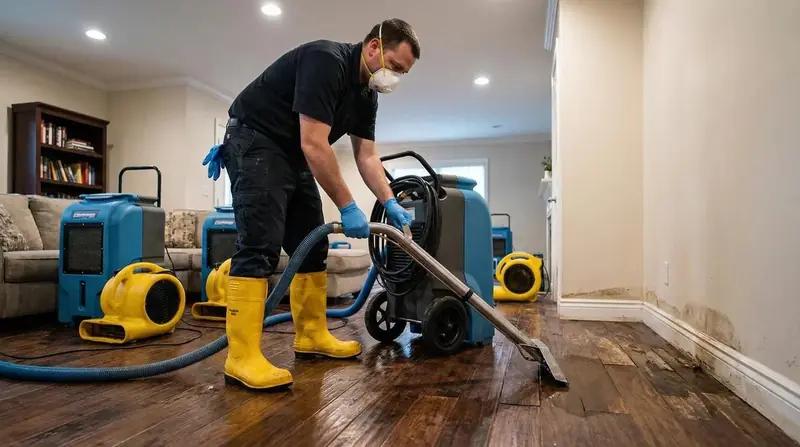
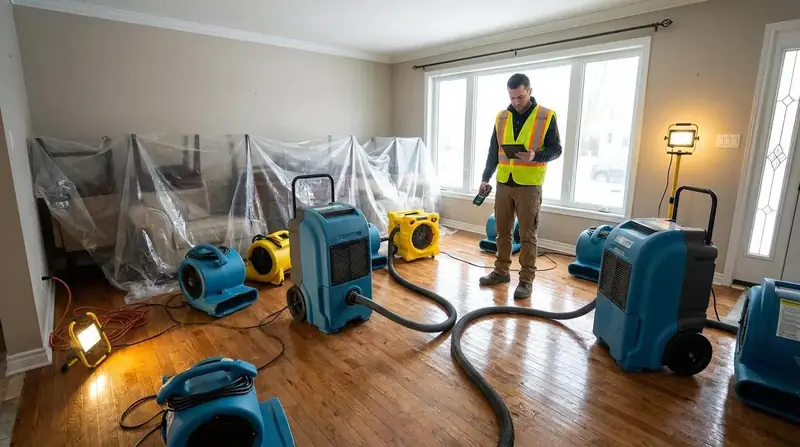
For water that is still moving: a burst supply line, a failed water heater, an overflow upstairs. The job is to stop the spread, get the water out and start drying as soon as possible.
Emergency restoration stepsReferral service for water damage in Knoxville and nearby East Tennessee towns
How referrals workKnoxville, Knox County and nearby towns
Water on the floor, in the basement or coming through a ceiling? Start with the steps below to stop it spreading. Then get connected with a local restoration provider for water removal, drying and flood cleanup.
By the Water Damage Services Knoxville editorial team · Last reviewed
These five steps limit the damage and protect an insurance claim. Do them in this order if you can.
If water is near the electrical panel, or the ceiling is bulging, leave the room and call for help from outside it.
Step 1
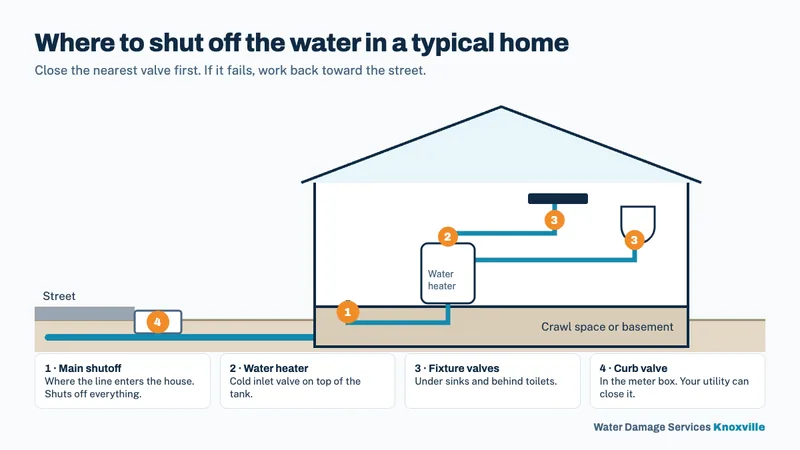
Close the main shutoff valve. In most Knoxville-area homes it sits where the water line enters the house, often in the basement, crawl space or a utility closet. If you cannot find it, the meter box at the street has a curb valve. The utility can help with that one.
Step 2
If water has reached outlets, cords or the panel, do not walk through it. Switch off the breaker only if you can reach the panel while standing on dry ground. Otherwise call the power company.
Step 3
Take wide shots and close-ups before anything is moved: the source, the waterline on walls, flooring, furniture and serial plates on appliances. Insurers ask for this first.
Step 4
Lift rugs, electronics, papers and photos to a dry floor. Put foil or wood blocks under furniture legs so they stop wicking water.
Step 5
Report the loss early and write down the claim number. Ask whether they need to inspect before drying starts. Most will tell you to prevent further damage straight away.
Three kinds of jobs make up most water damage calls in the Knoxville area. Each one starts differently, so pick the closest match.
For water that is still moving: a burst supply line, a failed water heater, an overflow upstairs. The job is to stop the spread, get the water out and start drying as soon as possible.
Emergency restoration steps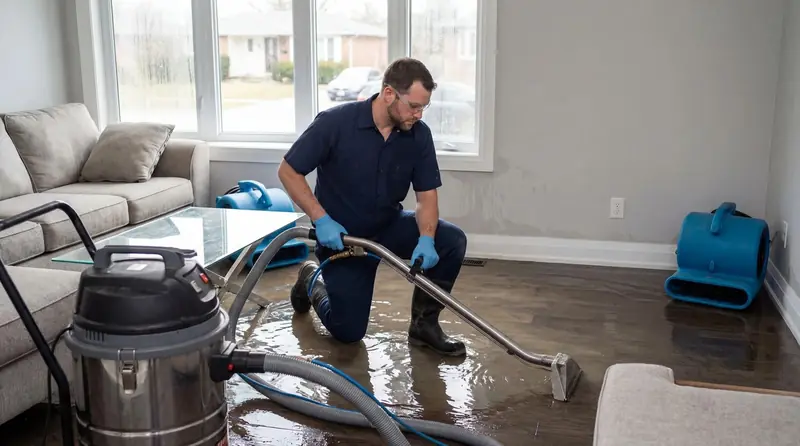
Truck-mounted or portable extraction pulls standing water out of carpet, pad, hardwood and basements before air movers and dehumidifiers take over.
How water removal works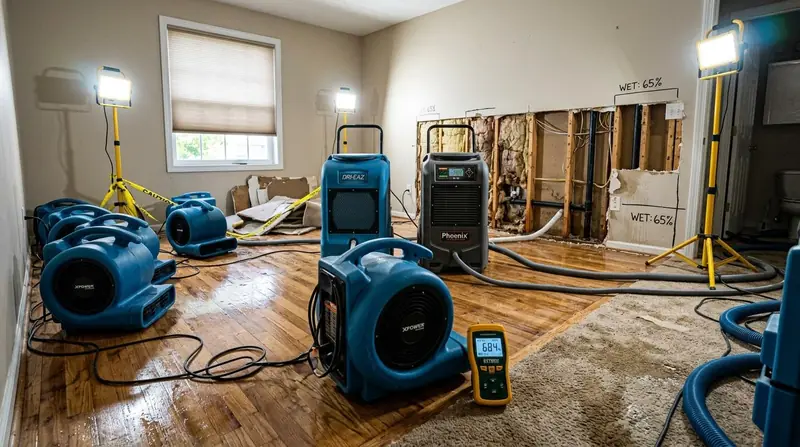
For water that came from outside. Flood water is treated as contaminated, so cleanup usually means removing soaked materials, cleaning and sanitizing, then drying.
Flood cleanup processMost people do not call about "water damage". They call about a stain, a smell or a wet floor. Find yours in the list. Each one links to the page that explains what usually happens next.
We are a referral service, so we will not tell you we are the best crew in town. Here is what we would check before letting anyone start drying a house.
This site connects you with restoration providers. It does not send its own crew. Here is the whole process.
Use the call button on any page. The call is free.
Say where it is coming from, how long it has been there and which rooms are wet. Clean pipe water and sewage water are handled very differently.
We connect you with an independent restoration provider who takes calls for your ZIP code, when one is available.
The provider sets the visit time, the price and the plan with you directly. You are free to say no or call someone else.
Requests come in from all over Knoxville: downtown, Bearden, Fountain City, West Knoxville, South Knoxville, Halls, Powell and Karns. We also take requests from towns in Sevier, Blount, Loudon, Anderson and Roane counties.
Coverage depends on which providers are taking calls that day. The provider confirms they can reach you before anything is booked.
Also taking requests from
Karns, Halls, Hardin Valley, Corryton, Mascot, Strawberry Plains, Heiskell, Alcoa, Louisville, Rockford, Seymour, Kodak, Loudon, Greenback, Clinton, Oliver Springs, Norris and Kingston. See all service areas.
We will add verified customer reviews here once we have them. We do not publish made-up testimonials. Until then, here is what you can expect from a professional first visit.
Water mitigation is the urgent part: stopping the water, extracting it, removing soaked materials and drying the structure. Restoration is the repair that follows, such as new drywall, flooring and paint. Mitigation should start right away. Restoration waits until moisture readings show the house is dry.
Some water damage companies in Knoxville, TN handle both the drying and the water damage repair. Others hand the rebuild to a general contractor. Ask which you are getting. The emergency restoration guide compares them side by side.
There is no fixed price, because cost depends on the size of the wet area, the water category, the materials and how long the water sat. For scale, the Insurance Information Institute puts the average water damage and freezing homeowners claim at $15,400 for 2019 to 2023. We do not quote prices.
Ask any provider how they bill before work starts, and get it in writing.
Often, when the damage is sudden and accidental, such as a burst pipe or a failed supply line. Standard policies usually exclude slow leaks over time and flooding from outside water, which needs separate flood cover. Sewer and drain backup is often covered only with an add-on. Your policy wording decides.
These claims are common. The Insurance Information Institute reports that about one in 60 insured homes has a water damage or freezing claim each year, and the category made up 22.6% of homeowners insurance losses in 2023.
Clean-water jobs often dry in a few days with professional equipment. Hardwood, plaster and finished basements take longer. Yes, water damage can cause mold: the EPA advises drying wet materials within 24 to 48 hours to prevent mold growth, and keeping indoor humidity below 60 percent.
Drying is done when moisture readings match dry areas of the same material, not when the surface feels dry. See water removal and extraction for how drying is checked.
Hidden water damage shows up as a musty smell, stains or bubbling paint, floors that cup or feel soft, a water bill higher than usual, or a mold patch that keeps coming back. The water is often inside a wall, under flooring or in a crawl space, where you cannot see it.
For water damage cleanup near you, a restoration provider can trace hidden moisture with meters and thermal cameras before opening anything.
Sources: Insurance Information Institute, Homeowners and Renters Insurance; EPA, A Brief Guide to Mold, Moisture and Your Home.
Shut off the water at the main valve, keep away from wet electrics, and photograph the damage before moving anything. Then move valuables to a dry spot and report the loss to your insurer. The first-hour steps above cover each one.
Call a professional when water has soaked into carpet pad, drywall, insulation or a subfloor, when more than one room is wet, when the water came from a sewer or from outside, or when it has sat for more than a day. Surface water on tile can often be handled with a wet vac and fans.
The EPA says wet materials should be cleaned and dried within 24 to 48 hours to prevent mold growth. Past that window, plan on some materials being removed rather than dried in place. Source: EPA, A Brief Guide to Mold, Moisture and Your Home.
Your ZIP code, where the water came from, roughly when it started, which rooms and floors are affected, whether the source is stopped, and your insurance company if you plan to claim. Photos help if the provider asks for them.
Report the loss as soon as you can, but do not wait for an adjuster to stop the water or start emergency drying. Most policies expect you to prevent further damage. Keep receipts and photos of everything you do.
Usually not. Standard homeowners policies generally exclude flooding from rising surface water. Flood cover comes from a separate policy, often through the National Flood Insurance Program. Sudden pipe bursts are treated differently and are often covered. Your policy wording decides. Source: FloodSmart.gov.
We pass your details to an independent restoration provider who accepts requests for your area, when one is available. They contact you to confirm the job, the timing and the price. We do not do the work, and we do not set their prices.
It depends on the wet area, the water category, the materials and how long the water sat. For scale, the Insurance Information Institute reports an average water damage and freezing claim of $15,400 for 2019 to 2023. Providers set their own prices.
Often, yes, because sudden and accidental leaks are usually covered. Slow leaks over months and outside flooding usually are not. Report the loss early, stop the water, and keep photos and receipts. Your policy wording decides what is paid.
Yes. Surfaces can feel dry while water stays trapped in carpet pad, wall cavities and subfloors. The EPA advises drying wet materials within 24 to 48 hours to prevent mold, which air drying alone rarely achieves for soaked materials.
A musty smell, bubbling paint, swollen baseboards, cupped flooring, stains that grow, and a water meter that moves with every tap off. Any of these means water may be inside a wall or under a floor.
We will connect you with an independent restoration provider who takes calls for your area.