For Maryville and Alcoa homeowners
Shut off the main valve, keep away from wet electrics and photograph the damage before moving anything. Older Maryville homes often have plaster walls and plank subfloors that hold water longer, so get moisture readings rather than trusting how a surface feels. We take requests from Maryville, Alcoa, Louisville, Rockford, Friendsville, Townsend and Walland.
Which Maryville addresses do you take requests from?
Requests come in from Maryville ZIP codes 37801, 37803 and 37804, and from Alcoa (37701), Louisville (37777), Rockford (37853), Friendsville (37737), Townsend (37882) and Walland (37886). The provider confirms whether they can reach your address when they call.
Maryville is the county seat of Blount County, with 31,907 residents at the 2020 Census. It sits in the foothills of the Great Smoky Mountains, with its twin city Alcoa directly to the north.
Why do older Maryville homes need extra care after water damage?
Maryville has a mix of older houses near downtown and newer subdivisions further out. Older homes bring their own water damage issues:
- Plaster walls hold water longer than drywall and dry slowly. They can often be dried in place, but it takes patience and good readings.
- Older supply and drain lines such as galvanized steel corrode from the inside and tend to fail at joints.
- Hardwood over plank subfloors lets water run between boards and into the crawl space below.
- Lead paint may be present in homes built before 1978. If walls or trim need cutting, ask the provider how they handle it.
The EPA's Renovation, Repair and Painting rule sets lead-safe work practices for paid work that disturbs paint in pre-1978 homes.
Why do Maryville crawl spaces get wet after rain?
Many Blount County homes sit on sloped lots over crawl spaces. When gutters overflow or the ground slopes toward the house, rain finds its way underneath. Water in a crawl space raises humidity in the whole house and can soften the subfloor over time.
- A musty smell inside after rain is often the first sign.
- Check downspouts and grading before paying for repeated drying.
- Wet insulation under the floor usually has to be removed, not dried.
Our water removal and extraction guide explains how crawl space water is pumped and dried.
Do Maryville creeks flood homes?
Pistol Creek runs through Maryville, and the Little River comes down from the mountains through Townsend and Walland before passing east and north of the city. Heavy rain in the foothills can raise small creeks quickly. Surface water entering a home is treated as contaminated, and it is usually a flood insurance matter. See our flood cleanup guide, and check an address on the FEMA Flood Map Service Center.
What are the most common water damage calls in Maryville and Alcoa?
- Burst pipes in crawl spaces and exterior walls during cold snaps
- Failed water heaters in garages, basements and closets
- Slow leaks behind showers and under sinks that soften floors
- Water in crawl spaces after long rain
- Ceiling leaks from upstairs bathrooms
Water still coming in? Start with emergency water damage restoration.
Where is the main water shutoff in a Maryville home?
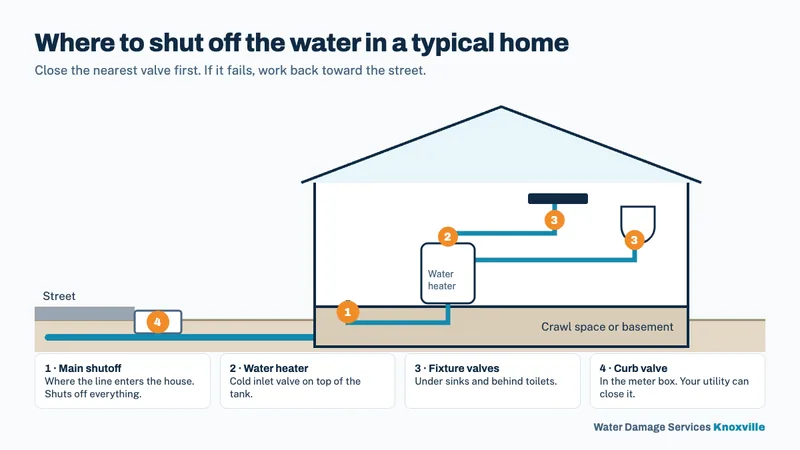
Know where the main shutoff is before you need it. In crawl space homes it is often just inside the crawl space door or near the water heater. If it will not close, the curb valve at the meter can be shut by your water utility. Their number is on your water bill.
How is drying plaster different from drying drywall in Maryville?
In older Maryville homes, wet plaster is usually dried in place rather than cut out. Plaster is dense and holds water longer than drywall, so drying takes more time and steady moisture readings. Drywall is easy to cut and replace. Plaster is not, so the extra drying time is usually worth it.
Plaster sits on wood lath, and the lath swells as it soaks up water. When it dries, the plaster can lose its grip. Watch for bulges, cracks that keep spreading, or patches that sound hollow when tapped. Those areas may need repair after drying, even when the wall itself is dry.
Questions to ask the restoration provider before work starts:
- Will you take moisture readings on the plaster and log them on each visit?
- Can the wall cavity be vented and dried without removing the plaster?
- If plaster or trim has to come out, how will you handle possible lead paint?
- What reading counts as dry for this wall, and will I get a copy of the log?
The water damage glossary explains moisture meters and other terms the crew will use.
How do Maryville homeowners keep crawl space pipes from freezing?
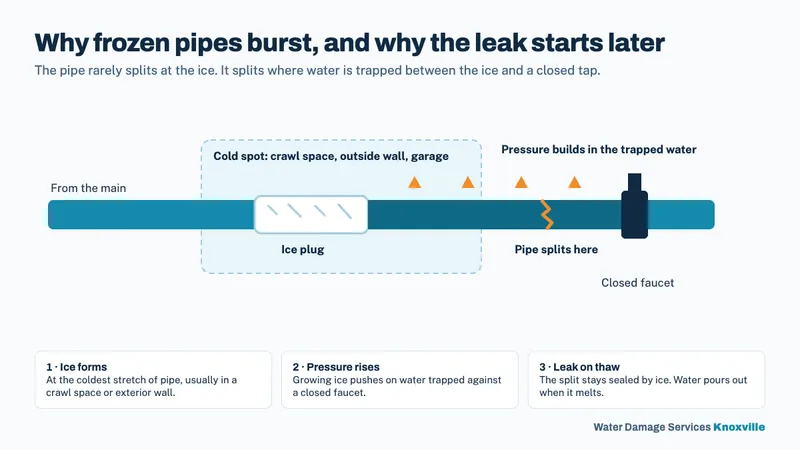
In Maryville, the pipes most likely to freeze run through crawl spaces, garages and exterior walls. The American Red Cross lists unheated areas like crawl spaces, basements, attics, garages and kitchen cabinets as the highest risk. Older galvanized lines that are already corroded split most easily.
- When you are away in cold weather, leave the heat no lower than 55 F. Keep the thermostat at one setting through the day and night.
- Let cold water drip from faucets served by exposed pipes.
- Thaw a frozen pipe with a heating pad, a hair dryer or towels soaked in hot water.
- Never use a blowtorch, a kerosene or propane heater, or any open flame.
A frozen pipe often leaks only when it thaws, so know where the main shutoff is first. See our burst pipe guide for what to do once water is running.
What humidity should a Maryville crawl space have after water damage?
A Maryville crawl space should be dried until humidity stays below 60 percent, and ideally between 30 and 50 percent. That is the range the EPA recommends to limit mold. Pump out standing water first, then dry wet materials within 24 to 48 hours.
Blount County's sloped lots mean some crawl spaces take on water after every long rain. Drying fixes the damage once, but humidity comes back if the water source is outside. A simple hygrometer left under the house shows whether the space stays dry between storms.
- Mold on joists or the subfloor covering more than about 10 square feet is a job for a professional, according to the EPA.
- Do not paint or caulk over mold on framing. The EPA advises against it.
- Wet insulation and a torn vapor barrier are usually removed and replaced.
What should Townsend and Walland homeowners tell a restoration provider?
Homes in Townsend and Walland sit closer to the mountains along the Little River, so tell the provider early whether the water came from inside the house or from outside. Creek or river water is Category 3 under the IICRC S500 standard, which changes what can be saved and what gear the crew needs.
- The source. A burst pipe is Category 1. Rising creek or river water is Category 3.
- Directions. Rural and hillside addresses can be hard to find. Give landmarks, gate codes and which door to use.
- Power and access. Say whether the power is on and whether the driveway is passable.
- Rentals. If it is a cabin you rent out, say when the next guests arrive.
The EPA says water damage from sewage or other contaminated water calls for a professional experienced with contaminated buildings. For outside water, see our flood cleanup guide.
Sources: Maryville, Tennessee (Wikipedia, citing the 2020 Census); EPA RRP program; American Red Cross, frozen pipes; EPA, A Brief Guide to Mold, Moisture and Your Home; EPA, Mold Cleanup in Your Home; IICRC S500.