The short version
Stop using water anywhere in the house, keep children and pets away and do not touch the water without gloves and boots. Sewage is Category 3 water, so soaked carpet, drywall and furniture are removed and hard surfaces are disinfected. Insurance usually covers it only with a sewer and drain backup endorsement.
What should I do first when sewage backs up into my house?
Stop adding to it and keep people away from it. Every flush, shower or load of washing in the house sends more water toward the blockage, and it comes out at the lowest drain.
- Stop using all water in the house: toilets, sinks, showers, the dishwasher and the washing machine.
- Keep children and pets out of the affected area and close the door if you can.
- Turn off power to the area at the breaker if water is near outlets or appliances and you can reach the panel from dry ground.
- Do not touch the water or soaked items without waterproof gloves and boots. Wash hands well afterward.
- Photograph the backup and the drain it came from, then call a plumber to clear the line and a restoration provider to clean up.
Why is sewage cleanup treated differently from other water damage?
Because sewage is Category 3 water under the IICRC S500 standard, the most contaminated class. It carries bacteria, viruses and other pathogens, so anything porous it soaks into cannot be reliably cleaned.
The EPA advises that when water damage was caused by sewage or other contaminated water, you should bring in a professional who has experience cleaning and fixing buildings damaged by contaminated water. Household cleaning products and a wet vac are not enough on their own.
- Carpet, pad, upholstered furniture, mattresses and soaked drywall and insulation are normally removed and thrown away.
- Hard surfaces such as concrete, tile and sealed wood are cleaned and disinfected.
- The area is dried with equipment after cleaning, not before.
Is a toilet overflow the same as a sewage backup?
Not always. Under the IICRC S500 standard, a toilet overflow without waste is Category 2 grey water. Water carrying waste, or sewage coming up from a drain, is Category 3, the most contaminated class. The difference decides what can be dried and what must be thrown away.
| What happened | IICRC category | What usually follows |
|---|---|---|
| Toilet overflow, no waste | Category 2 (grey water) | Clean, disinfect and dry; ask the provider what can be saved |
| Washer or dishwasher overflow | Category 2 (grey water) | Clean and dry; check what the water soaked into |
| Toilet overflow with waste | Category 3 | Porous materials removed, hard surfaces disinfected |
| Sewage from a floor drain or basement toilet | Category 3 | Porous materials removed, hard surfaces disinfected |
If you are not sure which it is, treat the water as Category 3 and wear gloves and boots.
Who should stay away from a sewage backup?
Anyone who does not need to be near it. Sewage carries bacteria, viruses and other pathogens. Keep young children, pregnant people, older adults, anyone with a weak immune system or a lung condition, people with open cuts, and pets away from the area until it is cleaned and dried.
- Close the door to the area so the smell and spray do not spread.
- If you must go in, wear waterproof gloves, boots and eye protection, then wash hands with soap and clean water.
- Do not eat, drink or smoke in the affected area.
- Call a doctor if anyone gets sick after contact, or if a cut was exposed to the water.
How does sewage get into the house?
A backup happens when the drain line cannot carry water away, so it flows back up to the lowest opening. That is usually a basement floor drain, a basement toilet or shower, or a ground-floor drain in a house without a basement.
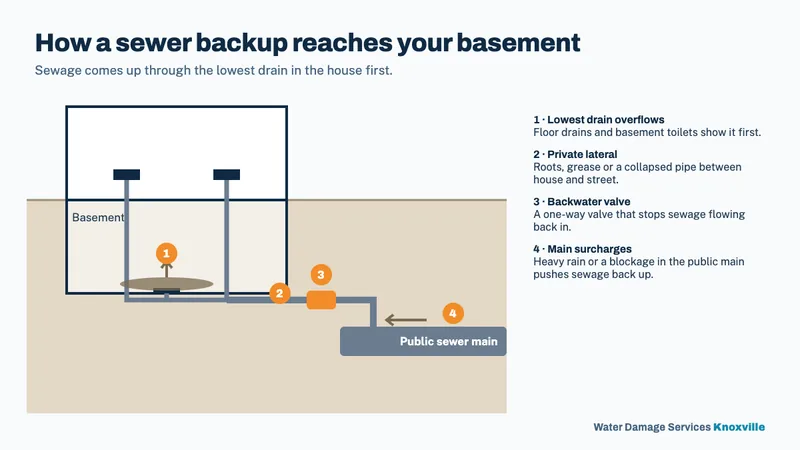
- A blockage in your own line, between the house and the street, from tree roots, grease, wipes or a collapsed pipe.
- A surcharged public sewer main, often during heavy rain when storm water gets into the sewer system.
- A blockage inside the house, which usually affects one fixture rather than the lowest drain.
Who is responsible for a sewer backup: me or the utility?
It depends on where the blockage is. Many utilities make the property owner responsible for the private service line, called the lateral, between the house and the public main, and the utility responsible for the main itself. In Knoxville, wastewater is handled by KUB, and other towns around Knoxville have their own utilities.
If several houses on your street back up at the same time, or the backup happened during heavy rain, report it to your sewer utility straight away. A plumber with a camera can show where a blockage is, which settles who fixes it.
Do I need a sewer camera inspection after a backup?
If the backup came from the main line, yes. It is the most reliable way to find the cause. A plumber feeds a waterproof camera through a cleanout into the sewer line and watches the video. It shows roots, grease, cracked, collapsed or sagging pipe, and exactly where the problem sits.
- It shows whether the blockage is in your lateral or the public main, which settles who pays for the fix.
- It tells you whether clearing the line is enough or a section needs repair.
- Ask for a copy of the video and the distance to any problem, for the utility and your insurer.
Have the line cleared and inspected before rebuilding starts, so a second backup does not ruin new drywall and flooring.
What has to be thrown away after a sewage backup?
Anything porous that sewage soaked into. Sewage is Category 3 water, and porous materials cannot be reliably cleaned of it, so they are removed. Hard, non-porous items can usually be cleaned and disinfected. Photograph everything before it goes, and keep a list for your insurance claim.
- Carpet and carpet pad.
- Upholstered furniture, mattresses and box springs.
- Drywall and insulation the water reached.
- Particleboard and MDF furniture and cabinets.
- Stuffed toys, pillows, cardboard boxes, books and paper.
- Any food, medicine or cosmetics the water touched.
Concrete, tile, metal, glass and hard plastic can usually be cleaned and disinfected. Ask the provider about solid wood furniture and washable clothing before throwing them out.
How long does sewage cleanup take?
It depends on how far the sewage spread and how much has to come out. A small backup on a bare concrete floor is a short job. A finished basement that needs drywall, flooring and insulation removed takes longer, and rebuilding is a separate stage that starts only when everything is dry.
- Clear the line. A plumber fixes the blockage so the backup stops.
- Extract and remove. The crew pumps out sewage and takes out contaminated materials.
- Clean and disinfect all remaining hard surfaces.
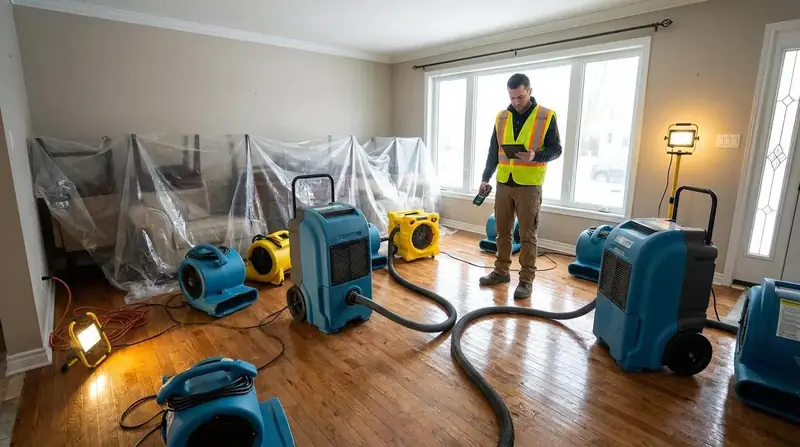
- Dry with dehumidifiers and air movers until moisture readings are normal. The EPA advises drying within 24 to 48 hours to prevent mold.
- Rebuild drywall, insulation and flooring once the area is dry.
What affects the cost of sewage cleanup?
The size of the affected area, how much porous material must be removed, how long the sewage sat, and how much rebuilding follows. Category 3 work also needs protective gear, containment, disinfection and disposal, which clean water jobs do not. A provider can only give a firm number after seeing the damage.
- Area and depth: one bathroom floor or a whole basement.
- Finishes: carpet, drywall, cabinets and flooring that must come out.
- Time: sewage that sat longer soaks further into walls and floors.
- Containment: sealing the area off from the rest of the house.
- Plumbing repair: clearing or fixing the line is a separate bill from the plumber.
Does homeowners insurance cover a sewage backup?
Often not, unless your policy has a sewer and drain backup endorsement. Standard homeowners policies frequently exclude water that backs up through drains and sewers. The endorsement usually has its own limit, which may be lower than the cost of cleaning and rebuilding a finished basement.
Check your policy for the endorsement and the limit now. If you have a backup, report it right away and keep photos, receipts and samples of removed materials if the insurer asks for them.
How do I prevent another sewer backup?
- Install a backwater valve. It lets water leave the house but closes when sewage flows back. A plumber can tell you whether one suits your line, and some areas require a permit.
- Do not flush wipes, grease or paper towels. Even wipes sold as flushable can catch in pipes and roots.
- Have the lateral inspected if you have large trees near the line or slow drains throughout the house.
- Add the endorsement to your homeowners policy if you have a basement with a floor drain.
For basements flooded from other sources, see basement flooding cleanup. For outside flood water, which is also Category 3, see flood cleanup.
Sources: EPA, Mold Cleanup in Your Home; IICRC S500; EPA, Flooded Homes; EPA mold and moisture guide.