The short version
Structural drying uses air movers to release moisture, dehumidifiers to remove it from the air and moisture readings to confirm progress. It takes days because water leaves dense materials slowly. The EPA advises starting in the first 24 to 48 hours and keeping humidity between 30 and 50 percent. Fans alone do not dry a building.
What is structural drying?
Structural drying is the controlled removal of moisture from a building's materials after water gets in. It uses air movers, dehumidifiers and sometimes air scrubbers, and it is guided by moisture readings instead of guesswork. The goal is to bring wet drywall, framing, subfloor and flooring back to their normal dry condition.
It is the drying part of water mitigation. The water mitigation guide covers the whole job: the first visit, dry logs, invoices and insurance. This page is about the drying itself: what each machine does, why it takes days, how different materials behave and how to tell when drying has really finished.
What equipment is used to dry a water-damaged house?
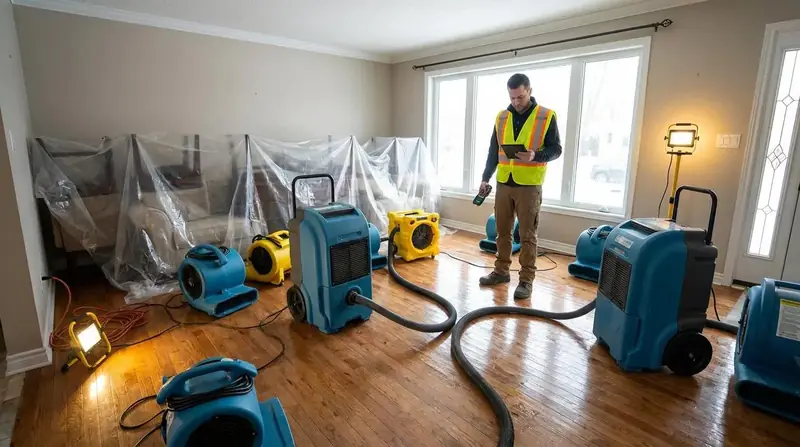
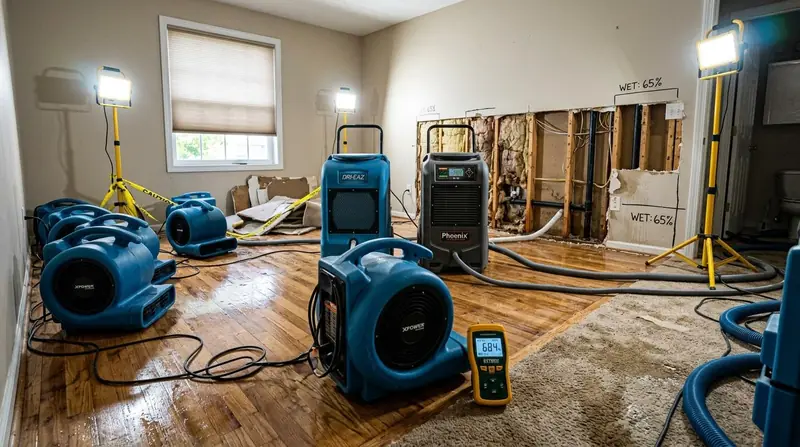
Three kinds of machines do most of the work: air movers, dehumidifiers and air scrubbers. Each does a different job, and they work as a system. Restoration teams choose brands and quantities, so ask what is on site and why.
| Equipment | What it does | Why it is needed |
|---|---|---|
| Air movers | Blow air across wet floors, walls and ceilings | Moving air lifts moisture off the surface so the material can release more from inside |
| Dehumidifiers | Pull water vapor out of the air and drain or pump it away | Without them, the moisture just moves into the air and settles back into other materials |
| Air scrubbers | Filter particles out of the air | Help when demolition, dust or suspected mold spores are in the air |
| Moisture meters and thermal cameras | Show how wet materials are and where the damp areas are | Decide where to place equipment and when drying is done |
Some jobs add other tools, such as injection systems that push dry air into a wall cavity or mats that pull moisture out of a hard floor. Restoration teams differ in what they carry, so ask which methods they use for your materials. Moisture readings are the part that turns equipment into drying, and the water damage glossary explains the terms you may hear.
How do air movers and dehumidifiers work together?
Air movers release moisture from the material and dehumidifiers remove it from the room. Neither works well alone. If you only move air, the room fills with vapor. If you only dehumidify, the wet surfaces dry slowly because no air is moving across them.
The drying room is usually closed off so the dehumidifiers deal with one body of air. Doors and windows stay shut during drying, which can surprise people who think open windows help. In humid East Tennessee summers, outdoor air can be wetter than the air inside, and an open window can carry moisture into the room. The EPA says to keep indoor humidity below 60 percent, ideally between 30 and 50 percent, and that is the range drying is trying to reach.
Why does drying take days instead of hours?
Water comes out of materials slowly, and the air can only take so much at a time. Building materials hold water inside, in their pores, so surface drying is quick while the inside lags. Drying is limited by how much moisture the air can carry away, not by how hard the machines blow.
Several things set the pace.
- The material. Dense, thick materials such as hardwood and concrete release water slowly. Thin, porous ones dry faster.
- How long it stayed wet. Materials soaked for longer hold more water deeper in.
- Air conditions. Warm, dry air takes up more moisture than cool, damp air.
- Airflow. Dead corners, closed cabinets and cavities behind walls dry slowest.
- The amount of water. A soaked room takes longer than a damp wall.
The EPA advises drying water-damaged areas and items in the first 24 to 48 hours to prevent mold growth. That is when drying should begin and the reason restoration teams set equipment quickly. It is not a promise that everything will be dry then. A restoration team should be able to explain why your job needs the time it does.
How long does water damage take to dry?
It depends on the materials, the amount of water and the conditions, so no honest restoration team can give a fixed number before inspecting. A small clean spill on a hard floor can dry quickly. A flooded room with wet walls, subfloor and insulation takes longer, and thick materials take longest. Ask for a target reading rather than a promised day.
Drying is done when the readings say so. Wet areas are compared against readings from an unaffected area of the same material, and the job ends when they match. Keep indoor humidity in the EPA range once equipment comes out. If you are told it will be done by a set date regardless of readings, ask what reading backs that up.
How are different materials dried?
Each material holds and releases water differently. The table shows what to expect, in general terms. Restoration teams judge each case by readings, and some materials are replaced rather than dried.
| Material | How it behaves | What to expect |
|---|---|---|
| Drywall | Absorbs and wicks water upward; can sag, soften or stain | Brief wetting may dry in place. Soaked or long-wet drywall is usually cut out. See drywall water damage repair |
| Plaster | Dense and slow to release water; may crack or lose its bond to the lath | Dries slowly. Some can be saved, and loose or crumbling plaster is removed |
| Hardwood floor | Swells, cups or crowns as it absorbs water | Often dried with floor mats or panels. It can take time and may still need sanding or replacement. See water damaged floor repair |
| Subfloor | Plywood and boards hold water under the finished floor | Needs drying even when the top looks fine; wet layers can trap moisture |
| Concrete | Porous and thick; releases water slowly from within | Surface dries sooner than the slab. Hard floor coverings can trap what is left below |
| Insulation | Fiberglass and batting hold water and flatten | Usually removed if soaked, since it is hard to dry in a closed cavity |
| Cabinets and trim | Particleboard swells and breaks down; solid wood may dry | Solid wood may be saved; swollen particleboard is usually replaced |
The restoration cost side of these choices is in water damage restoration cost. The point here is that the table is a starting guess, and the meter makes the call. Carpet and pad are a special case, covered in wet carpet drying.
How do you dry inside walls and under floors?
Water that is out of sight needs a way to be reached. In a wall, that can mean small holes in the drywall, removing baseboard or cutting away the lowest part of the wall so the cavity can get airflow. Under floors, it can mean lifting boards, drilling small holes or using mats and panels that pull moisture from the surface.
The reason is simple: air movers dry what air touches. A closed cavity with wet insulation and framing will not dry from the room side alone. Removing a strip of drywall costs less than rebuilding after mold sets in, which is why restoration teams sometimes open walls that look fine. They should show you the meter reading that justified it. The signs of water damage guide helps you spot trouble you cannot see.
Crawl spaces are a special case. Many older Knoxville homes have crawl spaces, and wet insulation, a torn vapor barrier or damp soil can keep the floor above wet. See crawl space water removal for pump-out and drying under the house.
How do you set a drying goal and check it?
The goal is a moisture reading that matches dry material and a room within the EPA humidity range. You and the restoration team should agree on that number at the start, and every visit should move closer. Readings, not appearance, show that the structure is dry.
- Ask what the goal reading is for each material, such as drywall, framing and subfloor.
- Compare to a dry reference. A reading from an unaffected wall or floor of the same material is the baseline.
- Check the room. Indoor humidity should end up in the EPA range of 30 to 50 percent, below 60 percent at most.
- Ask for readings at the hard spots: low in walls, under cabinets, along baseboards and in corners.
- Do not stop early. If a reading is still above the goal, ask what the plan is.
This is the check you can run yourself, even without a restoration team. A pin or pinless moisture meter and a hygrometer cost little compared with a failed repair.
Why are fans alone not enough?
Fans move air but do not remove the moisture. A box fan blows damp air around the room, and the water ends up back in drywall, furniture or the next room. Without a dehumidifier, the humidity rises and drying stalls.
Fans also cannot reach inside walls or under flooring, and they cannot tell you what is still wet. For a small, clean spill caught fast, a fan and an open window on a dry day may be enough. For anything bigger, drying needs the moisture taken out of the air and measured. If a musty smell shows up later, see water damage smell.
Should I rent drying equipment or hire a restoration team?
For a small, clean, recent spill, renting a dehumidifier and a few fans can work. For water in walls, under floors or in more than one room, professional drying is usually the better route. Rented equipment has no way to measure what is wet, and sizing it by guess is easy to get wrong.
| Question | Renting equipment | Professional drying |
|---|---|---|
| Can it find hidden water? | Only if you buy or borrow a meter and know how to use it | Meters and thermal cameras are standard tools |
| Who sizes the equipment? | You, by guess or rental counter advice | The restoration team, based on the rooms and materials |
| Who checks progress? | You | The restoration team on each visit |
| Best for | Small clean spills on hard floors caught fast | Walls, subfloor, insulation, several rooms or contaminated water |
Contaminated water changes the answer. The EPA says to call a professional experienced with buildings damaged by contaminated water, and sewage backup is not a rental job. Restoration teams differ in what they offer, so confirm directly what they will do and how they will measure it.
What is it like to live at home during drying?
Expect noise, warm air and power use. Drying equipment is loud, the dehumidifiers add heat, and the machines run all day and night. Many people find it hard to sleep in or near the drying area, and some choose to stay elsewhere.
- Noise: air movers and dehumidifiers run constantly. Ask where units will be placed.
- Power: equipment needs outlets. Ask the restoration team whether they need dedicated circuits so you do not trip a breaker.
- Heat: a closed, dehumidified room feels warm and dry. That is normal.
- Pets and children: keep them away from cords, blowing air and open walls.
- Do not move or unplug units. Ask first, since a moved machine can leave a wet area untouched.
If the water was contaminated, or anyone has asthma or a chronic lung condition, ask a restoration team whether to stay out of the affected rooms. The CDC notes that people with these conditions can have stronger reactions to mold.
What are the signs that drying stopped too early?
A smell, a spot that stays damp or a reading that rises again all point to unfinished drying. The most common sign is a musty smell that returns after the machines leave. Others include cupping floors, paint that bubbles or peels, soft baseboards and stains that reappear.
- A musty or sour smell that comes back, or gets stronger in humid weather.
- Baseboards, cabinet bases or drywall that feel soft or cool to the touch.
- Flooring that cups, buckles or lifts after being rebuilt over.
- Visible mold or dark spots, which the mold after water damage guide explains.
- Indoor humidity that stays above the EPA's 60 percent limit.
If you see these, ask the restoration team to re-check readings before anything is closed up. Do not paint or caulk over suspect areas, because the EPA says not to paint or caulk moldy surfaces. Fixing a wall before it is dry means opening it again later.
Sources: EPA mold and moisture guide; EPA, Mold Cleanup in Your Home; CDC, About Mold and Your Health.