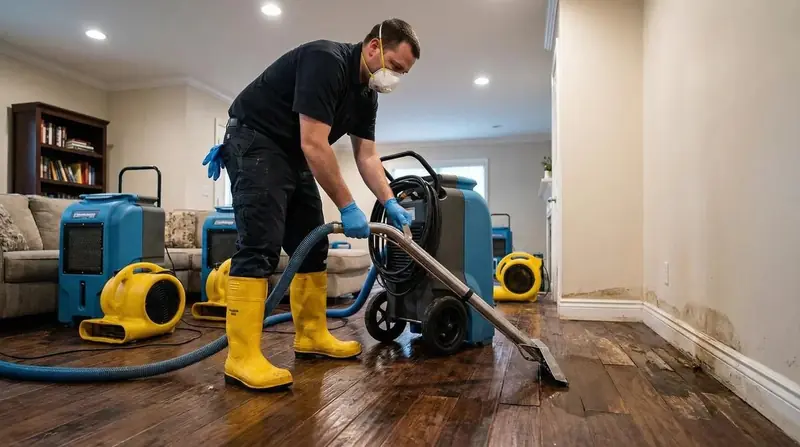
For Seymour and Kodak homeowners
Stop the water at its source, turn off power to wet areas if you can do it safely, and photograph the damage before moving anything. Seymour water damage restoration usually starts with plumbing or appliance leaks in newer homes and runoff on sloped lots. We take requests from Seymour, Kodak and nearby Sevier County ZIP codes.
Which Seymour and Kodak addresses do you take requests from?
Requests are accepted for Seymour (ZIP 37865), Kodak (37764) and the Sevier County PO box ZIPs 37864 and 37868. A restoration team that works the area confirms they can reach your address when they call.
Seymour is not a city. It is an unincorporated community that straddles two counties, in the northwest corner of Sevier County and the northeast corner of Blount County. Kodak is a separate community on State Routes 139 and 66, now partly inside Sevierville. Mention which side of the county line you are on if you are near it, because it can matter for permits and for your insurance paperwork.
Why does fast growth change water damage risk in Seymour?
Seymour grew from 8,550 residents in 2000 to 10,919 in 2010 and 14,705 at the 2020 Census, according to Wikipedia's tally of the decennial counts. That is a lot of houses built in a short window, and houses from the same era tend to fail in the same ways.
- Plastic supply lines and fittings. Newer plumbing is usually PEX or CPVC. Leaks tend to start at a fitting, not along the pipe.
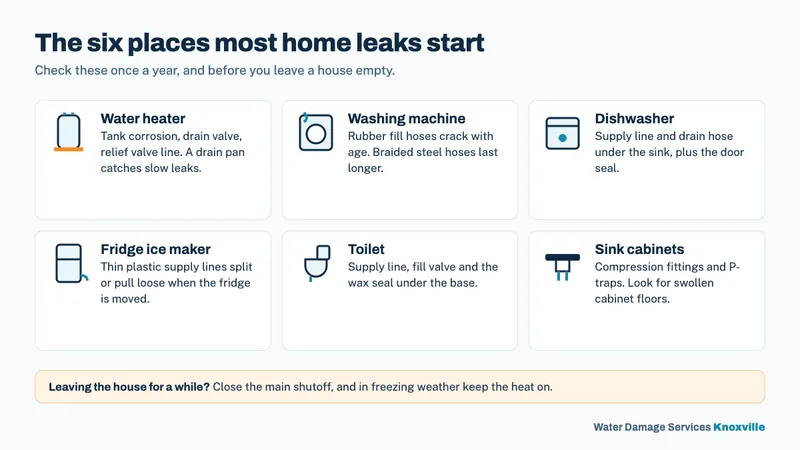
- Appliance connections. Braided washer hoses, ice maker lines and dishwasher supply lines are the usual first failure in homes that are not yet old.
- Roof and flashing details. Water that gets in at a chimney, a dormer or a window head often shows up as a ceiling stain far from the opening.
- Builder-grade water heaters. A tank that fails near the end of its life can empty into a closet or garage in minutes.
If a home is newer, check whether a builder or manufacturer warranty still applies before you pay out of pocket. Our appliance leak guide covers the fixtures to check first.
What does the terrain around Seymour do to rain and runoff?
Seymour sits in a rolling valley where the Smoky Mountain foothills meet the Ridge-and-Valley country, with Bluff Mountain to the south and the Bays Mountain ridge to the north. Water runs off those ridges toward low ground, and driveways, lawns and slab edges in between can end up on the wrong side of the slope.
Wikipedia lists the community's area as 16.03 square miles, and only 0.01 square mile of that is water. There is no big river running through town to blame. Most wet-weather problems here come from grading, gutters and undersized pipes, which Knox County's floodplain office also notes can flood homes outside mapped flood zones.
- Walk the outside of the house during a hard rain and see where the water goes.
- Extend downspouts away from the foundation, not just to the edge of the mulch.
- Water entering through a wall or slab is groundwater or runoff, which a standard homeowners policy usually excludes (NAIC). Ask your agent before you assume it is covered.
For the basement and lower-level version of this problem, see basement flooding cleanup.
How do Chapman Highway and US 411 affect who can reach you?
Most calls in Seymour are on or near Chapman Highway (US 441), which crosses the community on its way between Knoxville and Sevierville. In the middle of Seymour it meets US 411 from Maryville and Boyds Creek Highway (SR 338) in a four-way intersection.
That intersection makes Seymour easy to reach from three directions, but many homes sit well back on side roads and cul-de-sacs. When you call, give the main road you turn off, the last turn and any gate or shared driveway. A restoration team that can find the house on the first try starts drying sooner.
Kodak is reached by State Routes 139 and 66, just south of I-40. Its exit 407 has restaurants and shops, and a Buc-ee's opened there in 2023, so landmarks near the exit are easy to name when you give directions.
Who handles damage across the Sevier and Blount county line?
You deal with the same restoration teams and insurers either way, but permits, inspections and county services depend on which county the parcel is in. Check your tax bill or the county GIS map if you are not sure.
- Tell the restoration team the county when you call.
- If drywall, wiring or plumbing has to be rebuilt, ask who pulls permits and in which county.
- Keep the county named in your claim notes so the adjuster is looking at the right parcel.
What are the most common water damage calls in Seymour and Kodak?
| Call type | Typical source | First move |
|---|---|---|
| Wet kitchen or laundry floor | Ice maker, dishwasher or washer line | Shut the fixture valve, then the main if it will not hold |
| Ceiling stain or bulge | Roof leak or upstairs bath | Relieve pressure safely and keep out from under it |
| Water in a garage or lower level | Water heater, or runoff along a slab edge | Turn off power to wet circuits before stepping in |
| Frozen then split pipe | Crawl space, exterior wall or garage line | Find the main shutoff before the pipe thaws |
| Wet commercial space near I-40 | Sprinkler, restroom or kitchen plumbing | Stop the source and document closed areas |
If water is still moving through the house, start with emergency water damage restoration. For splits in cold weather, see the burst pipe guide.
How do I know how far the water spread behind the walls?
You cannot tell by looking, because water travels along framing and under flooring before it shows. A restoration team uses a moisture meter to map wet material and keeps readings until the same material reads dry. The water damage glossary explains the terms on a drying log.
For a Seymour home, ask for readings in the wall base, subfloor and any cabinet toe-kicks, not just the carpet. EPA guidance is to dry water-damaged areas and items in 24 to 48 hours to prevent mold growth, so the first day matters. Our water mitigation guide shows what that process looks like.
- Stop the source and shut off the water if needed.
- Turn off power to wet areas if you can do it safely.
- Photograph and video everything before moving it.
- Call your insurer, then request a restoration team.
- Ask for moisture readings on the first visit.
Is water damage covered by insurance in Seymour?
It depends on where the water came from. The Insurance Information Institute notes that accidental discharge from plumbing, heating, air conditioning or a household appliance is a named peril on standard forms, while flood damage is excluded and needs a separate policy.
- Sewer backup is not covered by a typical homeowners policy or by flood insurance. It is usually an add-on.
- Damage from lack of maintenance is not covered, so keep records of upkeep.
- Hold off on major permanent repairs until the adjuster has seen the damage, but take reasonable steps to prevent more.
Read our insurance claims guide before you sign anything, and see restoration costs for how bills are usually built.
What should owners near I-40 and Dumplin Valley Road expect?
Kodak mixes older farm homes, subdivisions and commercial lots near the interstate. Because much of the land along SR 66 has been annexed into Sevierville since the 1990s, the same street can have a city address on one side and a county address on the other. The Sevierville page covers the city side, and Pigeon Forge is the next town south along the Parkway.
If you own a rental or a short-term stay in the area, ask the restoration team about access, lockboxes and how they will report back while you are away. Close contact between owner, manager and restoration team keeps the job from stalling.
Sources: Seymour, Tennessee (Wikipedia, citing the Census); Kodak, Tennessee (Wikipedia); Knox County floodplain information; NAIC homeowners insurance; EPA, A Brief Guide to Mold, Moisture and Your Home; Triple-I, disasters covered by homeowners insurance; Triple-I, settling claims.